Hi, what do you want to do?





TeachEngineering
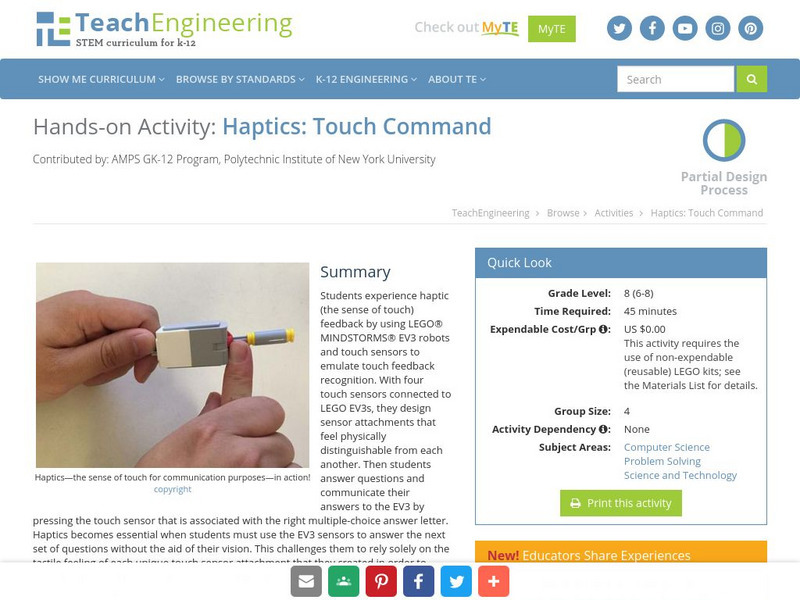
Teach Engineering: Haptics: Touch Command
Students experience haptic (the sense of touch) feedback by using LEGO MINDSTORMS NXT robots and touch sensors to emulate touch feedback recognition. With four touch sensors connected to LEGO NXTs, they design sensor attachments that...
TeachEngineering
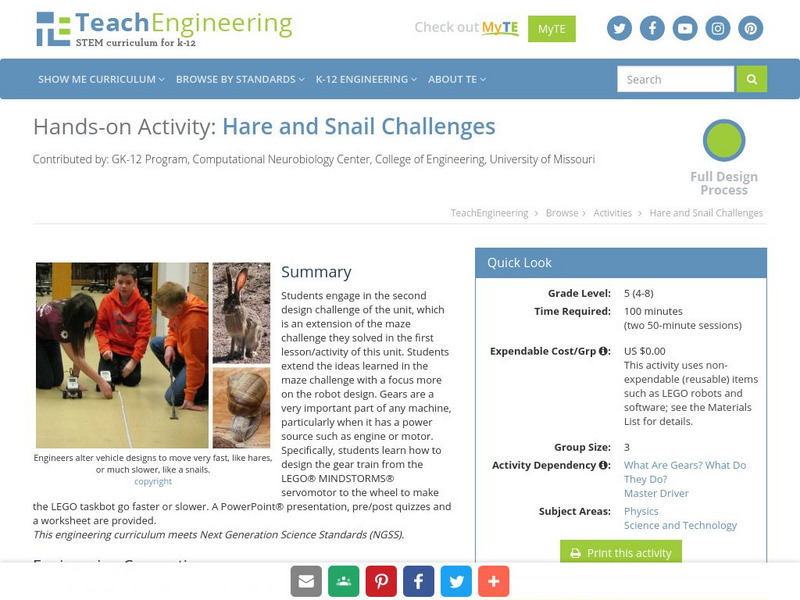
Teach Engineering: Hare and Snail Challenges
Students extend the ideas learned in the maze challenge in this unit with a focus more on the robot design. They learn how to design the gear train from the LEGO MINDSTORMS NXT servomotor to the wheel to make the LEGO taskbot go faster...
TeachEngineering
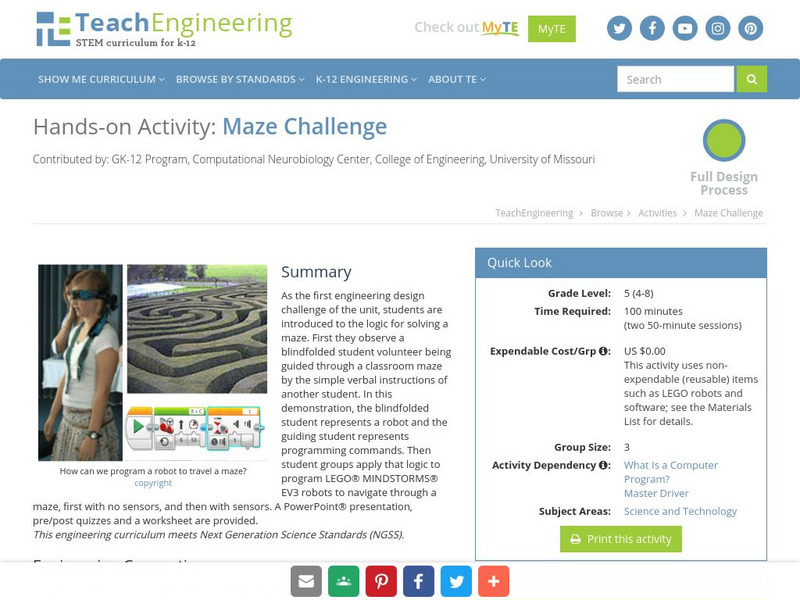
Teach Engineering: Maze Challenge
As the first engineering design challenge of the unit, students are introduced to the logic for solving a maze. student groups apply that logic to program LEGO MINDSTORMS NXT robots to navigate through a maze, first with no sensors, and...
TeachEngineering
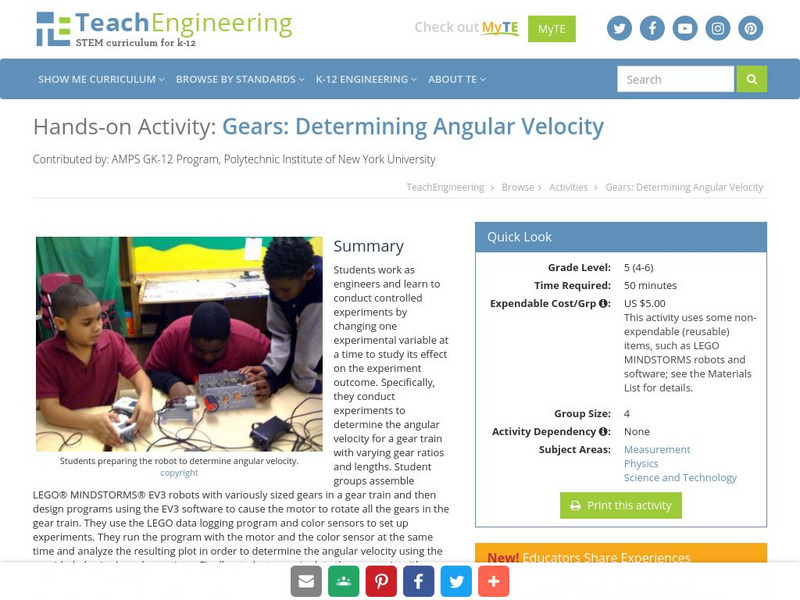
Teach Engineering: Gears: Determining Angular Velocity
Students work as engineers and learn to conduct controlled experiments by changing one experimental variable at a time to study its effect on the experiment outcome. Specifically, they conduct experiments to determine the angular...
TeachEngineering
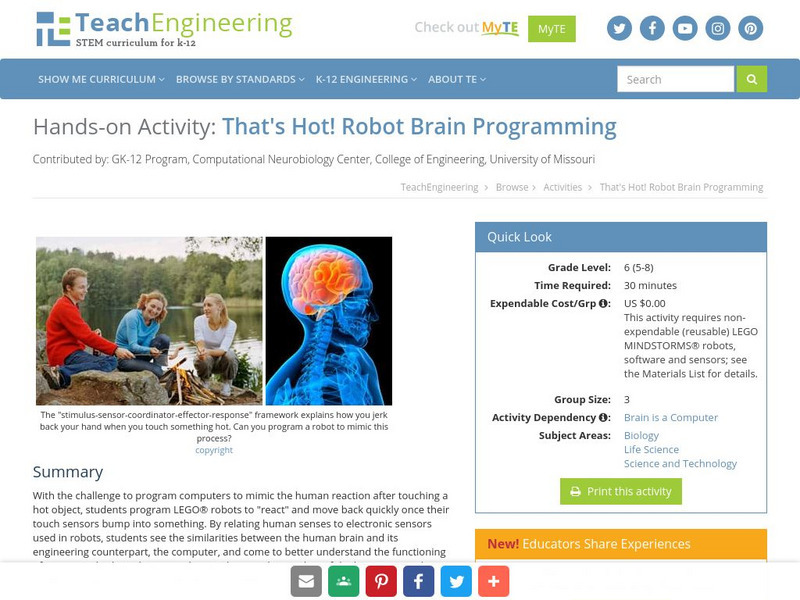
Teach Engineering: That's Hot! Robot Brain Programming
With the challenge to program computers to mimic the human reaction after touching a hot object, students program LEGO robots to "react" and move back quickly once their touch sensors bump into something. By relating human senses to...
TeachEngineering
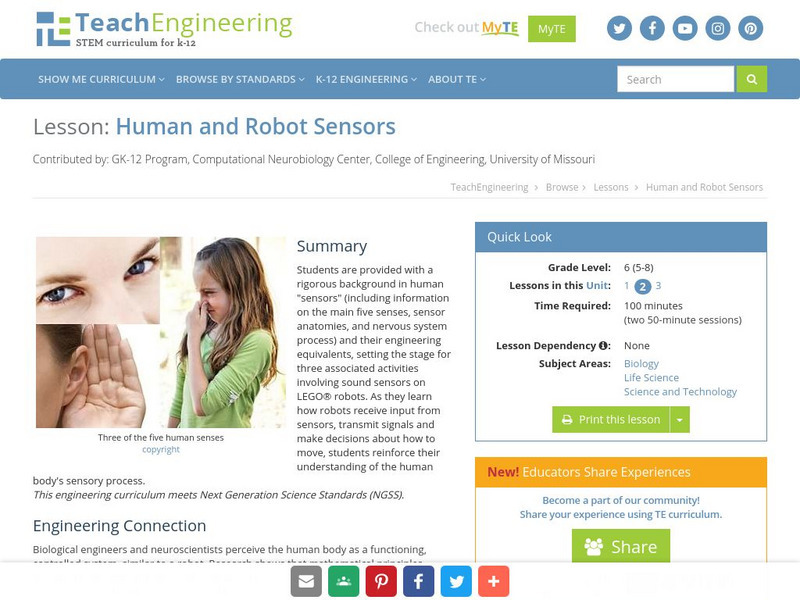
Teach Engineering: Human and Robot Sensors
Students are provided with a rigorous background in human "sensors" (including information on the main five senses, sensor anatomies, and nervous system process) and their engineering equivalents, setting the stage for three associated...
TeachEngineering
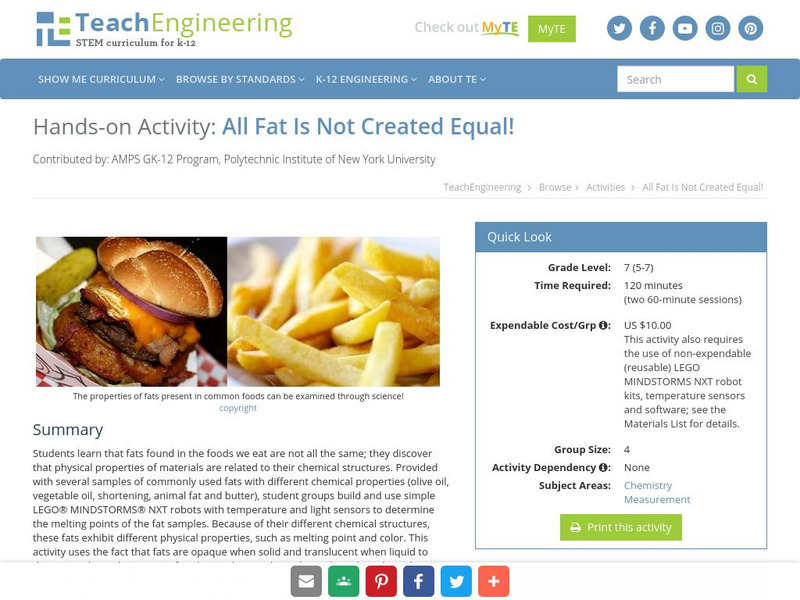
Teach Engineering: All Fat Is Not Created Equally!
Students learn that fats found in the foods we eat are not all the same; they discover that physical properties of materials are related to their chemical structures. Provided with several samples of commonly used fats with different...
TeachEngineering
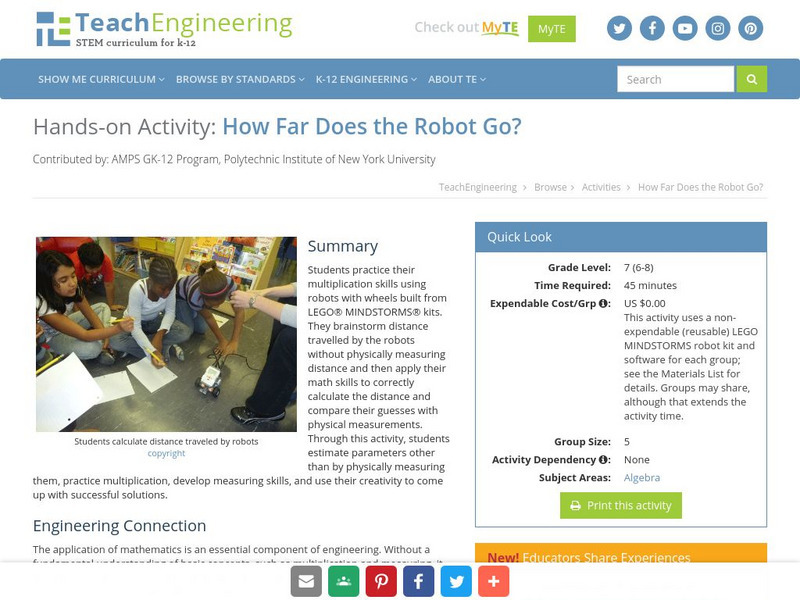
Teach Engineering: How Far Does the Robot Go?
Students practice their multiplication skills using robots with wheels built from LEGO MINDSTORMS NXT kits. They brainstorm distance travelled by the robots without physically measuring distance and then apply their math skills to...
TeachEngineering
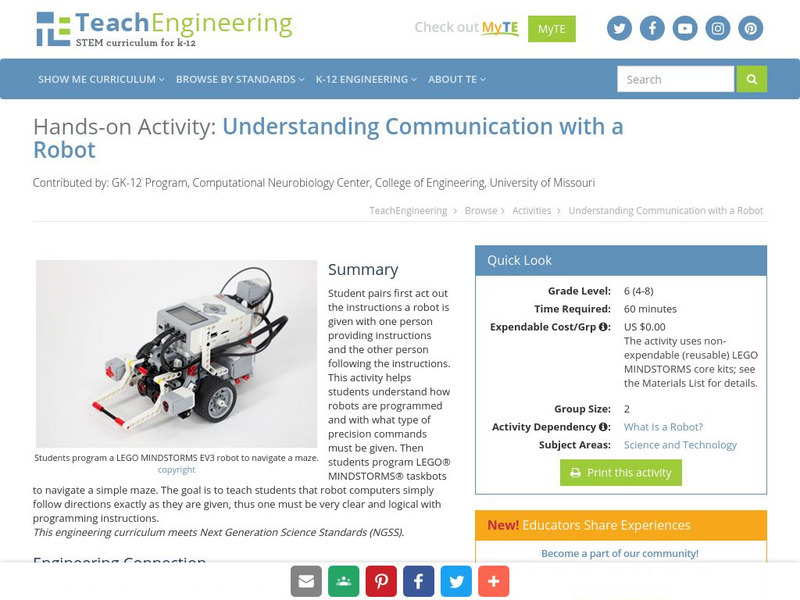
Teach Engineering: Understanding Communication With a Robot
Student pairs first act out the instructions a robot is given with one person providing instructions and the other person following the instructions. This activity helps students understand how a robot is programmed and with what type of...
TeachEngineering
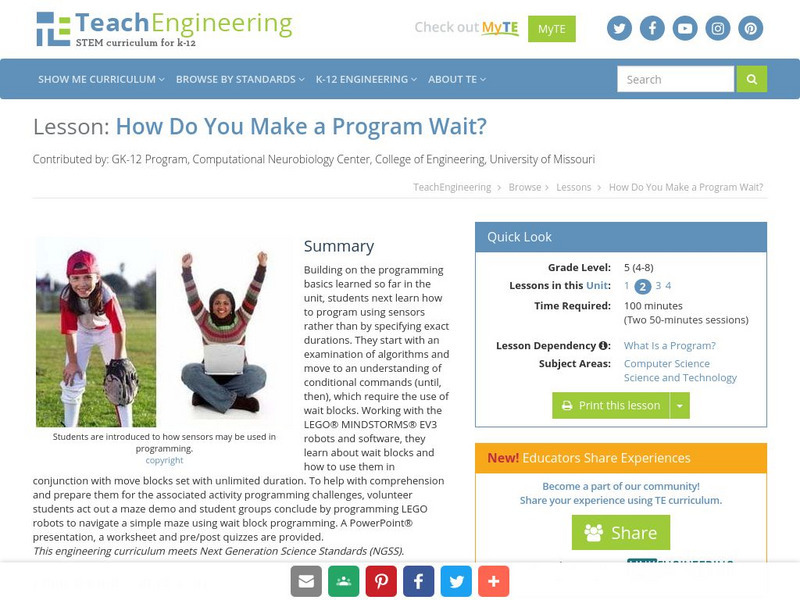
Teach Engineering: How Do You Make a Program Wait?
Building on the programming basics learned so far in a corresponding Robotics unit, students learn how to program using sensors rather than by specifying exact durations. Working with the LEGO MINDSTORMS NXT robots and software, they...
TeachEngineering
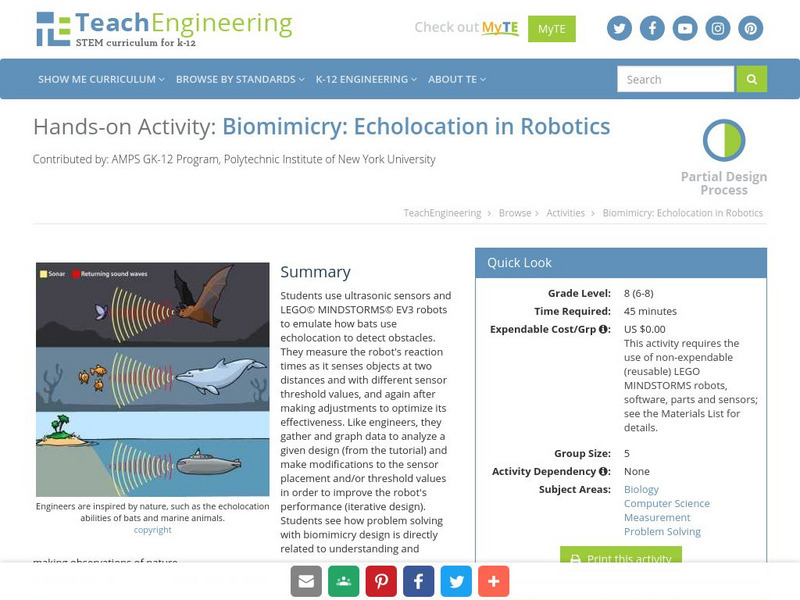
Teach Engineering: Biomimicry: Echolocation in Robotics
Students use ultrasonic sensors and LEGO MINDSTORMS NXT robots to emulate how bats use echolocation to detect obstacles. They measure the robot's reaction times as it senses objects at two distances and with different sensor threshold...
TeachEngineering
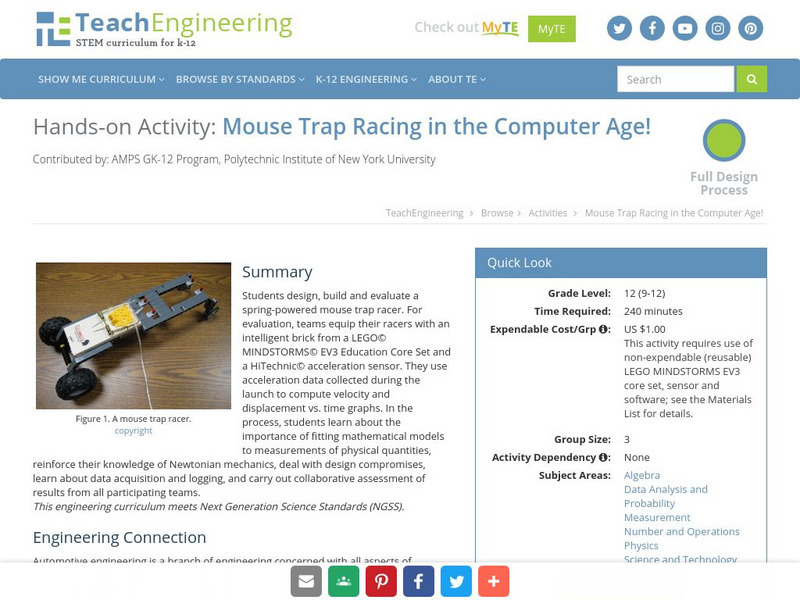
Teach Engineering: Mouse Trap Racing in the Computer Age!
Students design, build and evaluate a spring-powered mouse trap racer. For evaluation, teams equip their racers with an intelligent brick from a LEGO MINDSTORMS NXT Education Base Set and a HiTechnic acceleration sensor. They use...
TeachEngineering
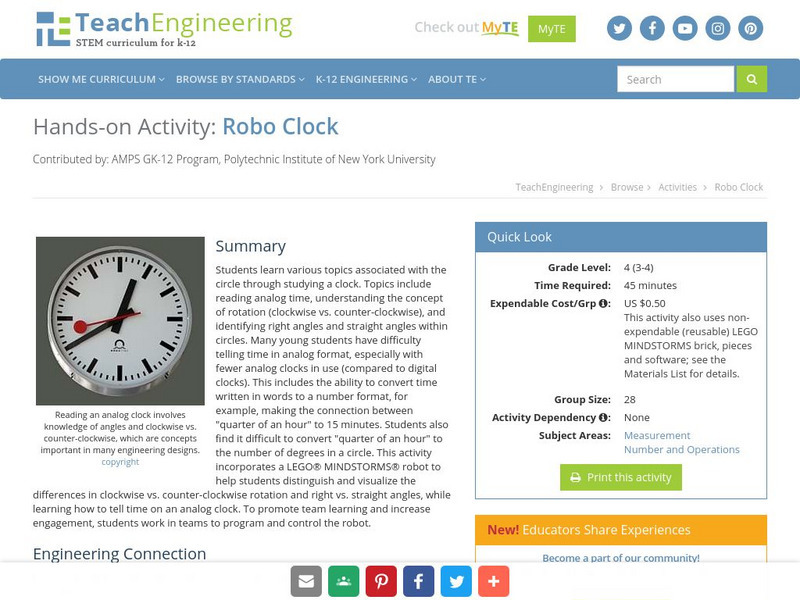
Teach Engineering: Robo Clock
Students learn various topics associated with the circle through studying a clock. Topics include reading analog time, understanding the concept of rotation (clockwise vs. counter-clockwise), and identifying right angles and straight...
TeachEngineering
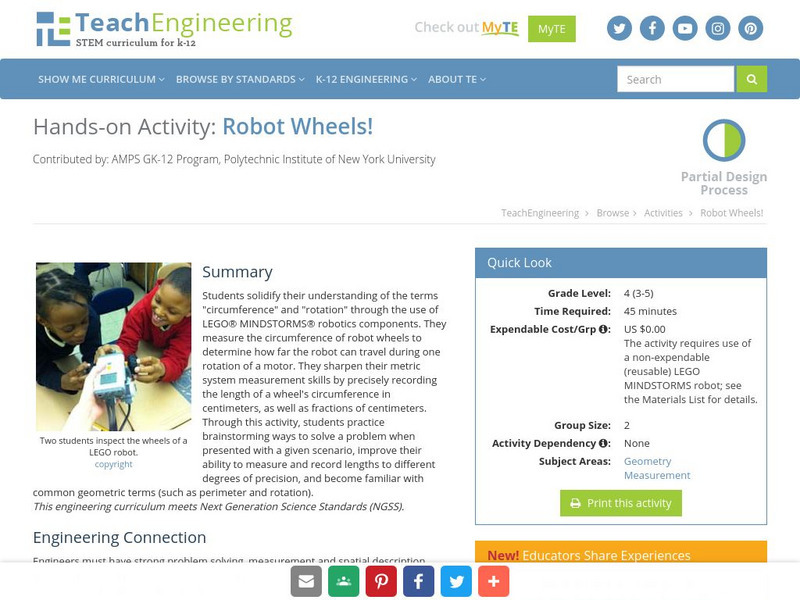
Teach Engineering: Robot Wheels!
Students solidify their understanding of the terms "circumference" and "rotation" through the use of LEGO MINDSTORMS NXT robotics components. They measure the circumference of robot wheels to determine how far the robot can travel during...
TeachEngineering
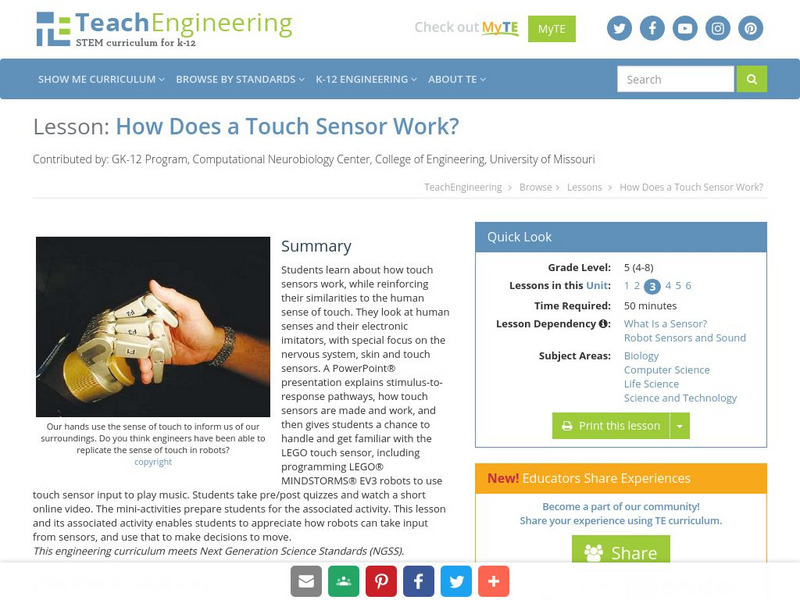
Teach Engineering: How Does a Touch Sensor Work?
Students look at human senses and their electronic imitators, with special focus on the skin and touch sensors. They have a chance to handle and get familiar with the LEGO touch sensor, including programming LEGO MINDSTORMS NXT robots to...
TeachEngineering
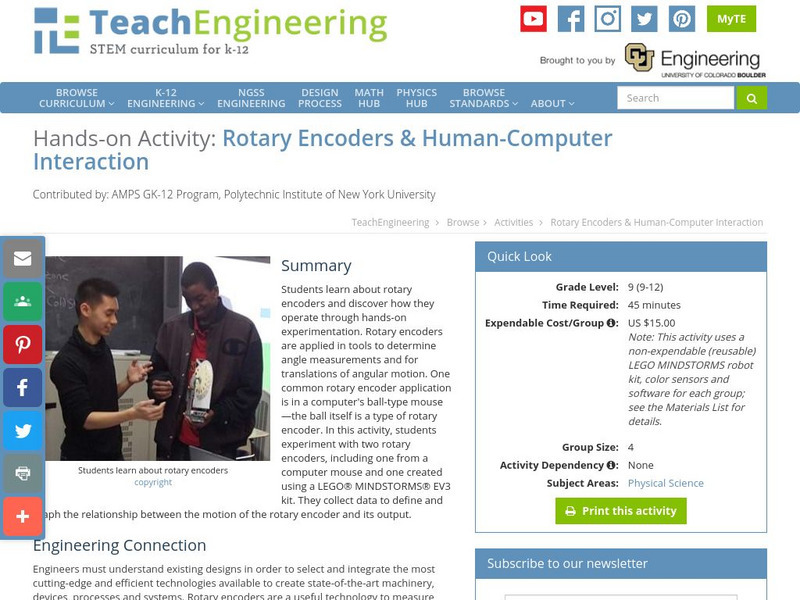
Teach Engineering: Rotary Encoders & Human Computer Interaction
Students learn about rotary encoders and discover how they operate through hands-on experimentation. Rotary encoders are applied in tools to determine angle measurements and for translations of angular motion. One common rotary encoder...
TeachEngineering
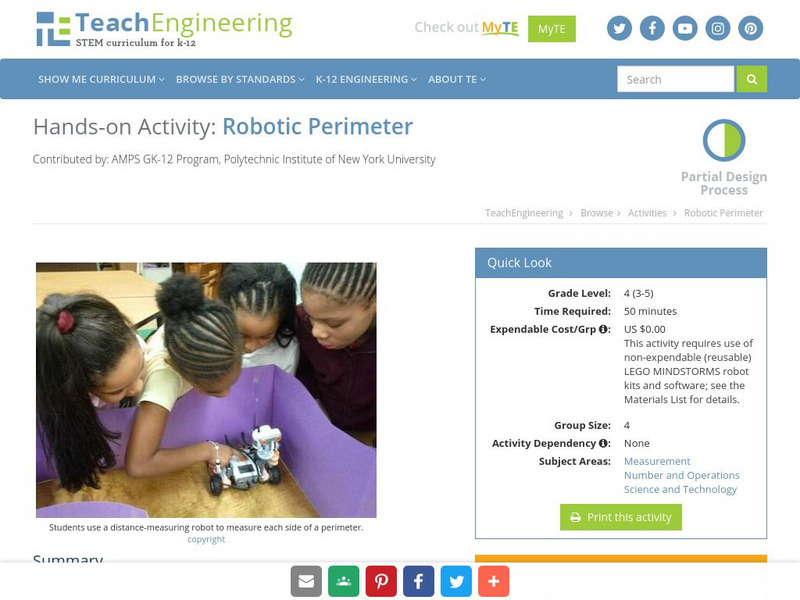
Teach Engineering: Robotic Perimeter
Students learn and practice how to find the perimeter of a polygonal shape. Using a ruler, they measure model rooms made of construction paper walls. They learn about other tools, such as a robot, that can help them take measurements....
TeachEngineering
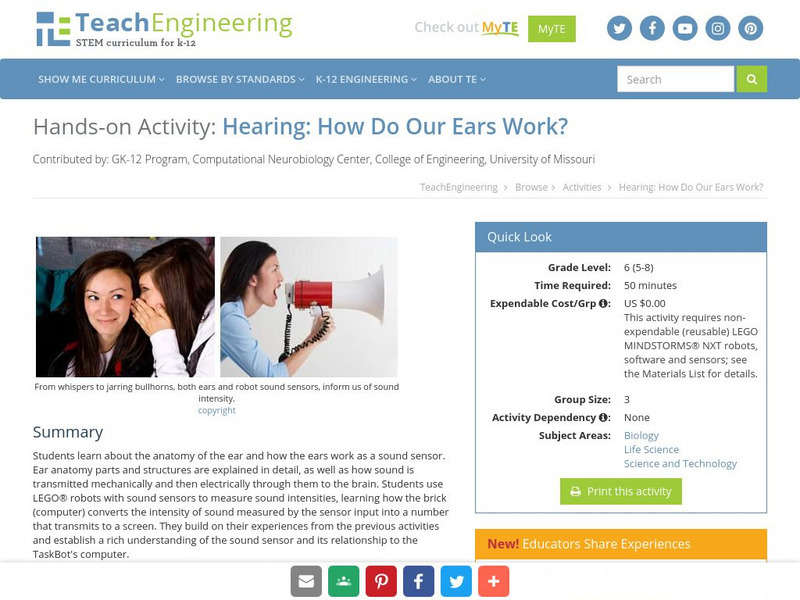
Teach Engineering: Hearing: How Do Our Ears Work?
Students learn about the anatomy of the ear and how the ears work as a sound sensor. Ear anatomy parts and structures are explained in detail, as well as how sound is transmitted mechanically and then electrically through them to the...
TeachEngineering
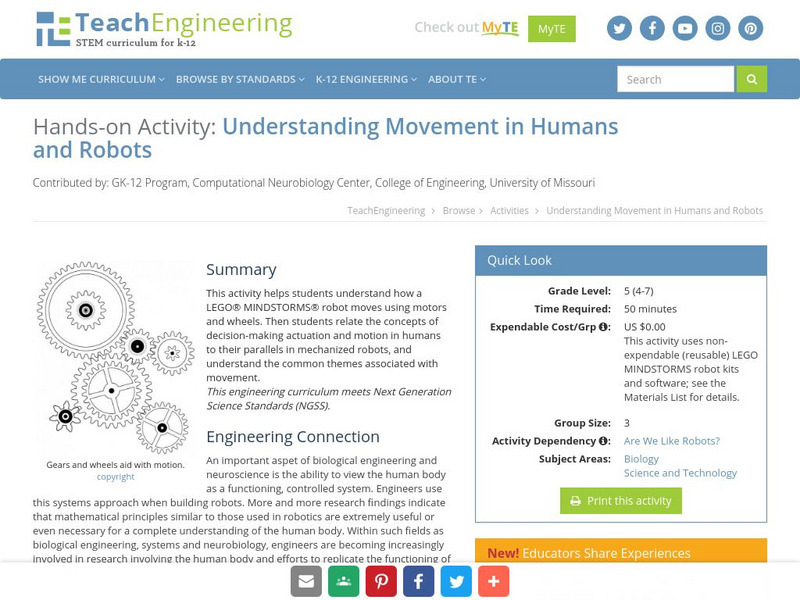
Teach Engineering: Understanding Movement in Humans and Robots
This activity helps students understand how a LEGO MINDSTORMS NXT robot moves using motors and wheels. Then students relate the concepts of decision-making actuation and motion in humans to their parallels in mechanized robots, and...
TeachEngineering
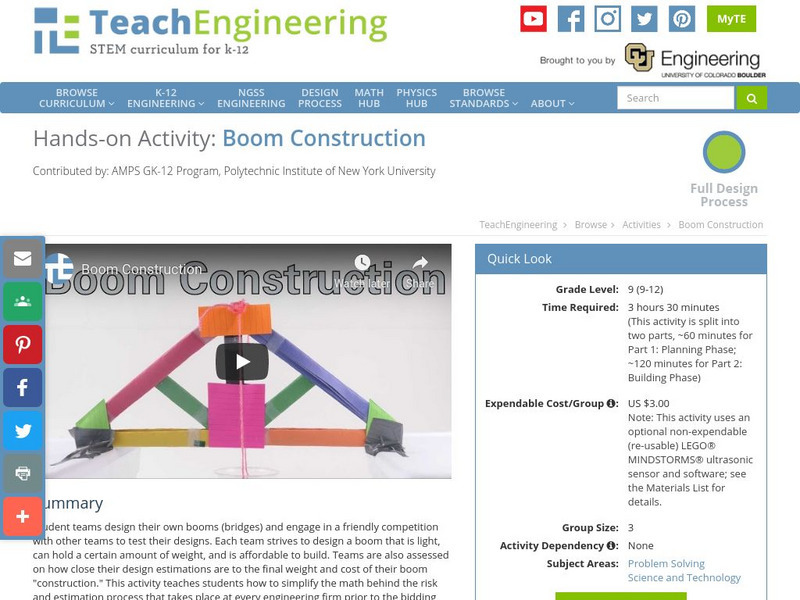
Teach Engineering: Boom Construction
Student teams design their own booms (bridges) and engage in a friendly competition with other teams to test their designs. Each team strives to design a boom that is light, can hold a certain amount of weight, and is affordable to...
TeachEngineering
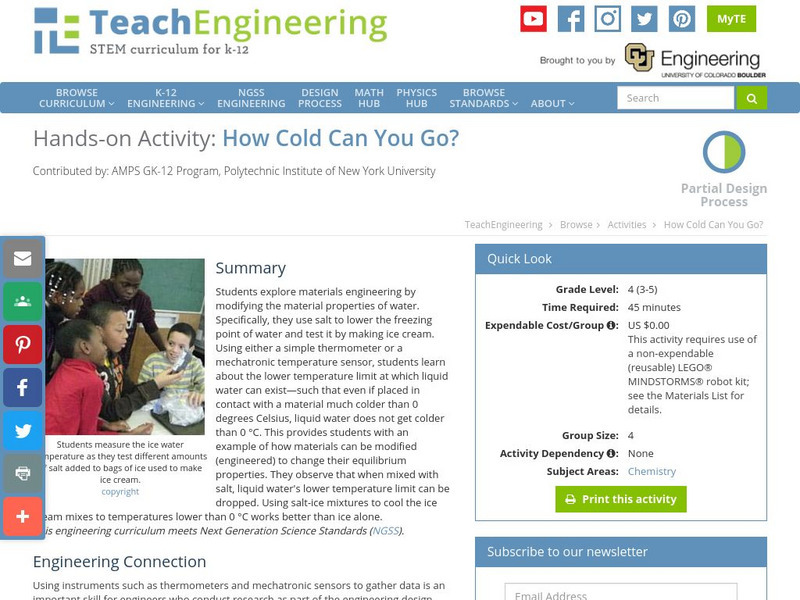
Teach Engineering: How Cold Can You Go?
Students explore materials engineering by modifying the material properties of water. Specifically, they use salt to lower the freezing point of water and test it by making ice cream. Using either a simple thermometer or a mechatronic...
TeachEngineering
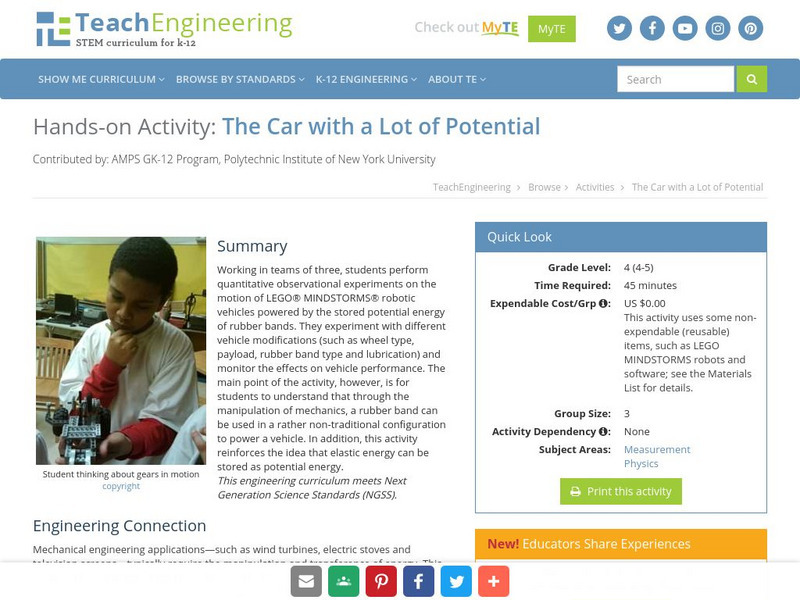
Teach Engineering: The Car With a Lot of Potential
Working in teams, students perform quantitative observational experiments on the motion of LEGO MINDSTORMS NXT robotic vehicles powered by the stored potential energy of rubber bands. Students understand that through the manipulation of...
TeachEngineering
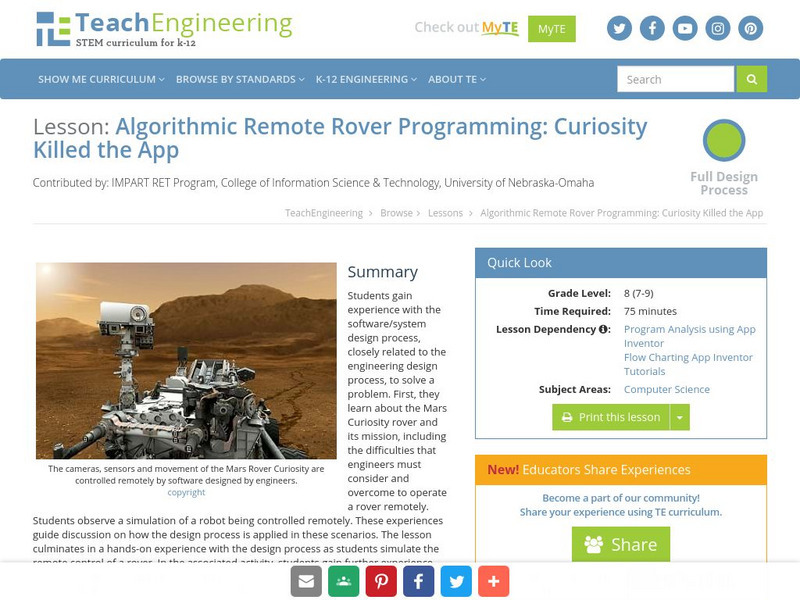
Teach Engineering: Curiosity Killed the App
Students gain experience with the software/system design process, closely related to the engineering design process, to solve a problem. First, they learn about the Mars Curiosity rover and its mission, including the difficulties that...
TeachEngineering
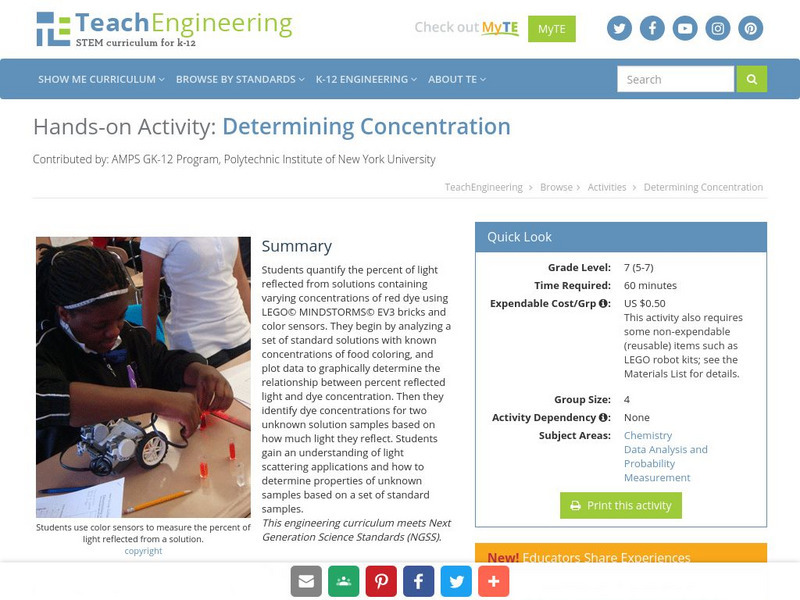
Teach Engineering: Determining Concentration
Students quantify the percent of light reflected from solutions containing varying concentrations of red dye using LEGO MINDSTORMS NXT bricks and light sensors. They begin by analyzing a set of standard solutions with known...