Hi, what do you want to do?





TeachEngineering
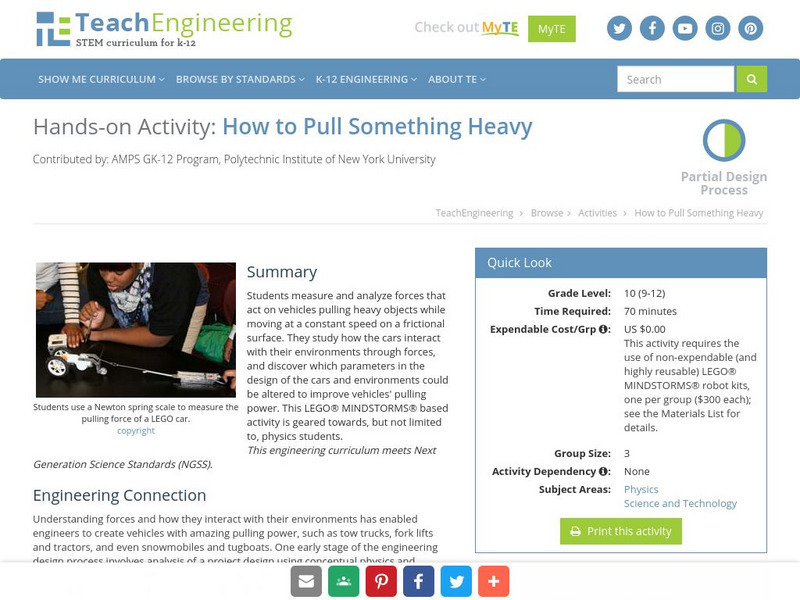
Teach Engineering: How to Pull Something Heavy
Students measure and analyze forces that act on vehicles pulling heavy objects while moving at a constant speed on a frictional surface. They study how the cars interact with their environments through forces, and discover which...
TeachEngineering
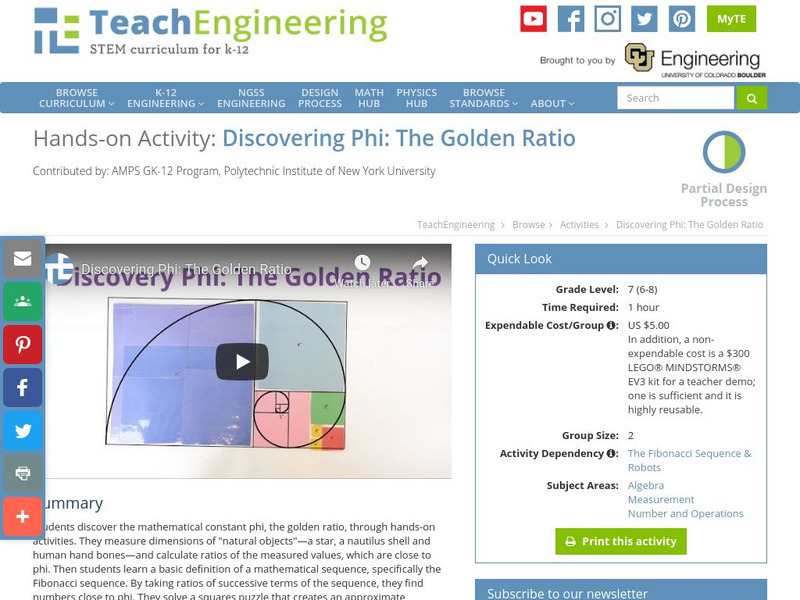
Teach Engineering: Discovering Phi: The Golden Ratio
Students discover the mathematical constant phi, the golden ratio, through hands-on activities. They measure dimensions of "natural objects"--a star, a nautilus shell and human hand bones--and calculate ratios of the measured values,...
TeachEngineering
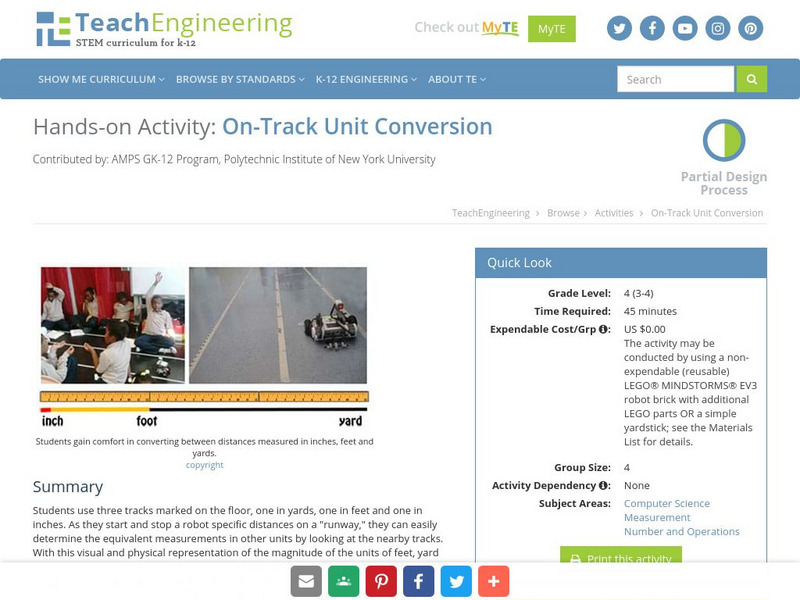
Teach Engineering: On Track Unit Conversion
Students use three tracks marked on the floor, one in yards, one in feet and one in inches. As they start and stop a robot specific distances on a "runway," they can easily determine the equivalent measurements in other units by looking...
TeachEngineering
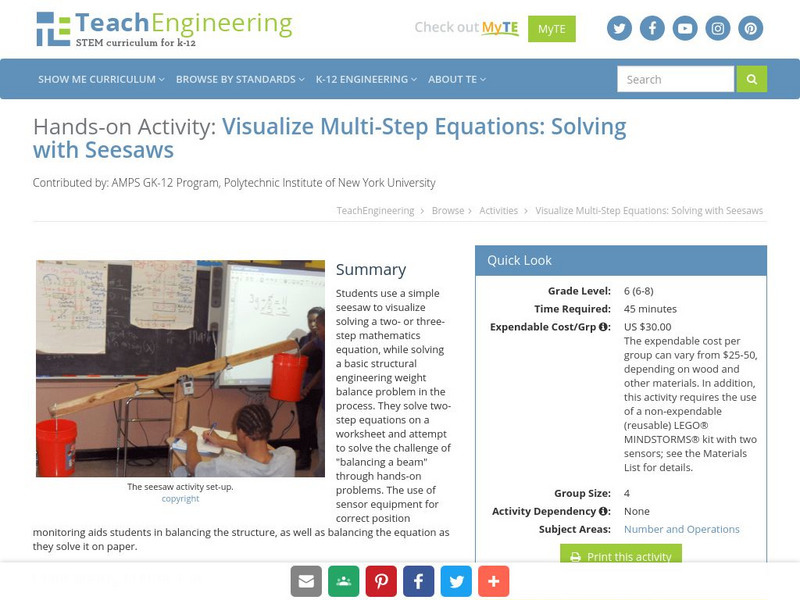
Teach Engineering: Solving With Seesaws
Students use a simple seesaw to visualize solving a two- or three-step mathematics equation, while solving a basic structural engineering weight balance problem in the process. They solve two-step equations on a worksheet and attempt to...

TeachEngineering
Teach Engineering: Measuring Distance With Sound Waves
Students learn about sound waves and use them to measure distances between objects. They explore how engineers incorporate ultrasound waves into medical sonogram devices and ocean sonar equipment. Students learn about properties, sources...
TeachEngineering
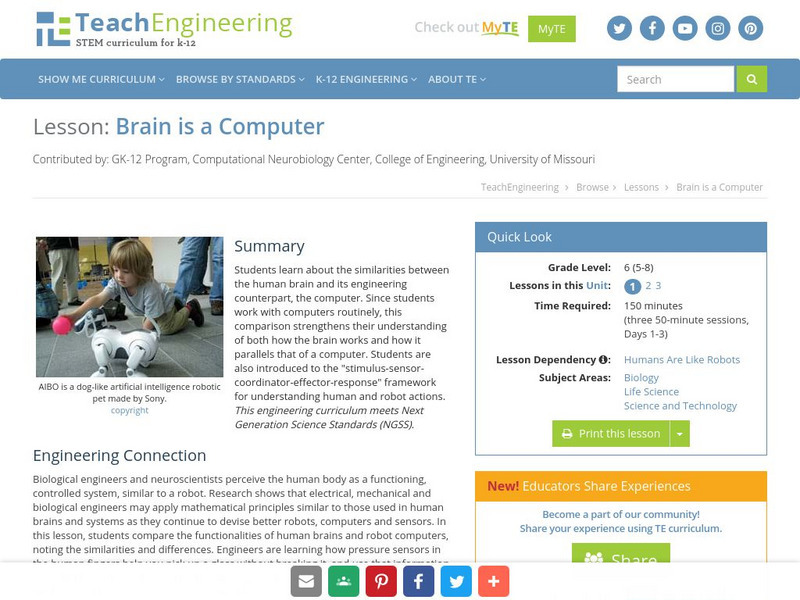
Teach Engineering: Brain Is a Computer
Young scholars learn about the similarities between the human brain and its engineering counterpart, the computer. Since students work with computers routinely, this comparison strengthens their understanding of both how the brain works...
TeachEngineering
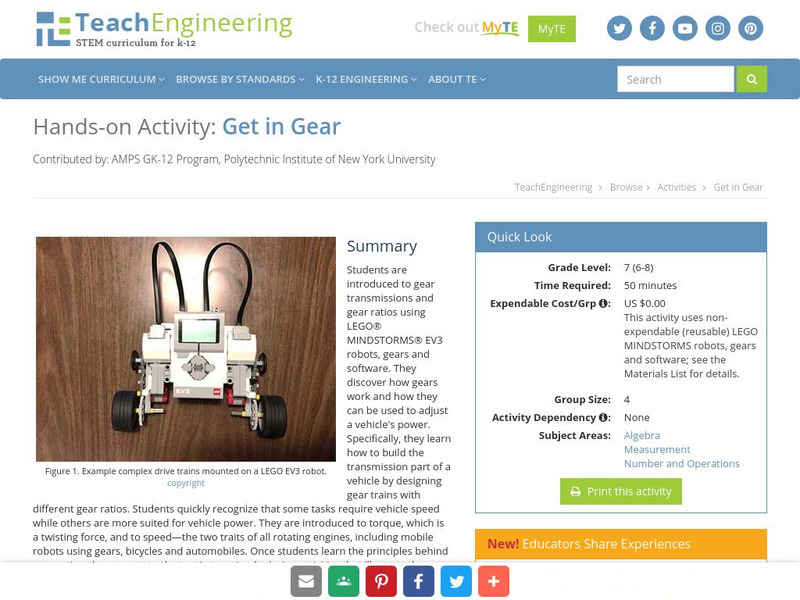
Teach Engineering: Get in Gear
Students discover how gears work and how they can be used to adjust a vehicle's power. Specifically, they learn how to build the transmission part of a vehicle by designing gear trains with different gear ratios.
TeachEngineering
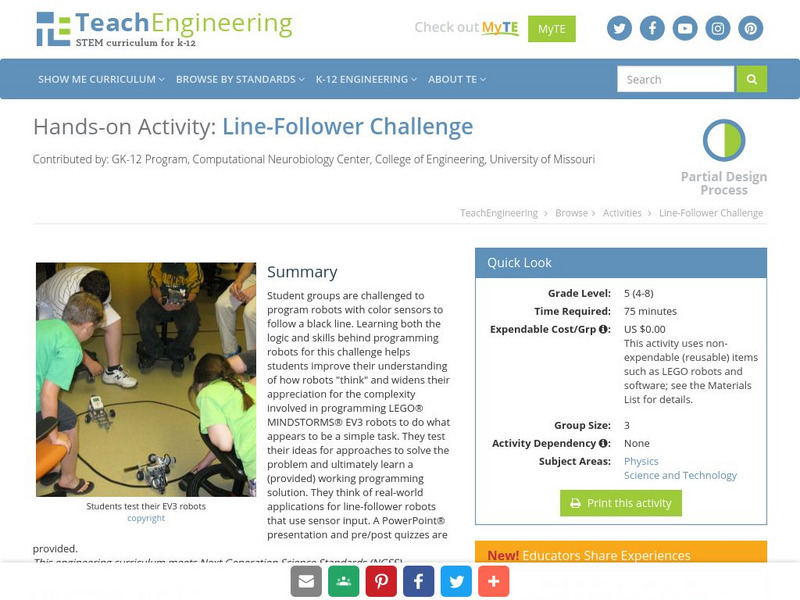
Teach Engineering: Line Follower Challenge
Student groups are challenged to program robots with light sensors to follow a black line. Learning both the logic and skills behind programming robots for this challenge helps students improve their understanding of how robots work, and...
TeachEngineering
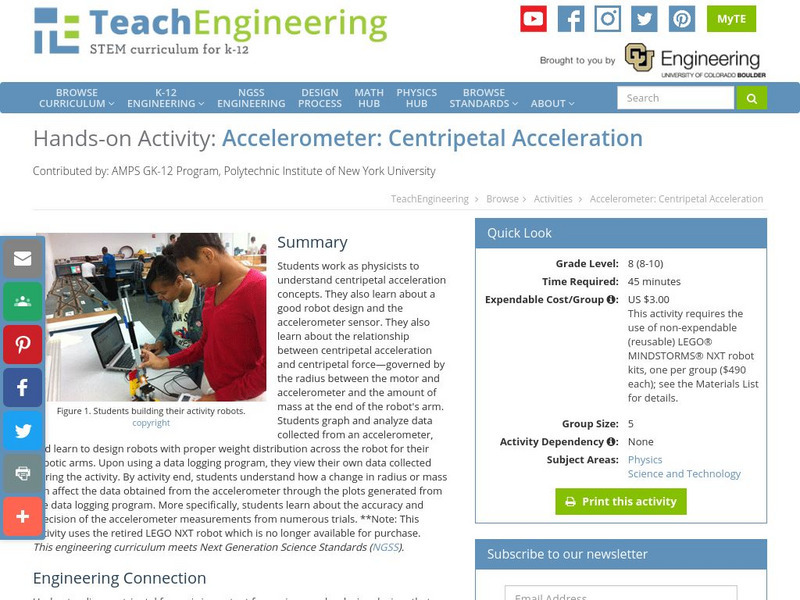
Teach Engineering: Accelerometer: Centripetal Acceleration
Students work as physicists to understand centripetal acceleration concepts. They also learn about a good robot design and the accelerometer sensor. They also learn about the relationship between centripetal acceleration and centripetal...
TeachEngineering
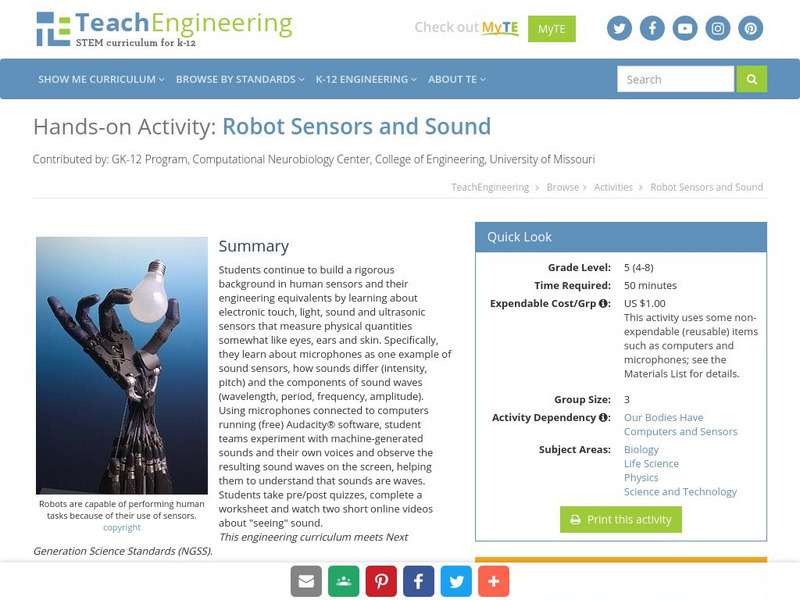
Teach Engineering: Robot Sensors and Sound
Using microphones connected to computers running Audacity software, student teams experiment with machine-generated sounds and their own voices and observe the resulting sound waves on the screen, helping them to understand that sounds...

Scientific American
Scientific American: Earthquake Proof Engineering for Skyscrapers
Young scholars construct a shake table, then build towers of different heights using Lego blocks, and test their stability on this platform. Next, they test towers with different sized bases, and towers made using different materials.
Other
Tufts University: Stomp: Nxt Activity Database
A collection of lesson plans that can be used with the Lego Mindstorms NXT robots. Lesson plans include procedure, student handouts, and programming code.
TeachEngineering
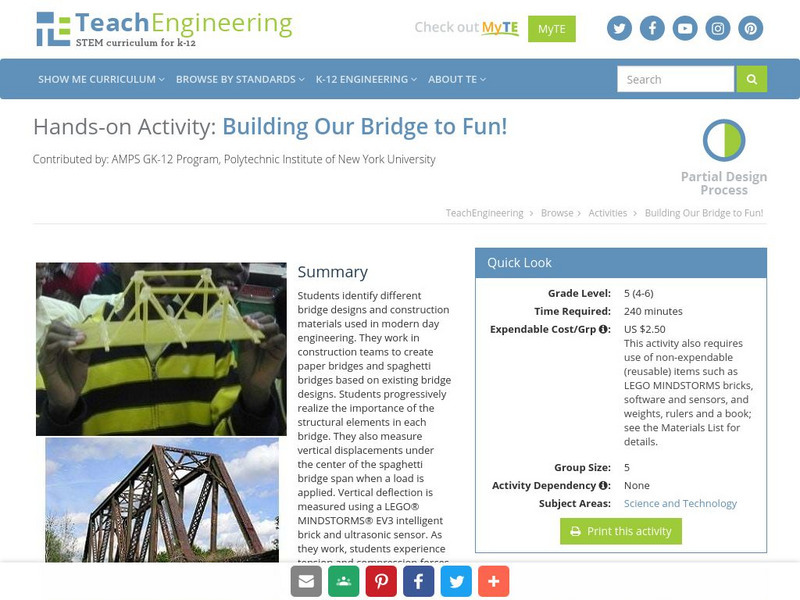
Teach Engineering: Building Our Bridge to Fun!
Students identify different bridge designs and construction materials used in modern day engineering. They work in construction teams to create paper bridges and spaghetti bridges based on existing bridge designs. Students progressively...

TeachEngineering
Teach Engineering: Gears: Lift It Up!
In this activity, students learn about the trade-off between speed and torque when designing gear ratios. The activity setup includes a LEGO pulley system with two independent gear sets and motors that spin two pulleys. Each pulley has...
TeachEngineering
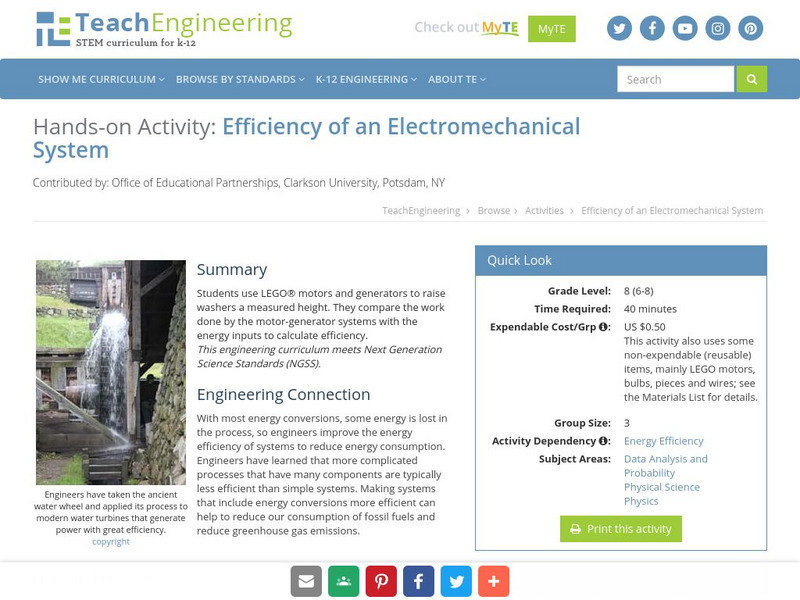
Teach Engineering: Efficiency of an Electromechanical System
Students use Lego motors and generators to raise washers a measured height. The work done by the motor-generator systems is compared with the energy inputs to calculate efficiency.

Khan Academy
Khan Academy: Bonus Points
After completing the electrical engineering project called Ant Bot, improve your machine and share your ideas with others.

Science Buddies
Science Buddies: Building Structures: It's a Slippery Slope
All structures require a foundation to keep them from falling down. This is especially important when a structure is built on a hill or on a slope. In this science project, you will build a tower of Lego Duplos on slopes with different...

Science Buddies
Science Buddies: Why Do Birds Fly in a v Formation?
In this science fair project, the student will make a wind tunnel to test how the formation of birds in flight affects flight efficiency. Make the bird models out of Legos and have fun with this project. The Science Buddies project ideas...

Khan Academy
Khan Academy: Challenge: Drum Partner
Learn how to use the sound sensor for the Lego robot with this page.