Hi, what do you want to do?






Curated OER
Clean Coal?
High schoolers determine, based on their knowledge of coal pollutants, the effectiveness of clean-coal technologies. They state and defend a position on whether power plants in the United States should be required to upgrade to available...

Curated OER
Cells and Cancer
Students idenitfy that cancer is a growth of mutated cells and that cancer cells are only one type of cell that causes disease in our body. They also identify that all eukaryotic cells contain a nucleus, cytoskeleton, and a cell...

Curated OER
The Acid Rain Test
Fourth graders engage in a research project to increase their ability to conduct experiments, interpret data and discuss results in a scientific paper. After doing a lab which simulates effects of acid rain, pairs of students write a...

Curated OER
Pocahontas: Ambassador to the New World
Students watch the video "Pocahontas: Ambassador to the New World," complete a vocabulary list and discuss the video using the provided questions.

Khan Academy
Khan Academy: Risk Factors for Drug Use and Drug Abuse
A description of the factors (biological risks, psychological risks, socio-cultural risks, and environmental risks) that relate to each other in complicated ways that can lead to drug abuse or drug addiction.

Khan Academy
Khan Academy: Risk Factors for Bipolar Disorder
Examined are factors that increase the risks of bipolar disorder: psychological, environmental, genetic, neuro chemical, and difference in brain structure and function.
Geographypods
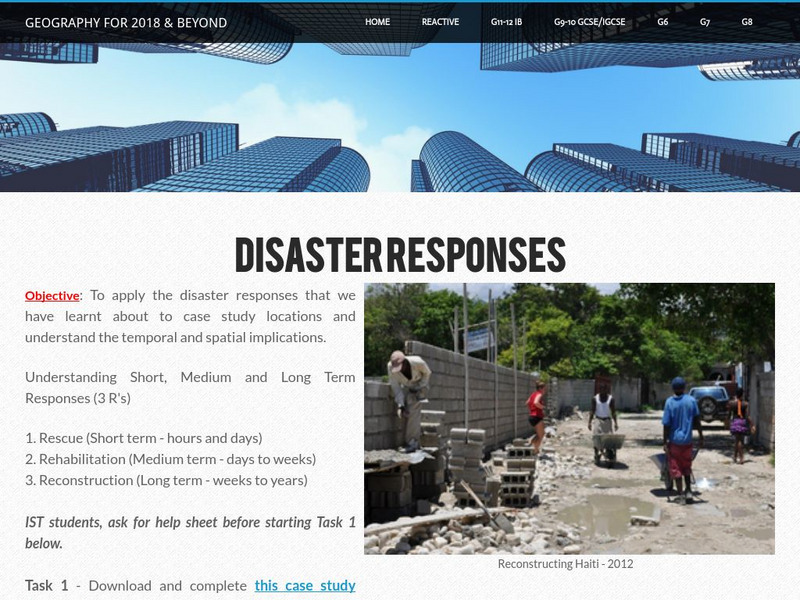
Geographypods: Hazards and Risk Management: Adjustments and Responses
In this learning module, students learn about disaster responses, the three types (short, medium, and long-term) and the different levels of response (local, national, and international). They examine the responses in various case...
University of Utah
University of Utah: Genetic Science Learning Center: The New Science of Addiction
Multidisciplinary examination of the science of addiction attempts to unravel its complexities by considering genetics, brain chemistry, environmental risk factors, and related topics.
![U.s. Dept of Health and Human Services: Cancer and the Environment [Pdf] Website](https://content.lessonplanet.com/knovation/original/224070-96b08e2e287ce61f7938dd5f317a86cb.jpg?1661495292 "U.s. Dept of Health and Human Services: Cancer and the Environment [Pdf] Website")
National Institutes of Health
U.s. Dept of Health and Human Services: Cancer and the Environment [Pdf]
Document provides information on the causes and nature of cancer and particularly the substances in the environment that are known to cause or may cause cancer in humans such as tobacco, ultraviolet radiation, pesticides, and metals.