Hi, what do you want to do?






Curated OER
Weighted Averages
Weighted averages can be tricky to explain! However, this study guide makes it easy for teachers by including definitions, explanations, and breaking down problems into three steps. Includes mixture problems and uniform motion problems.

Teach Engineering
Can You Resist This?
Some things are hard to resist. Small collaborative groups build circuits and calculate the voltage using Ohm's Law. Budding engineers explore the connection between the voltage across different resistors and linear...

Curated OER
Solving Multi-Step Inequalities
Ready to study inequalities with your class? Use this worksheet to solve multi-step inequalities and graph the solutions. The document would be great to use as a study guide as you present the material, or could easily be modified and...

Google
The Law of Large Numbers and Probability
Learners investigate why theoretical probability doesn't always match reality. The activity involves using Python 2.7 (or Sage) to set up a Bernoulli Trial. It also involves setting up a spreadsheet to simulate the Birthday Paradox....

Curated OER
Interpreting Graphs
Sixth graders interpret linear and nonlinear graphs. They create graphs based on a problem set. Next, they represent quantitive relationships on a graph and write a story related to graphing.

US Department of Energy
The Ring Fling Machine
Class members build a machine to demonstrate Lenz's law and help this scientific principle come to life. After building a ring fling machine, instructions for properly operating the machine and a few thought-provoking questions lead to...

EngageNY
Comparing Rational Expressions
Introduce a new type of function through discovery. Math learners build an understanding of rational expressions by creating tables and graphing the result.

Curated OER
Graphing and the Coordinate Plane
Learners examine the four quadrants of Cartesian coordinate plane. They play maze games and coordinate games to discover how to read and plot points on the plane. Students plot points on the coordinate plane and examine the ratio of...

Curated OER
Introduction to Functions
Students explore functions, function rules, and data tables. They explore terms of linear functions. Students use computers to analyze the functions. Students write short sentences to explain data tables and simple algebraic expressions.

Curated OER
Complex Roots: A Graphical Solution
Using their Ti-Nspire to determine the solutions of parabolas, high schoolers explore the concept of complex roots. Students determine if parabolas have real or complex roots. High schoolers determine the the axis of symmetry...

Curated OER
Michigan Virtual Field Trip
Students analyze data from a virtual field trip to Michigan. They conduct Internet research on mileage and travel time between cities, calculate and compare fuel costs, and research and calculate lodging, activities, and meal costs.

Curated OER
Introduction to Fractals: Geometric Fractals
Middle schoolers study and observe the patterns made by the areas of the Sierpinski Triangle. Students use the computer to draw two or three iterations to discover the number patterns. Middle schoolers complete worksheets based on...

Curated OER
First Class First? Using Data to Explore the Tragedy of the Titanic
Learners analyze and interpret data related to the crew and passengers of the Titanic. They research information on a Titanic database to illustrate specific statistical conclusions, and whether or not social status affected the outcome.

Other
Nearpod: Graphing Linear Equations in Standard Form
For this lesson on a standard form, students explore how to identify and graph a linear equation in standard form.
Khan Academy
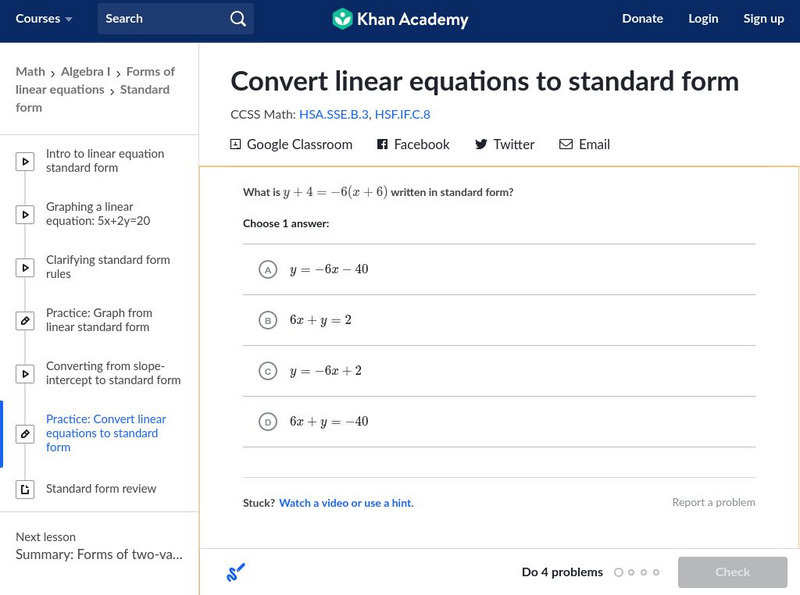
Khan Academy: Convert Linear Equations to Standard Form
Convert linear equations in various forms into standard form. Students receive immediate feedback and have the opportunity to try questions repeatedly, watch a video or receive hints.

Khan Academy
Khan Academy: Convert Linear Equations to Standard Form
Convert linear equations in various forms into standard form.
National Council of Teachers of Mathematics
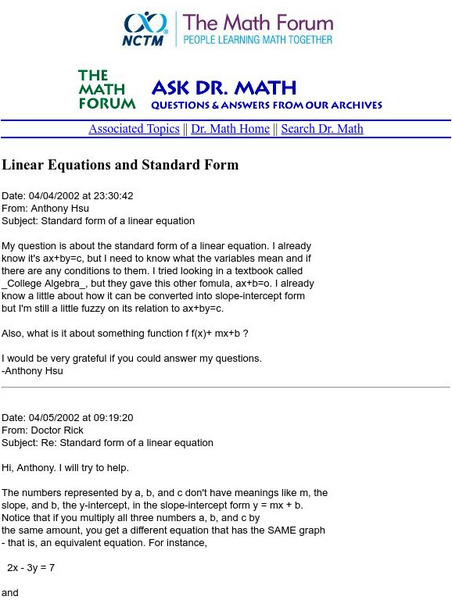
The Math Forum: Ask Dr. Math: Standard Form of a Line
Dr. Math gives an inspiring and clear discussion about equations of lines and lines as functions. The Dr. discusses the benefits of the standard form of a line and prompts the student with an equation which can not be written in the...

Khan Academy
Khan Academy: Graph From Linear Standard Form
Find the graph of a linear equation given in standard form.

CK-12 Foundation
Ck 12: Algebra: Standard Form of Linear Equations
[Free Registration/Login may be required to access all resource tools.] This lesson covers finding the equation of a line in standard form and the intercepts.
Khan Academy
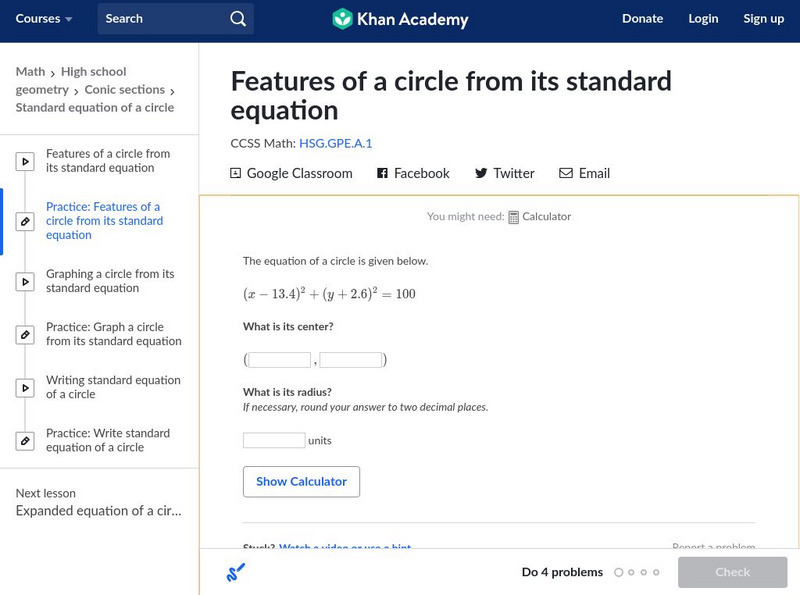
Khan Academy: Features of a Circle From Its Standard Equation
Find the center and radius of a circle given the equation in standard form. Students receive immediate feedback and have the opportunity to try questions repeatedly, watch a video or receive hints.

Khan Academy
Khan Academy: Slope From an Equation in Slope Intercept Form
In this exercise, students practice determining slope from an equation written in standard form. Students receive immediate feedback and have the opportunity to watch a video, get hints, or try questions repeatedly.
Khan Academy
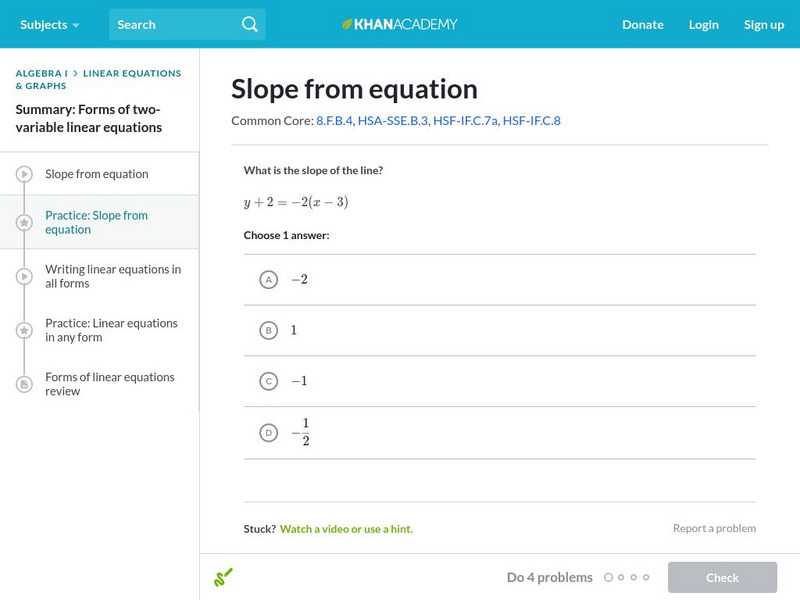
Khan Academy: Slope From Equation
Find the slopes of lines whose equations are given in various forms. For example, find the slope of 2x+3y=5. Students receive immediate feedback and have the opportunity to try questions repeatedly, watch a video or receive hints.
Other
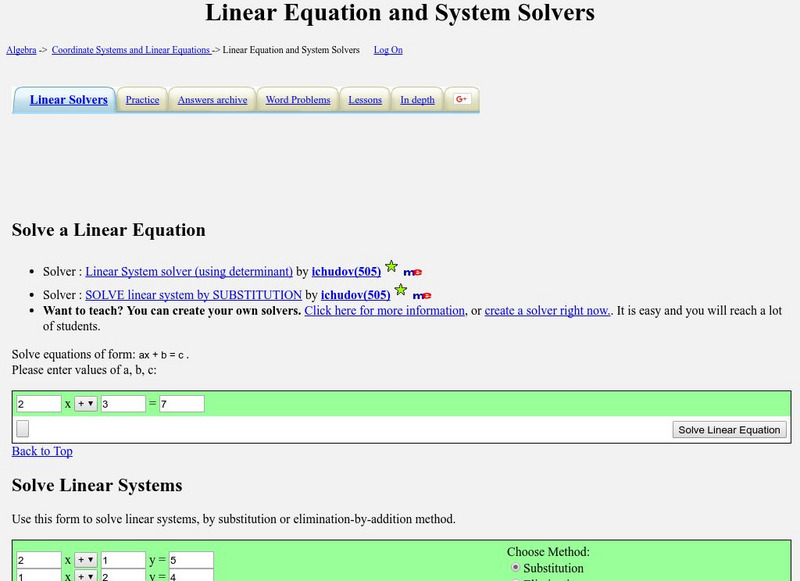
Algebra.com: Linear Equation and System Solvers
Linear equations can be solved and graphed using this interactive site. This site allows the user to enter any linear equation in standard form and the y-intercept will be found through a step-by-step process. Systems of inequalities can...
Khan Academy
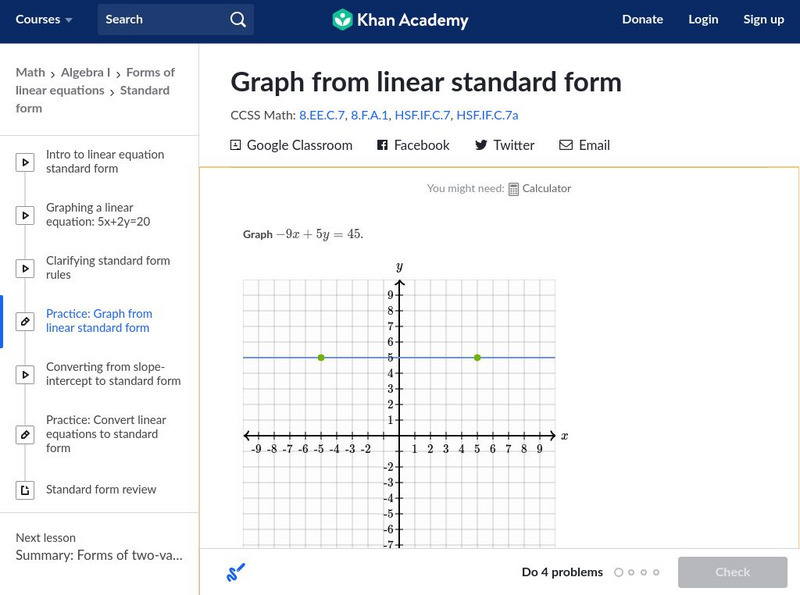
Khan Academy: Graph From Linear Standard Form
Find the graph of a linear equation given in standard form. Students receive immediate feedback and have the opportunity to try questions repeatedly, watch a video or receive hints.