Hi, what do you want to do?






Curated OER
Backyard Bugs
Explore the concept of scientific classification and the similarities and differences between plant and animal species. Your class will participate in hands-on activities by investigating dichotomous keys and classifying their shoes. To...

Curated OER
Bacteria Aren't All Bad!
Teaching students about the diversity of the Bacteria Kingdoms and their importance to humans

Curated OER
Taxonomy Concept Map
Reinforce learners' knowledge of scientific taxonomy with a helpful concept map worksheet. Using a word bank, young biologists fill in the blanks to complete the description of organism classification.


Curated OER
Prokaryote Coloring
In this prokaryote coloring activity worksheet, 7th graders read an informative passage about prokaryotes. Students answer questions about the passage and color the picture.

Curated OER
World of Protists
Students observe a jar of pond water and predict how much life they think exists in the jar and watch a "Bill Nye: The Science Guy" video regarding protists. They participate in an online virtual pond dip where they begin to familiarize...

Curated OER
Plant Classification
Students share with the class how they think plants are classified and are assessed on their prior knowledge. They use a packet to complete throughout the week at their own pace, which includes various activities to familiarize...

Curated OER
NS 6: Monerans, Viruses
Students compare the structures and functions of viruses and bacteria relating their impact on other organisms. They review the main vertebrate groups. Students are describing the characteristics of the main group of vertebrates: ...

Curated OER
Earthworms
Fifth graders research the earthworm and write a one paragraph report on its anatomy and habitat. They learn about worms and how to dissect them through Video Streaming and virtual dissections, along with actually dissect a worm as...

Curated OER
Transmission of Disease
Students provide names of viral diseases that they would possibly like to be infected with today; listing them on the Smart Board. They then come to an agreement about what virus to use and use beakers of fluids to simulate how viruses...

Curated OER
Animal Kingdom: Phylum Chordata
Students use a dichotomous key to classify various vertebrate jar speciments into classes. They examine the speciments for general characteristics of each class and fill in a corresponding chart and then complete a few final assessment...

Curated OER
Invertebrate Classification
Students discuss the recent disovery of the "furry lobster" to peak interest in the animal kingdom. They classify various speciments using invertebrate dichotomous keys, identifying major animal phyla and classes. Thy the complete the...

Curated OER
The Fungus Among Us
Students explore the basic characteristics and roles of fungi. They discuss the importance of fungi to humans. Students investigate the relationship between cell structure and function and explore the diversity and variation of...

Curated OER
Zoology Word Search Puzzle
In this science learning exercise, students look for the words that are related to the concept of zoology that is reviewed in the sheet. They also acquire new vocabulary.

BiologyWise
Biology Wise: Archaebacteria and Eubacteria Difference
Explains what archaebacteria and eubacteria are and presents a chart showing how they differ in structure and characteristics.
Estrella Mountain Community College
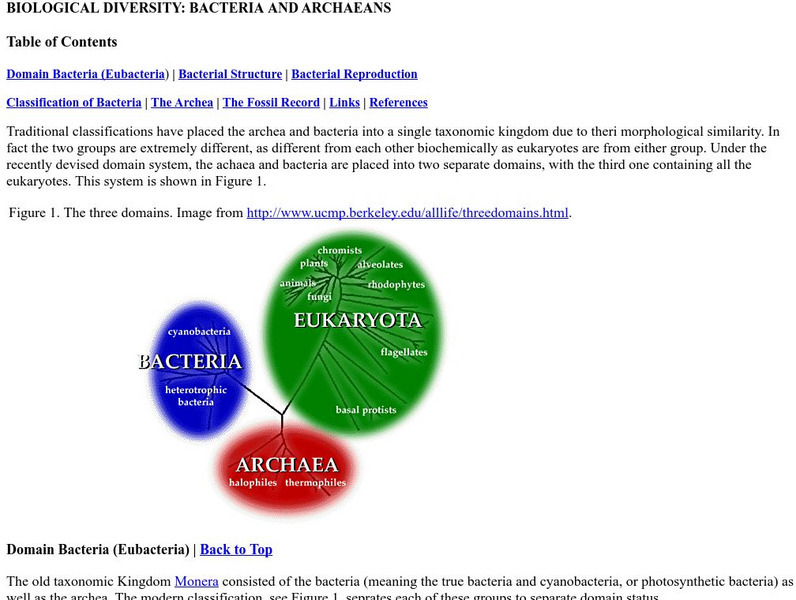
Online Biology Book: Biological Diversity: Bacteria and Archaeans
In this online biology textbook, learn about the two prokaryotic domains of life, which include eubacteria and acrhaebacteria.
Other
Secondary Science Program: The Six Kingdoms
A short overview of the six kingdoms in our scientific classification system: Plants, Animals, Protists, Fungi, Archaebacteria, and Eubacteria.
CK-12 Foundation
Ck 12: Episd: Prokaryote Classification
[Free Registration/Login may be required to access all resource tools.] Students will understand where bacteria live, the different types of prokaryotes, and extremephilic bacteria.
CK-12 Foundation
Ck 12: Biology: Prokaryote Classification
[Free Registration/Login may be required to access all resource tools.] Overview of classifying prokaryotes and prokaryotic domains.
City University of New York
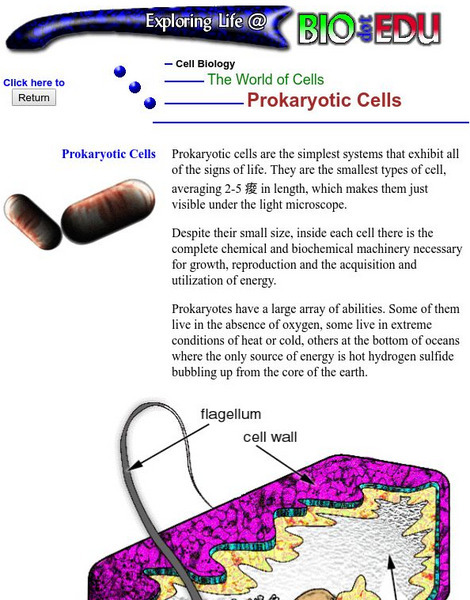
Brooklyn College: The World of Cells: Prokaryotic Cells
A very nice introduction to this group organized in a concise, easy to follow format.

Open Curriculum
Open Curriculum: New Kingdoms
Between 1866 and 1977, a total of four new kingdoms were added to the original plant and animal kingdoms identified by Linnaeus. The new kingdoms include Protista (protists), Fungi, Monera (eubacteria), and Archaea (archaebacteria)....

Tree of Life Project
The Tree of Life Web Project
The Tree of Life is a multi-authored, Internet distributed project containing information about phylogeny and biodiversity. The Tree of Life can be used to locate information about a particular group of organisms through their taxonomy.
Other
Panhandle Area Educational Consortium: The Six Kingdoms of Life [Pdf]
Scientists look at the evolutionary history of organisms to divide them into kingdoms. For awhile, there has been 5 kingdoms, but many scientist are now using 6 kingdoms.

Tom Richey
Slide Share: Overview of Six Kingdoms
This slideshow provides an overview of the six kingdoms.