Hi, what do you want to do?






PBS
Pbs Learning Media: Mammals Get Their Chance
In this video segment adapted from NOVA, animations of an asteroid hitting Earth are used to illustrate this widely accepted theory of dinosaur extinction and the resulting conditions that favored mammals.

Howard Hughes Medical Institute
Hhmi: Bio Interactive: Pocket Mouse Film With Quiz
Learn about selective pressure and how genes are involved in adaptations by watching this video on pocket mice. The video focuses on the research of Dr. Michael Nachman, "whose work in the field and in the lab has quantified the...
Estrella Mountain Community College
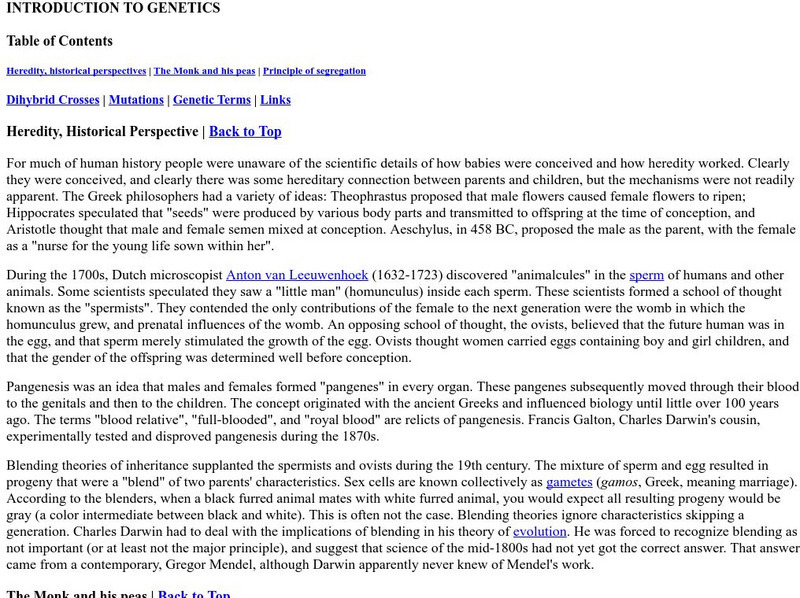
Estrella Mountian College: Introduction to Genetics
This site explains genetic beliefs before and after Mendel, and also includes a section on Mendel himself and his experiments, entitled, "The Monk and his Peas".
PBS
Pbs Learning Media: Dinosaur Train
Dinosaur Train sparks children's interest in life science and natural history. As they explore a variety of animals, children develop the inquiry skills and knowledge needed to help them think, talk and act like paleontologists. Choose...

Other
Historia Del Idioma Espanol
An informative study, in Spanish, of the history of the Spanish language, its origins, its evolution, and its history in America. There is also an article about the Argentine adaptations of the language, and another link that covers the...
Other
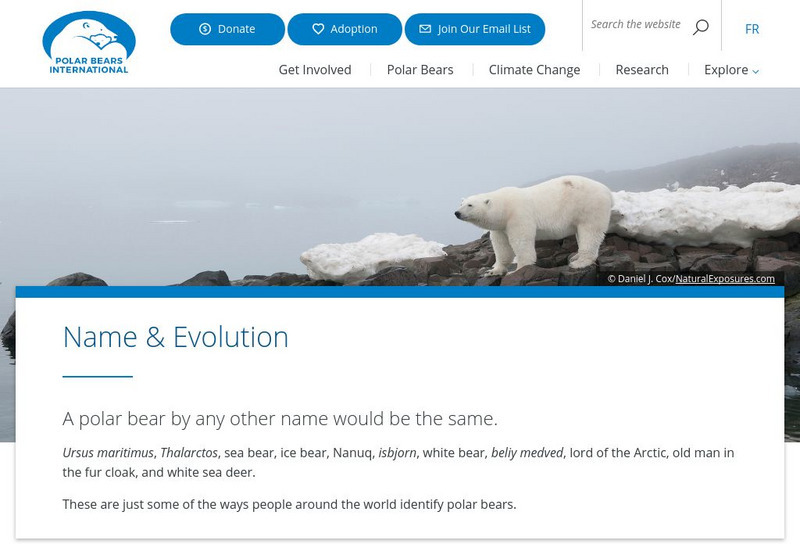
Polar Bears International: The Bear Facts
This site from Polar Bears International, dedicated to the worldwide conservation of the polar bear and its arctic habitat, provides extensive information about the polar bear. Content includes polar bear I.Q., hibernation facts,...
John F. Kennedy Center
The Kennedy Center: Musical Harlem
The Kennedy Center's ArtsEdge offers a great unit for introducing jazz to students. Its use of Harlem as the "glue" which binds together elements such as jazz history and jazz terminology, makes it particularly effective for the...
Other
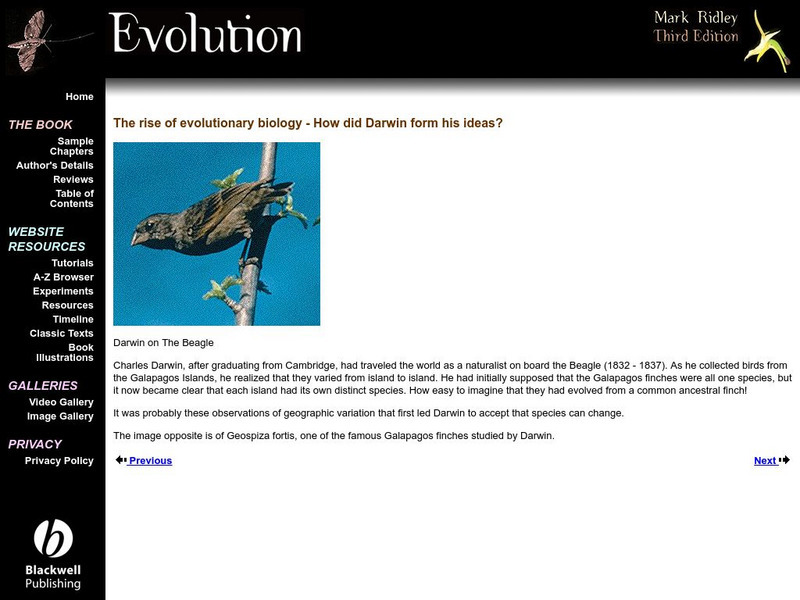
The Rise of Evolutionary Biology: Darwin's Ideas
These pages are part of a site called "Evolution," that accompany a textbook by the same name. Mark Ridley is the author. This section is about Darwin, his travels, and his observations that led to "On The Origins Of Species."
University of California
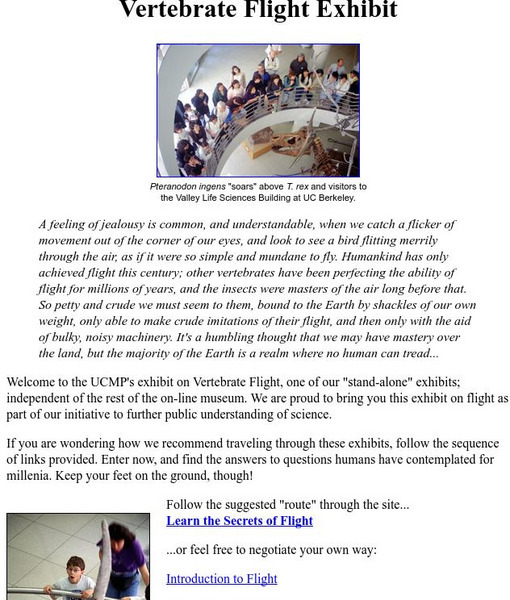
Ucmp: Entrance to the Vertebrate Flight Exhibit
This University of California Berkeley page provides information on the evolution of vertebrate flight and includes links to the following topics: Introduction to Flight, The Physics of Flight, Gliders and Parachuters, The Evolution of...
Vision Learning
Visionlearning: Biology: Charles Darwin I: The Origin of Species
Instructional module focusing on the early work of Charles Darwin. Discusses Darwin's key role in supporting and describing the theory of evolution as driven by natural selection. Site also includes an interactive practice quiz and links...
BioMan Biology
Bio Man Biology: Snurfle Islands
Create a Snurfle and see whether it can survive in different environments. As you play the game, you will learn about natural selection and animal adaptations. At the end of the game, try the multiple-choice quiz to check your...
TeachEngineering
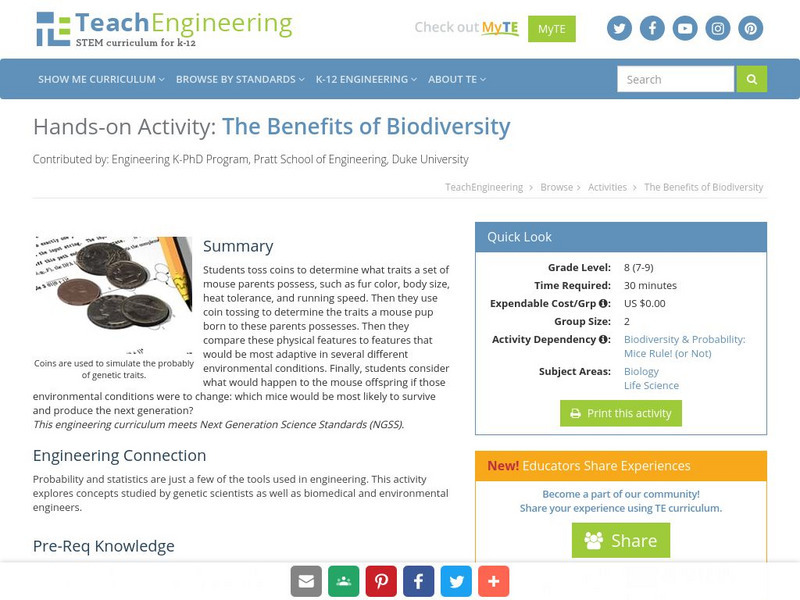
Teach Engineering: The Benefits of Biodiversity
First, students toss coins to determine what traits a set of mouse parents possess, such as fur color, body size, heat tolerance, and running speed. Next they use coin tossing to determine the traits a mouse pup born to these parents...
Estrella Mountain Community College
Online Biology Book: Development of Evolutionary Theory
Using diagrams and descriptive illustrations, this college-level biology reference book discusses the development of evolutionary theory.
OneWorld UK
One World: Tiki the Penguin: Genetic Engineering: Whose Genes?
Come along with Tiki the Penguin as he discovers what makes you a human or him a penguin! This site details some of the major issues relative to genetics - such as genetic engineering - in a way that is interesting and relevant to kids.
Science Education Resource Center at Carleton College
Serc: Comparative Anatomy of Bird vs. Human Leg Bones
This activity is designed for learners to compare and contrast the anatomy of bird and human leg bones. Students will kinesthetically model walking like a bird to note the differences in the foot bones.
CK-12 Foundation
Ck 12: Biology: Fish Structure and Function
[Free Registration/Login may be required to access all resource tools.] Describes the characteristics of fish suited for aquatic lifestyles.
TeachEngineering
Teach Engineering: Compare Human Made Objects With Natural Objects
In small groups, students will experiment and observe the similarities and differences between human-made objects and nature. The students will compare the function and structure of hollow bones with drinking straws, bird beaks, tool...

BBC
Bbc Schools: Ks2 Bitesize: Science: The Living World
This landing page includes learning modules on the following topics of: animals, plants, microorganisms, life cycles and reproductions, food chains, habits, humans and the environment, adaptation, inheritance, and evolution.

Vision Learning
Visionlearning: Biology: Galapagos Finches
Interactive animation illustrates how Charles Darwin used his study of finch beaks to explain evolution. A phylogenetic tree diagram shows how the birds' color and beak shape changed over generations.
OneWorld UK
One World: Stop Life in Danger
Elementary students will appreciate the cartoon style fact clips as the evolution of life on earth is laid out. Diversity, survival of the fittest, and ideas to help the environment are all included. An entertaining site for younger...
Biology Corner
Biology Corner: Peppered Moths Simulation
This simulation allows students to take on the role of a bird and eat different types of peppered moths. Students analyze which types of peppered moths do better in various environments.
PBS
Pbs Learning Media: American Chestnut Tree
This annotated slideshow adapted from KET's Electronic Field Trip to the Forest illustrates how blight decimated the American chestnut tree and the methods scientists use to identify and pollinate the remaining trees to create...

Concord Consortium
Concord Consortium: Stem Resources: Natural Selection
Build a dam in the middle of an ecosystem and observe how the population of plants and animals adapt to their new environment with this science simulation. Learn how the populations adapt to survive in their new habitat. Then remove the...
Howard Hughes Medical Institute
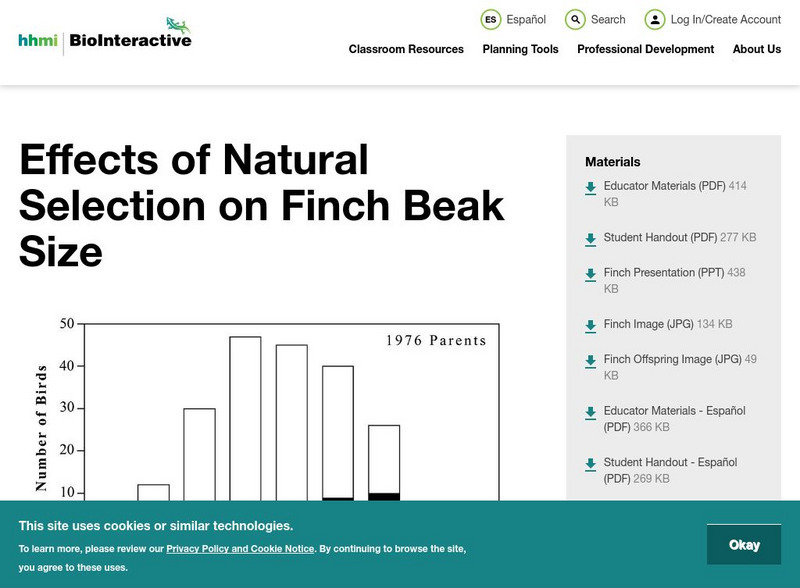
Hhmi: Bio Interactive: Effects of Natural Selection on Finch Beak Size
In this activity, students examine research on finches on the island of Daphne Major in the Galapagos Islands. The depth of the finches' beaks was measured before and after a drought. This data is displayed in graphs and students are...