Hi, what do you want to do?






National Institutes of Health
National Center for Biotechnology Information: Phylogenetics Factsheet
A detailed website that explains the history and process of classifying animals using evolutionary, molecular, and physical characteristics relationships. Website also contains information on evolution and evolutionary processes....

Biology Pages
Kimball's Biology Pages: Cladistics
This page discusses how the cladistic level of classification includes information from molecular biology to establish evolutionary relationships. The page discusses how this information is used to do this.

Vision Learning
Visionlearning: Biology: Galapagos Finches
Interactive animation illustrates how Charles Darwin used his study of finch beaks to explain evolution. A phylogenetic tree diagram shows how the birds' color and beak shape changed over generations.
PBS
Tracing Ancestry With Mt Dna
The most common mtDNA ancestor is an African woman named African "Eve" or Mitochondrial Eve. Good explanation of mtDNA versus nuclear DNA through visual interactive family tree.
University of California
Understanding Evolution: The History of Life: Looking at the Patterns
See how scientists use cladistics to study evolutionary relationships.
Science Education Resource Center at Carleton College
Serc: Microbial Evolution: Part 4
YouTube video continues the discussion of molecular phylogenetics and reconstruction of the tree of life.
Indiana University
Ensi: Introduction to Evolution Lesson Plan
This unit plan presented by the Evolution and the Nature of Science Institutes is one way to introduce evolution. The authors have created a Pre-test about what evolution is/is not to address misconceptions. There are handouts and...
CK-12 Foundation
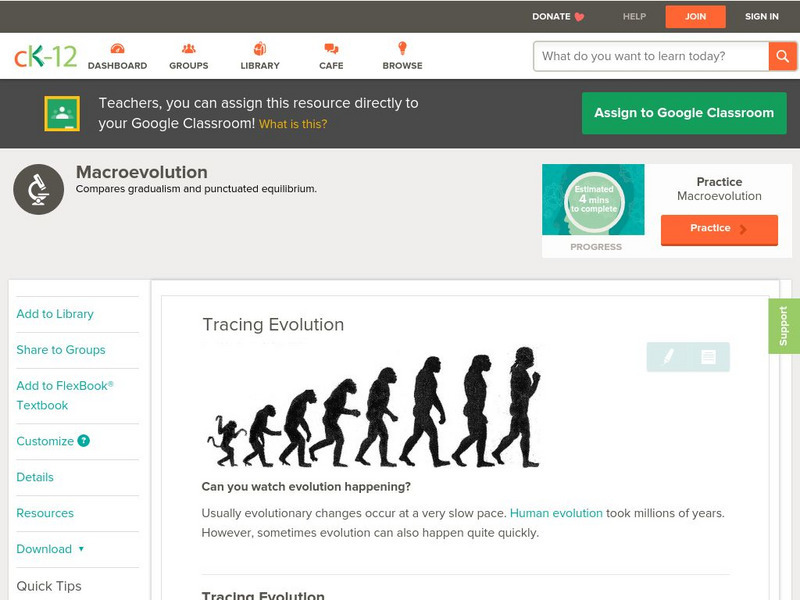
Ck 12: Life Science: Tracing Evolution
[Free Registration/Login may be required to access all resource tools.] How fast is evolution? Can you actually see evolution happening within your lifetime? Usually evolution takes a long time. So how can we visualize how it has...
Famous Scientists
Famous Scientists: Ernst Haeckel
Find out about Ernst Haeckel, a scientist known for his work with ecology, zoology, and the study of phylogeny.
Biology Corner
Biology Corner: Fossil Record
In this lesson, students use the fossil record to understand the topics of speciation, punctuated equilibrium, and gradualism. Students arrange fictitious animals' fossils by age based on appearance to create a fossil record.
McGraw Hill
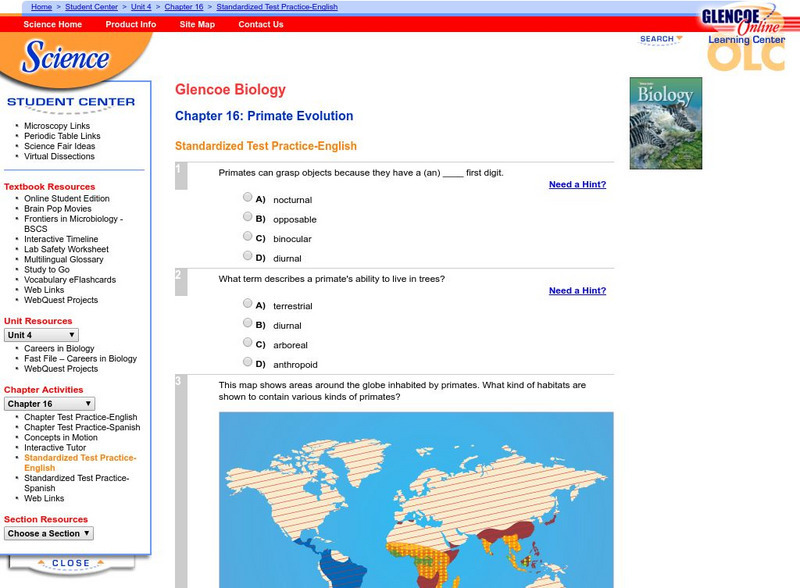
Glencoe Biology: Primate Evolution: Standardized Test Practice
Fifteen multiple choice questions over primate evolution. After the quiz, the self-checking feature allows students to see which were the correct answers.
Other
Evogeneao: Evolution: All in the Family
A website created to promote the teaching of evolution. The website features a Tree of Life that helps evolution be understood at a glance.
Annenberg Foundation
Annenberg Learner: Evolution of Tungara Frog Mating Calls
Use molecular information and observe female response patterns to learn about the mating calls of Physalaemus frogs. Examine the evolution of female preference for particular call characteristics.
Khan Academy
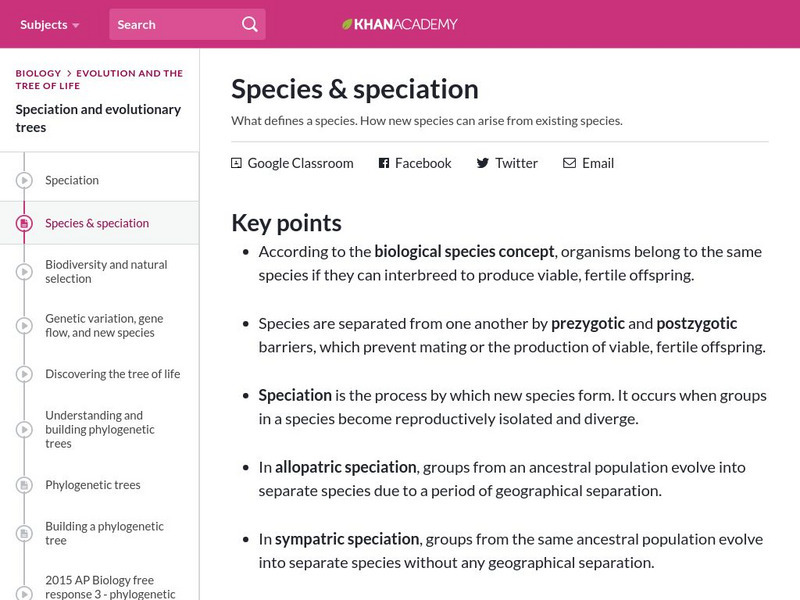
Khan Academy: Species & Speciation
Find out what defines a species, and learn how new species can arise from existing species.
University of California
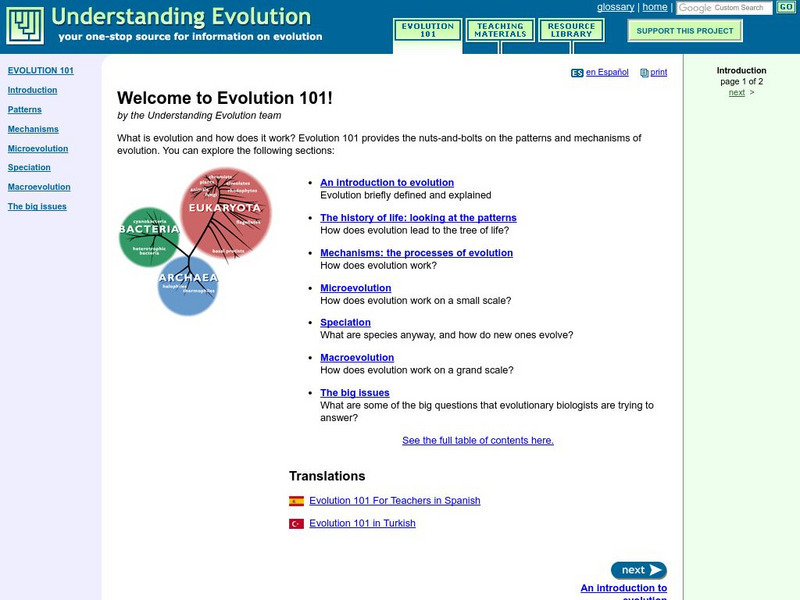
University of California Museum of Paleontology: Welcome to Evolution 101
What is evolution? This thorough site provides the basics of evolution focusing on the history of life, processes of evolution, microevolution, macroevolution, and more.
PBS
Pbs Online News Hour Extra: 200 Years Later, Darwin's Theories Still Inspire
Explore this concise article detailing Charles Darwin's Theory of Evolution and follow with discussion questions.

Other
Southwest Tennessee Community College: Classification of Organisms
College-level instructor's notes describing taxonomy. Explanations and images give a chronological history of the science of classifying organisms.

Khan Academy
Khan Academy: Answers to Exploration Questions: Evolution and Human Health
Get the answers to the exploration exercise about how evolution relates to human health.