Hi, what do you want to do?





ReadWriteThink
Read Write Think: Using Narrative for Expository Text
Lesson in which students read various narrative texts which provide a context for them to learn content-area topics. Narratives allow the students to begin to understand expository texts.
ReadWriteThink
Read Write Think: Get the Gist: A Summarizing Strategy for Any Content Area
A five-part standards-based lesson in which middle schoolers learn to write a 20 word summary of an informational text by focusing on answering the questions who, what, when, where, why, and how. This strategy can be applied to any...

PBS
Pbs Learning Media: How Disruptions Affect Animal Populations
Students explore the effects that ecosystem disruptions can have on animal populations. They learn about the disruptions that have driven three species-the Madagascar fish eagle, the Iberian lynx, and the rowi kiwi, to the brink of...
Better Lesson
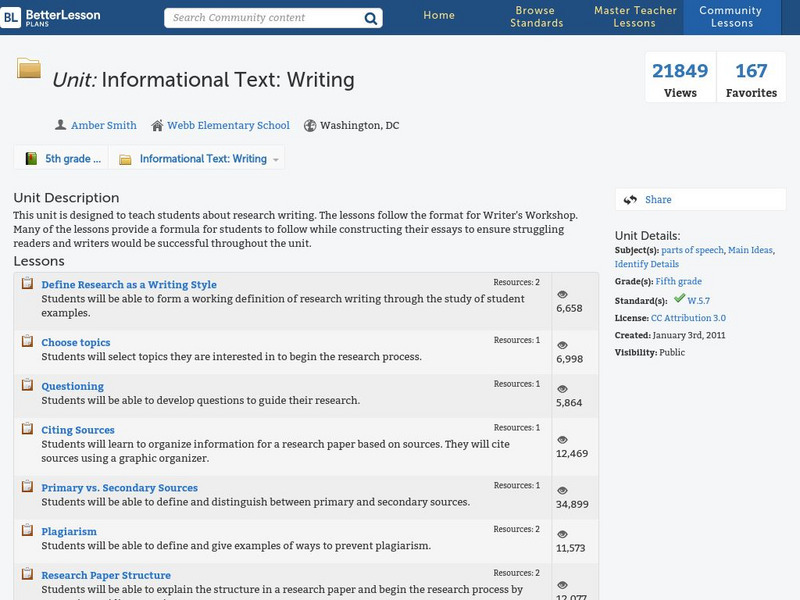
Better Lesson: Unit: Informational Text: Writing
This unit is designed to teach students about research writing. The lessons follow the format of Writer's Workshop. Many of the lessons provide a formula for students to follow while constructing their essays to ensure struggling readers...
Better Lesson
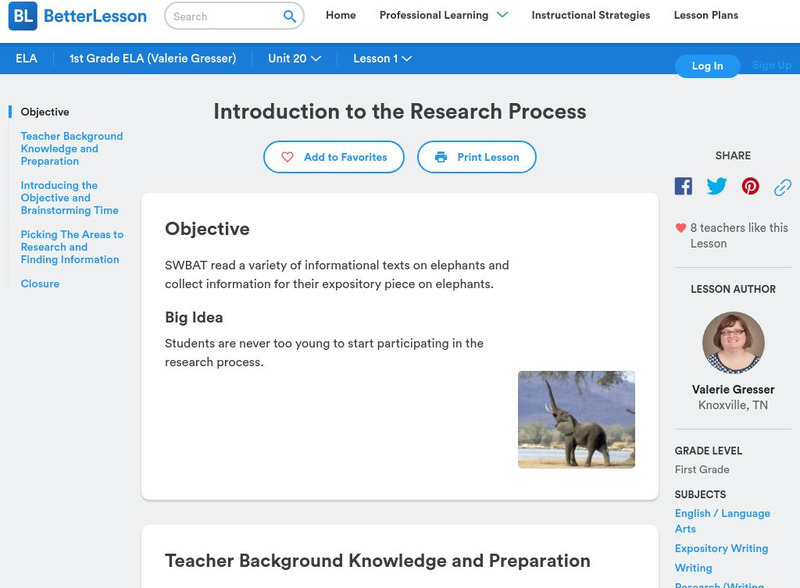
Better Lesson: Introduction to the Research Process
In this scaffolded lesson, 1st graders will independently gather information about elephants and then compile this information with their peers. This lesson is part of a unit that will culminate with an expository writing assignment.
Other popular searches
- Expository Text Structures
- Reading Expository Text
- Expository Texts Examples
- Expository Text Features
- Expository Text Lesson Plans
- Vocabulary, Expository Text
- Examples of Expository Texts
- Summarizing Expository Texts
- Identifying Expository Texts
- Vocabulary Expository Text
- Teaching Expository Texts