Hi, what do you want to do?






The Learning Depot
How to Write a Hook: 10 Ideas for Narrative, Expository, Persuasive/Argumentative Writing
A hook is a sentence or group of sentences that will capture or “hook” your reader’s interest and lure him or her to keep reading. The hook, also called the lead, will set the tone and mood for your essay and establish A hook can be a...
The Learning Depot
Structural Features of Text | Literary & Expository | Improve Your Reading Comprehension Skills
Recognizing text structure will help you be a better reader. Once you are familiar with the text's organizational pattern, you can make predictions as you read and form a mental map. In this lesson, we cover eight elements or structure...
The Learning Depot
Surface Level Features of Expository Text | Improve Your Reading Comprehension
Effective readers use the characteristics of text to their advantage. Whether consciously or subconsciously, knowing how to use these cues to your advantage will help you to strategically read and engage with text at a more effective...
Eric Buffington
Expository Essay
In this lesson I outline what an expository essay is, how to organize an expository essay and give some examples of when it would be good to use this writing type. This lesson was created for my friends at learning bird. Check out more...
Jeremy Thompson
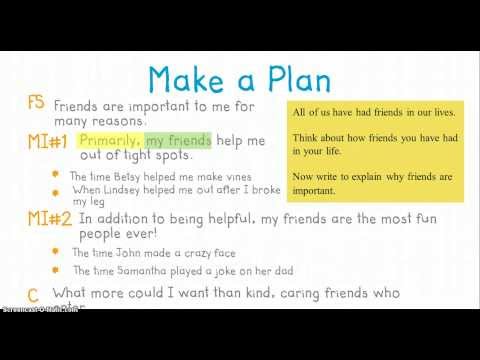
How to Plan & Write an Expository Essay
A 4th grade lesson on how to plan and write an expository essay to a prompt.

Imagine Learning Classroom
Learn Zillion: Writing a Thesis Statement Expressing the Main Idea
In this lesson, you will learn how to express the main idea by writing a thesis statement. [5:38]

Imagine Learning Classroom
Learn Zillion: Writing a Hook Sentence and Introducing a Thesis Statement
In this lesson, you will learn how to begin your response by first hooking the reader and then telling them what you will be arguing. [4:46]

Imagine Learning Classroom
Learn Zillion: Order the Information in Informational Writing
In this lesson, you will learn how to order the points of your essay by asking yourself, "What does my reader need to know first?" [5:07]

Imagine Learning Classroom
Learn Zillion: Write a Conclusion to an Informational Text by Recapping and Reflecting
In this lesson, you will learn how to write your conclusion by recapping and reflecting. [4:52]

Imagine Learning Classroom
Learn Zillion: Write a Research Thesis Statement
In this lesson, you will learn how to write a research thesis statement by restating your big research question in a complete sentence. [4:43]

Imagine Learning Classroom
Learn Zillion: Write the First Draft of an Informational Text
In this lesson, you will learn how to write the first draft of your essay by using the boxes and bullets outline as your guide. [4:52]

Imagine Learning Classroom
Learn Zillion: Choose a Research and Writing Topic by Asking Questions
In this lesson, you will learn how to choose a writing topic for an informational text by asking questions about your interests. [3:11]

Imagine Learning Classroom
Learn Zillion: Add Text Features to Informational Writing
In this lesson, you will learn how to support readers' understanding by adding textual features. [5:02]
Imagine Learning Classroom
Learn Zillion: Write Evidence to Support Your Answer in Your Own Words
In this lesson, you will learn how to support your answer by writing the evidence in your own words. [4:40]
Sophia Learning
Sophia: Writing Effective Introductions
A screencast lesson discussing and providing examples of three elements required for a strong introduction: an effective hook, a strong thesis, and appropriate background information. [5:39] CCSS.ELA-Literacy.WHST.6-8.2
Sophia Learning
Sophia: Informational Writing
This lesson introduces informational writing and discusses the goals of informational writing. [4:31] W.9-10.2 Informative. CCSS.ELA-Literacy.CCRA.W.2, W.11-12.2 Informative
Sophia Learning
Sophia: Body Paragraphs
This lesson introduces body paragraphs. [3:41] CCSS.ELA-Literacy.WHST.6-8.2.b
Sophia Learning
Sophia: Process Papers: Organization: Lesson 1
This lesson discusses structuring an outline for a process paper. It is 1 of 2 in the series titled "Process Papers: Organization."

Imagine Learning Classroom
Learn Zillion: Plan an Introductory Paragraph for an Informational Text
In this lesson, you will learn how to organize your introductory paragraph by using boxes and bullets. [4:28]

Imagine Learning Classroom
Learn Zillion: Organize an Informational Text
In this lesson, you will learn how to organize your research essay by using boxes and bullets.Slideshow includes a teaching rubric and tips for teachers. [4:58]
Sophia Learning
Sophia: Process Papers: Organization
This video lesson focuses on organizing a process paper including how to organize using chronological sequencing in a step-by-step fashion. It includes breaking down and evaluating it in either parts to a whole or whole to parts fashion.
Sophia Learning
Sophia: Writing Effective Introductions
This video tutorial lesson instructs how to write an effective introduction for an expository essay. The instructor explains her thinking as she provides four basic steps to immediately get the audience's attention in a piece of writing.

Imagine Learning Classroom
Learn Zillion: Video: Draft a Body Paragraph by Choosing Relevant Evidence
In this lesson, you will learn how to develop a body paragraph by choosing relevant and sufficient quotations and analysis. [7:33]

Imagine Learning Classroom
Learn Zillion: Begin Research by Listing What You Already Know
In this lesson, you will learn how to start research for writing an informational text by listing what you know and what you want to find out. [2:50]