Hi, what do you want to do?






Curated OER
Independent - To Be or Not Top Be - Day 2, Lesson C: Freedom of Speech
Fifth graders explore the following questions: What is it? What is it like? What is an example?

Curated OER
Scavenger Hunt
Students search for items in various parts of the newspaper noting the different types of information it provides.

Curated OER
Chameleons Are Cool!
Have your learners review what they know about camouflage using this lesson. Learners fill out a graphic organizer listing what they know or have questions about. This could be enhanced with the addition of a writing assignment in which...

Curated OER
Conditional Sentences "If" Clauses
In this conditional sentences worksheet, students learn how to write conditional sentences. They then use what they learned to write 4 conditional sentences.

Curated OER
Acting Out as we Go
Fourth graders use motor imaging to remember the definitions of words. In this vocabulary lesson, 4th graders work in groups to make a pantomime to help them remember a word. Students document the experience in their notebooks.

Curated OER
Worksheet for Analysis of a Newspaper Article
For this primary source analysis worksheet, students respond to 20 short answer questions that require them to analyze their selected newspaper articles.

Curated OER
Which Animals Should Be Saved?
Fifth graders investigate the concepts related to the endangerment of different animal species. They conduct research using a variety of resources. The skills of prediction are used to show the possible outcome of the extinction of a...

Curated OER
Creative Writing
Eleventh graders write a persuasive letter to the editor using the writing process.

Curated OER
African-American Heroes
Students explore websites about famous African-Americans. They work in pairs to decide on an African American who should be honored with a stamp. They write a letter recommending this person for a stamp including appropriate reason why...

E Reading Worksheets
E Reading Worksheets: Fact and Opinion Worksheets
Fact and opinion practice exercises, answer sheets, and explanation summaries are included on this tutorial site. Worksheets are tiered in levels of difficulty.
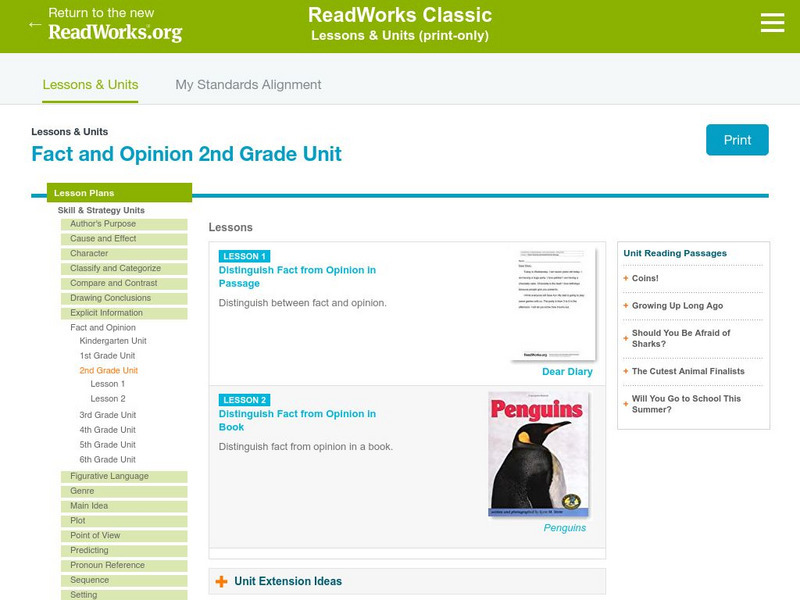
Read Works
Read Works: Grade 2: Two Lesson Unit: Fact and Opinion
[Free Registration/Login Required] Designed to teach students to identify fact and opinion in a text. Lessons are based on the text "Dear Diary" and the book Penguins by Lynn M. Stone. Includes ideas for direct teaching, guided practice,...
![Depaul University: Center for Urban Education: Classify Facts and Opinions [Pdf] Unit Plan](https://content.lessonplanet.com/knovation/original/119988-719af6c927af61affa025c27754c7fae.jpg?1661787067 "Depaul University: Center for Urban Education: Classify Facts and Opinions [Pdf] Unit Plan")
Polk Brothers Foundation Center for Urban Education at DePaul University
Depaul University: Center for Urban Education: Classify Facts and Opinions [Pdf]
Students will find three lessons about facts and opinions in this learning module. The following topics are linked in the module: contrast and evaluate fact and opinion; classify facts and opinions; and locate and classify facts.
E Reading Worksheets
E Reading Worksheets: Fact and Opinion: Reading Test 3
A 25-question quiz where students must identify statements as fact or opinion. Results can be printed, saved, or emailed.
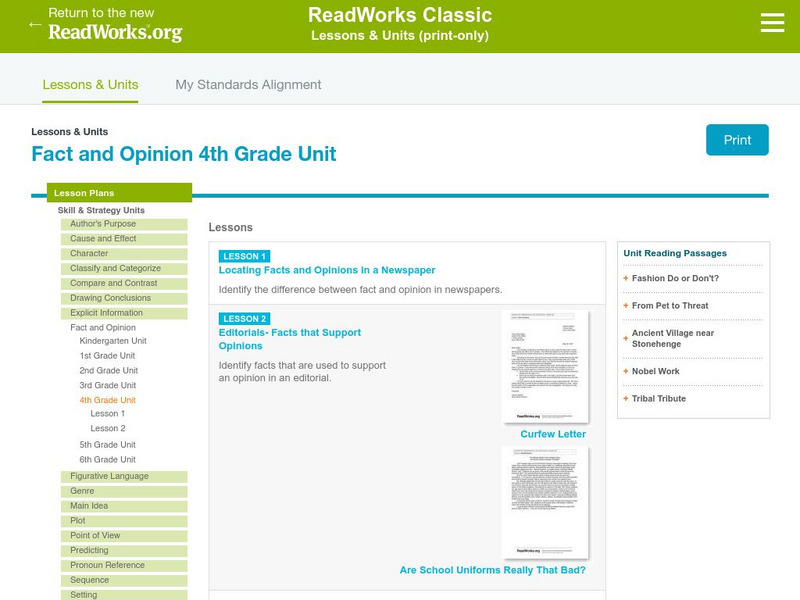
Read Works
Read Works: Fourth Grade: Two Lesson Unit: Fact and Opinion
[Free Registration/Login Required] A two-lesson unit on fact and opinion through which students identify facts and opinions in a newspaper article and understand how facts support opinions in an editorial. With free login, users have...
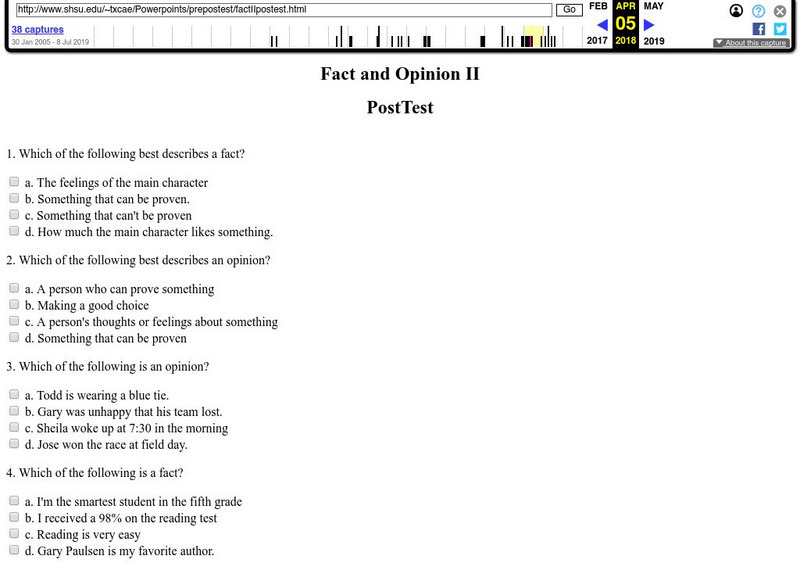
Sam Houston State University
Sam Houston State University: Fact and Opinion Ii Post Test
Students choose the fact and opinion statements in four multiple choice questions and then read two short texts and answer two multiple choice questions about facts and opinions presented in each. Answers are available when exercise is...

Read Works
Read Works: Fact and Opinion Kindergarten Unit: Fact
[Free Registration/Login Required] A lesson plan using Animal Touch by Kirsten Hall to teach students to find factual information inside informational texts. Includes ideas for teaching, guided practice, and independent practice....
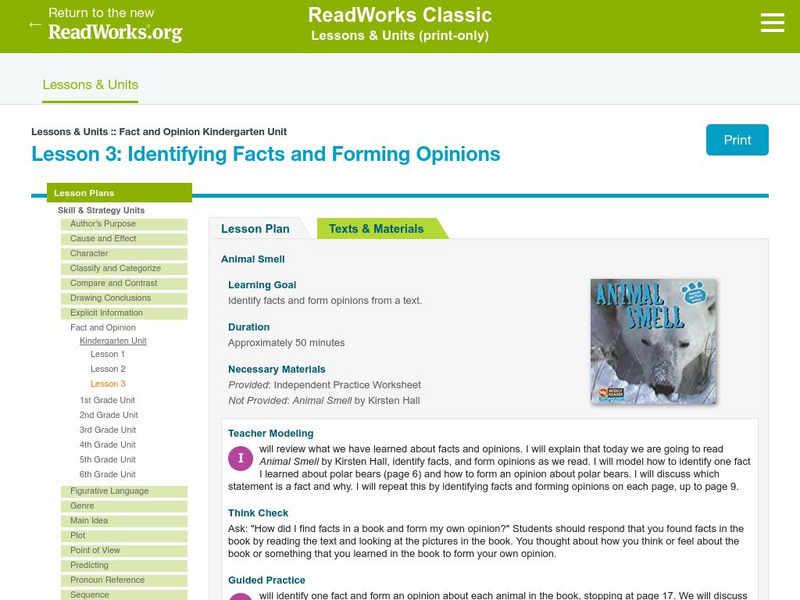
Read Works
Read Works: Lessons: Lesson 3: Identifying Facts and Forming Opinions
[Free Registration/Login Required] A lesson plan and materials to teach kindergarten students identify facts and form opinions using the book Animal Smell.
E Reading Worksheets
E Reading Worksheets: Fact and Opinion Lessons
In this learning module, students will learn more about the differences between facts and opinions. A PowerPoint presentation and related activity are provided to reinforce the topic of facts vs. opinions. This module is designed to...
Read Works
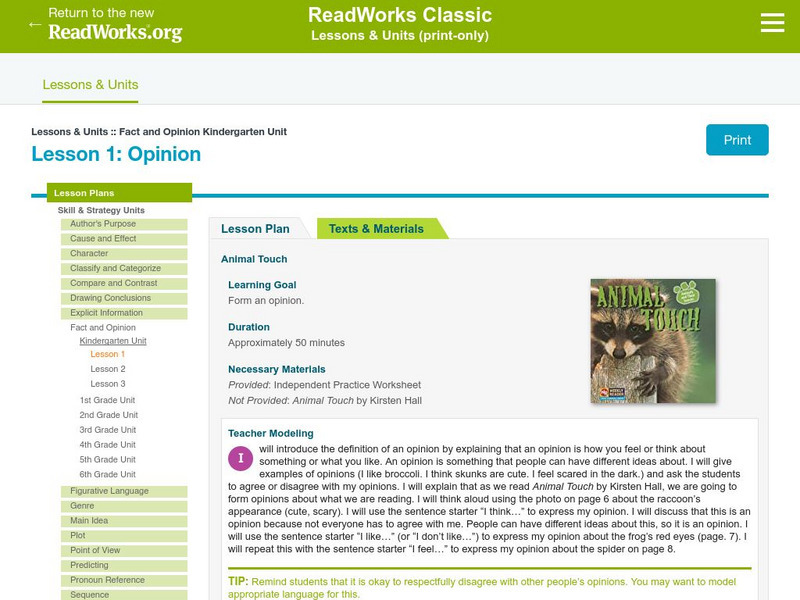
Read Works: Fact and Opinion Kindergarten Unit: Opinion
[Free Registration/Login Required] A lesson using Animal Touch by Kirsten Hall to teach students to form opinions based on information found within informational texts. Includes ideas for teaching, guided practice, and independent...
Read Works
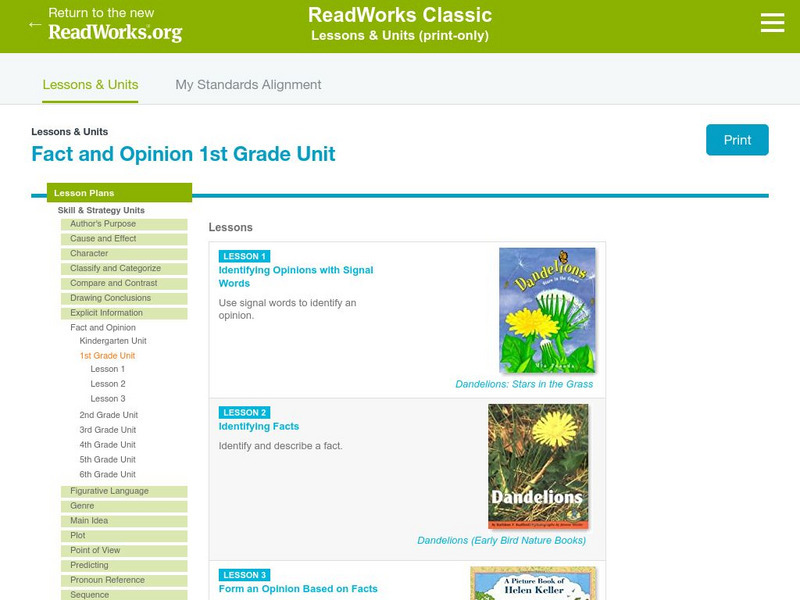
Read Works: Fact and Opinion 1st Grade Unit
[Free Registration/Login Required] A three-lesson unit on fact and opinion through which students learn how to identify opinions through signal words, identify facts in a non-fiction text, and use facts to help them formulate opinions of...
Read Works
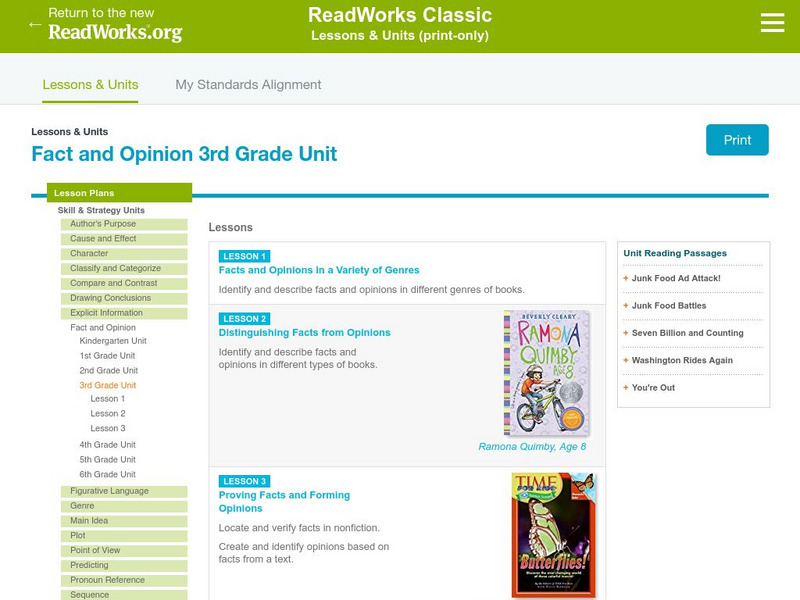
Read Works: Fact and Opinion 3rd Grade Unit
[Free Registration/Login Required] A three-lesson unit on fact and opinion through which students learn how to identify facts and opinions in different fiction genres. Students also use non-fiction texts to identify and verify facts and...
![Florida Center for Reading Research: Text Analysis: Matter of Fact or Opinion [Pdf] Lesson Plan](https://content.lessonplanet.com/knovation/original/509093-adc405a5910df5a982823c4579441be2.jpg?1661786984 "Florida Center for Reading Research: Text Analysis: Matter of Fact or Opinion [Pdf] Lesson Plan")
Florida Center for Reading Research
Florida Center for Reading Research: Text Analysis: Matter of Fact or Opinion [Pdf]
A lesson plan in which students work with a partner to write facts and opinions on different word cards. Materials are included.
![Florida Center for Reading Research: Text Analysis: Fact or Opinion Football [Pdf] Lesson Plan](https://content.lessonplanet.com/knovation/original/509104-a8eda078a78bb5576ea4d58dd580df72.jpg?1661786968 "Florida Center for Reading Research: Text Analysis: Fact or Opinion Football [Pdf] Lesson Plan")
Florida Center for Reading Research
Florida Center for Reading Research: Text Analysis: Fact or Opinion Football [Pdf]
A lesson plan in which students play a football card game by determining if sentences are facts or opinions. Materials are included.

Alabama Learning Exchange
Alex: Newspapers: Facts and Opinions
In order to sharpen a student's understanding of the differences between facts and opinions, this lesson plan incorporates both the close reading of a newspaper and the writing of a factual article and a letter to the editor.