Hi, what do you want to do?





Texas Education Agency
Texas Gateway: Kinematics: Falling Objects
By the end of this section, you will be able to describe the effects of gravity on objects in motion, describe the motion of objects that are in free fall, and calculate the position and velocity of objects in free fall.
OpenStax
Open Stax: Falling Objects
In the following interactive module, students will describe the effects of gravity on objects in motion. They will also describe the motion of objects that are in freefall and calculate the position and velocity of objects in freefall.
Science Education Resource Center at Carleton College
Serc: Projectile Motion and Gravity
In this lab, students will investigate how gravity affects an object that falls from a state of rest and how it affects an object that is projected outward from the same level at the same time. Students will observe the objects and...
CK-12 Foundation
Ck 12: Physical Science: Acceleration Due to Gravity
[Free Registration/Login may be required to access all resource tools.] Acceleration due to gravity and why falling objects with different masses accelerate at the same rate.

Physics Classroom
The Physics Classroom: 1 D Kinematics: How Fast? And How Far?
Students understand the physics of a free falling object through these illustrated example problems.

Discovery Education
Discovery Education: Physical Science: Gravity Gets You Down
In this lesson, students make predictions about falling objects of different sizes and masses to learn about gravity and air resistance. Includes audio vocabulary list and extension activities.

TeachEngineering
Teach Engineering: How Do Things Fall?
Students learn that it is incorrect to believe that heavier objects fall faster than lighter objects. By close observation of falling objects, they see that it is the amount of air resistance, not the weight of an object, which...
BBC
Bbc: Gcse Bitesize: Newton's Laws
This lesson focuses on Newton's Law for falling objects including terminal velocity, the three stages of falling, a diagram showing what happens to the speed of a skydiver from airplane to ground, velocity-time graphs for falling...
PBS
Pbs Learning Media: Galileo: His Experiments
This interactive activity from the NOVA Web site samples Galileo's experiments with falling objects, projectiles, inclined planes, and pendulums.
Physics Classroom
The Physics Classroom: 1 D Kinematics: Representing Free Fall by Graphs
In this physics tutorial, the motion of a free-falling motion will be represented using position versus time and velocity versus time graphs.
Utah Education Network
Uen: The Larger It Is the Harder It Falls
Understand the concept of force and the effect it has on the motion of objects.
TeachEngineering
Teach Engineering: Mechanics Mania
Through ten lessons and numerous activities, students explore the natural universal rules engineers and physicists use to understand how things move and stay still. Together, these rules are called "mechanics." The study of mechanics is...
Physics Classroom
The Physics Classroom: 1 D Kinematics: Acceleration of Gravity
The practice problems and illustrated examples in this tutorial help students understand the acceleration of gravity. The 'Value of g' widget the tutorial refers to can be found in the Interactives section (link is in side-bar) under...
TeachEngineering
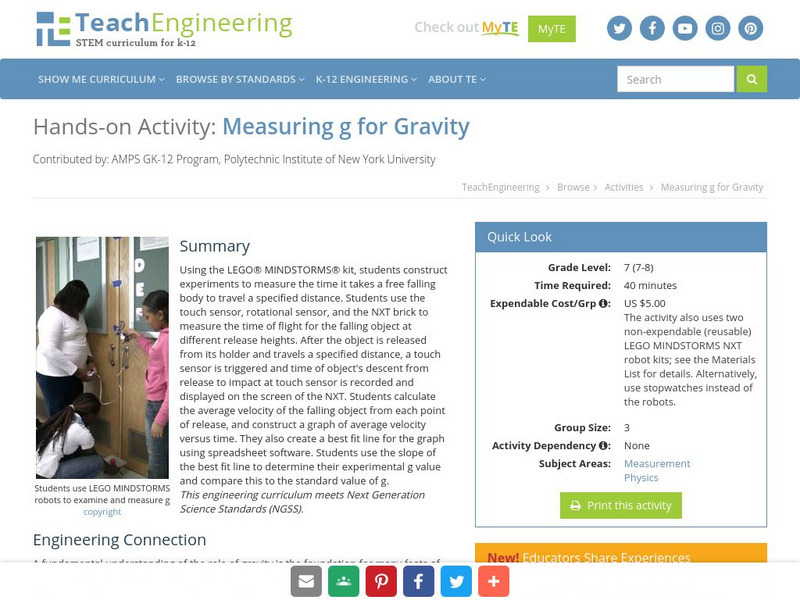
Teach Engineering: Measuring G
Using the LEGO MINDSTORMS NXT kit, students construct experiments to measure the time it takes a free falling body to travel a specified distance. Students use the touch sensor, rotational sensor, and the NXT brick to measure the time of...
TeachEngineering
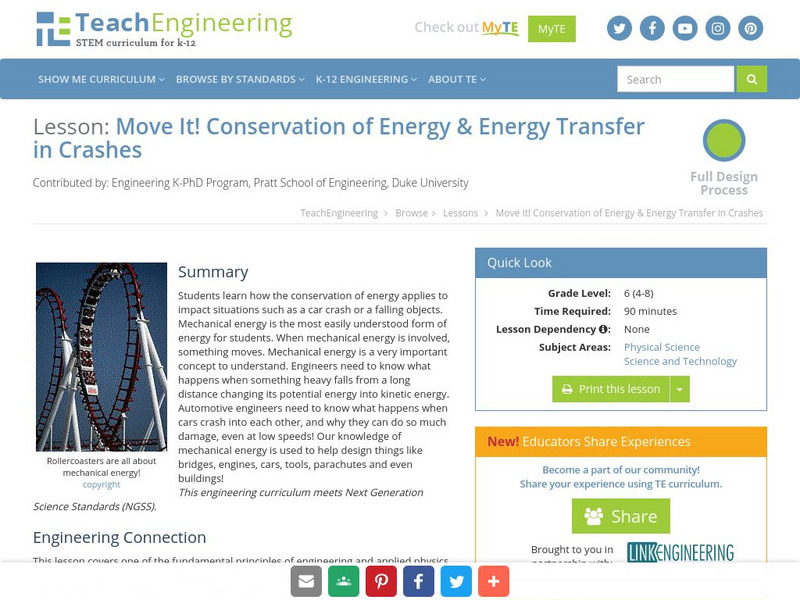
Teach Engineering: Move It!
Mechanical energy is the most easily understood form of energy for students. When there is mechanical energy involved, something moves. Mechanical energy is a very important concept to understand. Engineers need to know what happens when...
Physics Classroom
The Physics Classroom: Momentum and Collisions: Egg Drop Interactive
This egg-drop simulation allows students to explore the variables that result in a safe landing or a broken egg. The emphasis of the accompanying activity sheet is on the use of science reasoning skills to understand the physics behind...
Physics Classroom
The Physics Classroom: Elephant & Feather (Free Fall)
A demonstration involving an elephant and a feather and explanation of why all objects maintain the same acceleration in the state of free fall without any air resistance.
TeachEngineering
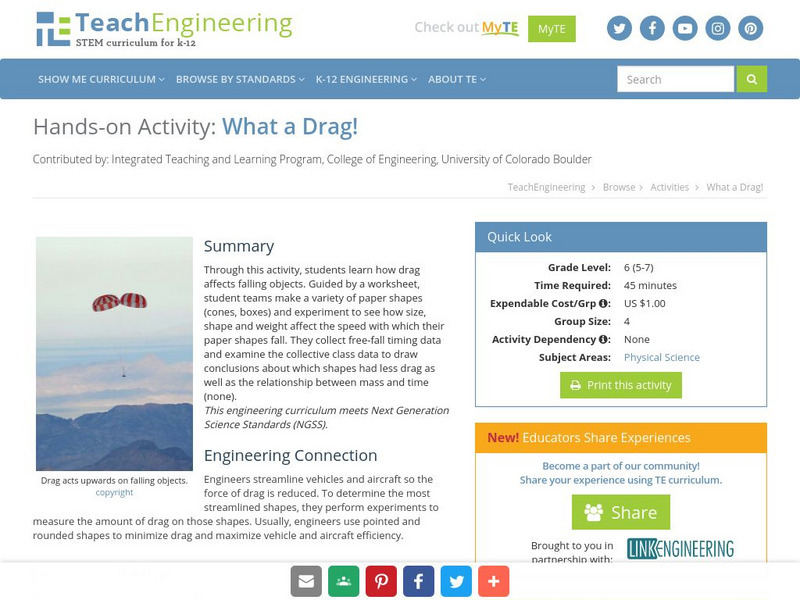
Teach Engineering: What a Drag!
The purpose of this activity is to demonstrate how drag affects falling objects. Students will make a variety of shapes out of paper and see how size and shape affects the speed with which their paper shapes fall. They will also be able...
Physics Aviary
Physics Aviary: Practice Problems: Dump Tower Level 1
Students must find the acceleration due to gravity on a planet and the impact speed of an object that has been falling from the top of a garish tower.
Physics Aviary
Physics Aviary: Practice Problems: Dump Tower Level 3
Students will be given information about a planet and they must calculate how long it takes an object to fall from the top of a garish tower.
Physics Aviary
Physics Aviary: Practice Problems: Dump Tower Level 2
Students must find the time it has been falling and the average speed it has been falling between to stories of a garish tower.
Physics Classroom
The Physics Classroom: 1 D Kinematics: The Big Misconception
An introduction to the ideas behind the misconception and misunderstanding of why all objects accelerate at the same rate. This explanation involves the concepts of force and mass.

NASA
Nasa: Beginner's Guide to Aerodynamics
Includes exhaustive information and a wealth of activities pertaining to aerodynamics and the physics of flight.
Department of Defense
Do Dea: Free Fall Constants for Earth
When you work with equations that show position, velocity, acceleration of objects that are flying or falling through the air, you will be using the constant that is the acceleration due to gravity. View formulas, explanations, and...