Hi, what do you want to do?





Other
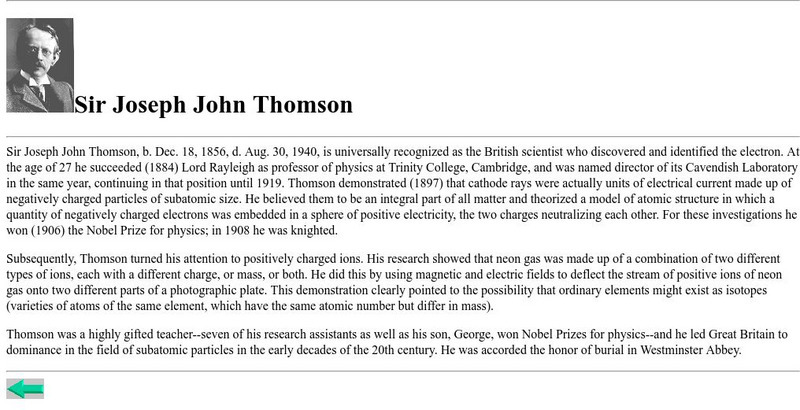
Sir Joseph John Thomson
Have you ever wondered who discovered the electron? The answer is Nobel Prize winning physicist Sir Joseph John Thomson.
TED Talks
Ted: Ted Ed: Einsteinium: Periodic Table of Videos
The team at Periodicvideos has created a TED-Ed Lesson for every element of the periodic table. Hear about einsteinium from a chemist who looks like the famous physicist. [1:52]

Nobel Media AB
The Nobel Prize: Eric A. Cornell Biographical
Contains an involved autobiography, focusing on Dr. Cornell's development as a scientist.
Nobel Media AB
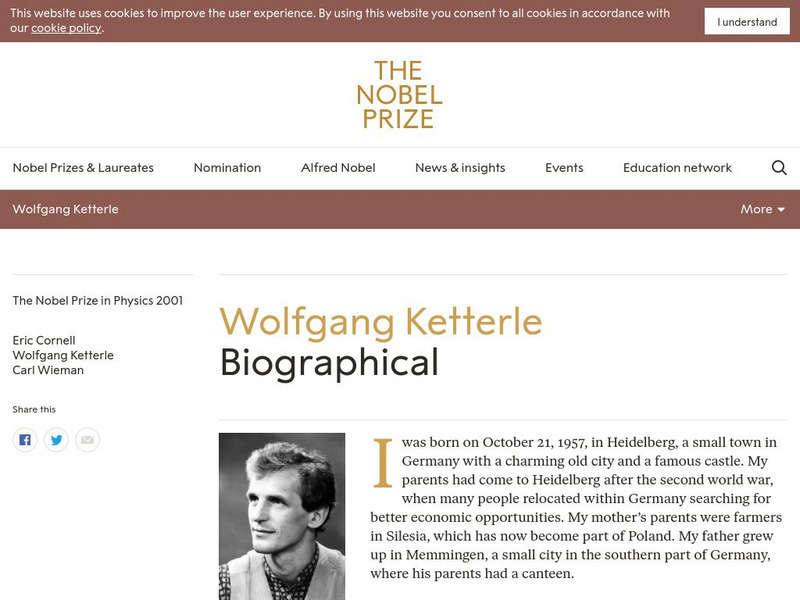
The Nobel Prize: Wolfgang Ketterle Biographical
Nobel e-Museum provides a site that contains a detailed autobiography of Wolfgang Ketterle, 2001 nobel laureate in physics.

Houghton Mifflin Harcourt
Harcourt: Biographies: Enrico Fermi
Read about the work of Italian physicist Enrico Fermi and learn how he showed the world the power of the atom.
Wikimedia
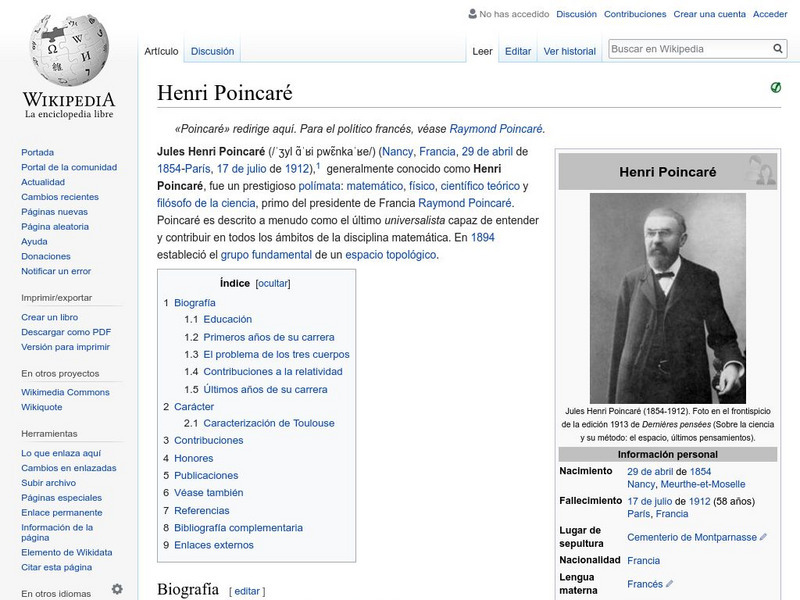
Wikipedia: Henri Poincare
Mathematics and Science often go together in physics and other studies. This site explores a physicist who utilized both fields to advance the ideas of relativity and other concepts.
TED Talks
Ted: Ted Ed: Schrodinger's Cat: A Thought Experiment in Quantum Mechanics
Austrian physicist Erwin Schrodinger, one of the founders of quantum mechanics, posed this famous question: If you put a cat in a sealed box with a device that has a 50% chance of killing the cat in the next hour, what will be the state...
National High Magnetic Field Laboratory
Magnet Academy: Paul Lauterbur
Chemist Paul Lauterbur pioneered the use of nuclear magnetic resonance (NMR) for medical imaging. He developed a technique, now known as magnetic resonance imaging (MRI), in the early 1970s that involves the introduction of gradients in...
Florida State University
Florida State University: Science, Optics & You: E Tienne Louis Malus
Biography of Etienne-Louis Malus (1775-1812), a famous French mathematician and physicist, best known for his work in double refraction and in polarization.
Florida State University
Florida State University: Science, Optics & You: Nicolaus Copernicus
Biography of Nicolaus Copernicus (1473-1543), the scientist who first put forward the theory that the Sun was the center of the universe.
National High Magnetic Field Laboratory
Magnet Academy: Gerd Binnig
Gerd Binnig co-developed the scanning tunneling microscope (STM) with Heinrich Rohrer. The STM allowed scientists entry into the atomic world in a new way and was a major advance in the field of nanotechnology. For their achievement,...
National High Magnetic Field Laboratory
Magnet Academy: Georg Bednorz
J. Georg Bednorz jointly revolutionized superconductivity research with K. Alex Muller by discovering an entirely new class of superconductors, often referred to as high-temperature superconductors. They managed to achieve...
National High Magnetic Field Laboratory
Magnet Academy: Joseph Henry
Joseph Henry was an American scientist who pioneered the construction of strong, practical electromagnets and built one of the first electromagnetic motors. During his experiments with electromagnetism, Henry discovered the property of...
National High Magnetic Field Laboratory
Magnet Academy: Karl Jansky
Karl Jansky discovered extraterrestrial radio waves while investigating possible sources of interference in shortwave radio communications across the Atlantic for Bell Laboratories, and is often known as the father of radio astronomy....
National High Magnetic Field Laboratory
Magnet Academy: Hans Christian Orsted
A discovery by Hans Christian Orsted forever changed the way scientists think about electricity and magnetism. While preparing to perform an experiment during a lecture at the University of Copenhagen, he found that the magnetized needle...
National High Magnetic Field Laboratory
Magnet Academy: Max Planck
In a career that lasted seven decades, Max Planck achieved an enduring legacy with groundbreaking discoveries involving the relationship between heat and energy, but he is most remembered as the founder of the "quantum theory."

Other
Finding Dulcinea: Marie Curie
Article on Marie Curie, who won two Nobel Prizes in Physics and Chemistry for her discoveries in radioactivity and radioactive elements.
Science Museum, London
Science Museum: Online Stuff: Marie Curie and the History of Radioactivity
Read about Nobel Prize winner, Marie Curie's life, and her historical work with radioactivity.
National High Magnetic Field Laboratory
Magnet Academy: Timeline of Electricity and Magnetism: 1880 1889
Nikola Tesla and Thomas Edison duke it out over the best way to transmit electricity and Heinrich Hertz is the first person (unbeknownst to him) to broadcast and receive radio waves.
National High Magnetic Field Laboratory
Magnet Academy: Timeline of Electricity and Magnetism: 1870 1879
The telephone and first practical incandescent light bulb are invented while the word "electron" enters the scientific lexicon.
National High Magnetic Field Laboratory
Magnet Academy: Timeline of Electricity and Magnetism: 1850 1869
The Industrial Revolution is in full force, Gramme invents his dynamo and James Clerk Maxwell formulates his series of equations on electrodynamics.
National High Magnetic Field Laboratory
Magnet Academy: Timeline of Electricity and Magnetism: 1840 1849
The legendary Faraday forges on with his prolific research and the telegraph reaches a milestone when a message is sent between Washington, DC, and Baltimore, MD.
National High Magnetic Field Laboratory
Magnet Academy: Timeline of Electricity and Magnetism: 1830 1839
The first telegraphs are constructed and Michael Faraday produces much of his brilliant and enduring research into electricity and magnetism, inventing the first primitive transformer and generator.
National High Magnetic Field Laboratory
Magnet Academy: Timeline of Electricity and Magnetism: 1820 1829
Hans Christian Orsted's accidental discovery that an electrical current moves a compass needle rocks the scientific world; a spate of experiments follows, immediately leading to the first electromagnet and electric motor.