Hi, what do you want to do?






Curated OER
I Can Use a Worm to Count
Kindergarteners use worms, puppets or other props to practice counting to 100. First, they listen to a read aloud of Count Worms by Roger Hargeaves. A worm pattern is used to count to 100, with each segment of the worm...

Curated OER
Wonderful Worms
Students identify living and non-living things and explain the importance of earthworms to the soil. They name some basic facts about earthworms, recognize basic worm vocabulary words and demonstrate vermicomposting techniques.

Curated OER
Meeting an Earthworm
Students inspect the anatomy of earthworms. In this earthworm lesson plan, students participate in a hands-on experiment as they analyze the structure of earthworms. Students demonstrate mastery through differentiated products. Lesson...

Curated OER
Observation of a Living Earthworm
Sixth graders examine earthworms and their parts. In this earthworm lesson students complete a lab worksheet on the earthworm and test its response to certain factors.

CK-12 Foundation
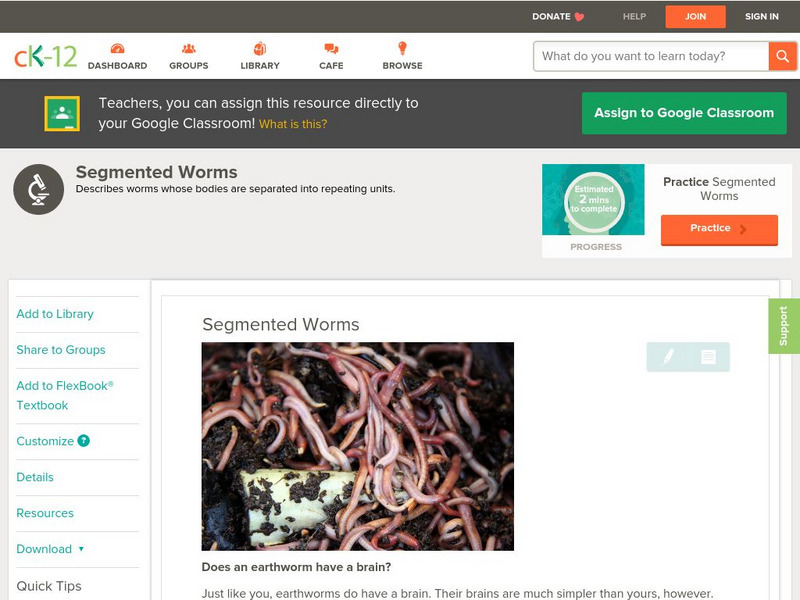
Ck 12: Life Science: 9.5 Segmented Worms
Learn about the physical features of segmented worms.
CK-12 Foundation
Ck 12: Life Science: Segmented Worms
[Free Registration/Login may be required to access all resource tools.] When you think of worms, you probably picture earthworms. There are actually many types of worms, including flatworms, roundworms, and segmented worms. Earthworms...
CK-12 Foundation
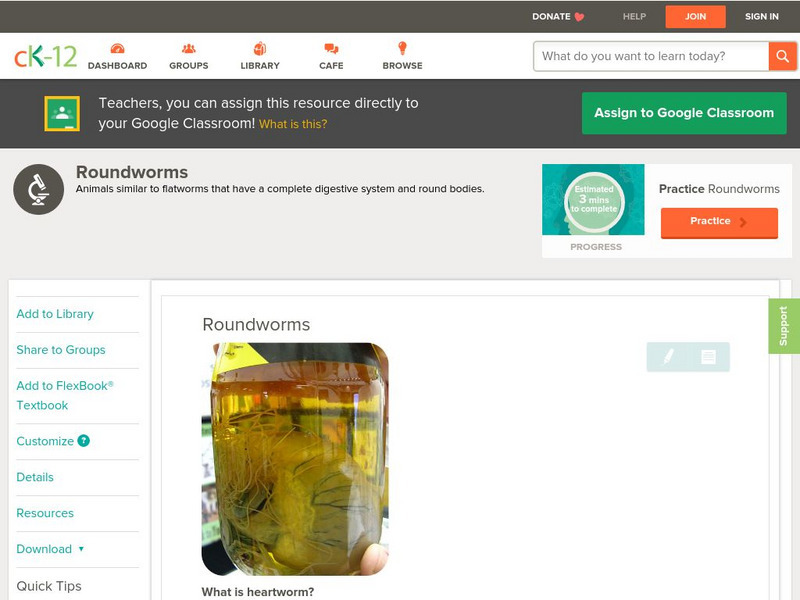
Ck 12: Life Science: Roundworms
[Free Registration/Login may be required to access all resource tools.] The word "worm" is not very scientific. This informal term describes animals that have long bodies with no arms or legs. Worms with round, non-segmented bodies are...

ClassFlow
Class Flow: Classifying Invertebrates
[Free Registration/Login Required] This is a lesson on classifying invertebrates based on their observable features. It focuses on the three types of worms: flatworm, roundworm, and segmented worm. The lesson contains 3 videos as well as...