Hi, what do you want to do?





Other
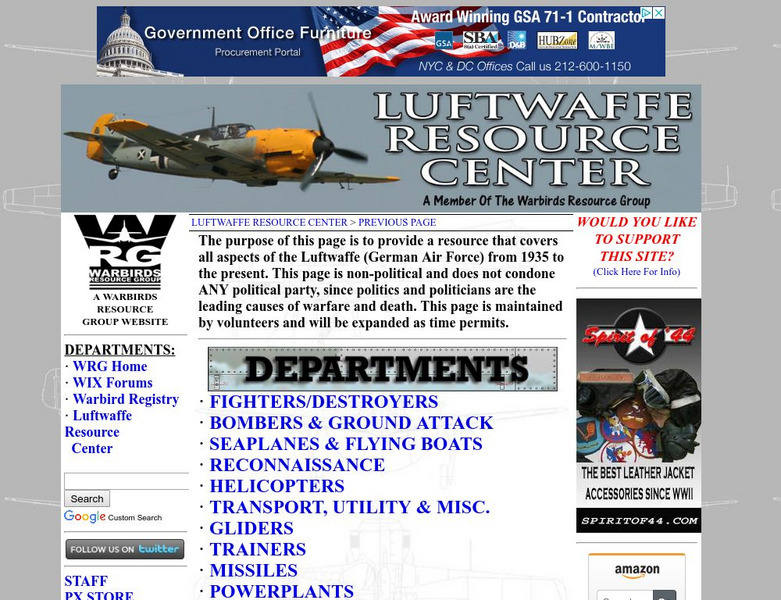
Warbirds Resource Group: Luftwaffe Resource Center
This comprehensive site catalogs the planes of the Luftwaffe from 1935 on, and provides detailed specifications on armaments, missiles, bombs and other accessories to air warfare. It does not present a history of their use, but rather a...
Read Works
Read Works: Unearthing Pterosaurs
[Free Registration/Login Required] This passage from the American Museum of Natural History is about the discovery and study of bones from Pterosaurs, extinct flying reptiles that are not exactly dinosaurs or birds. A question set, a...
National Humanities Center
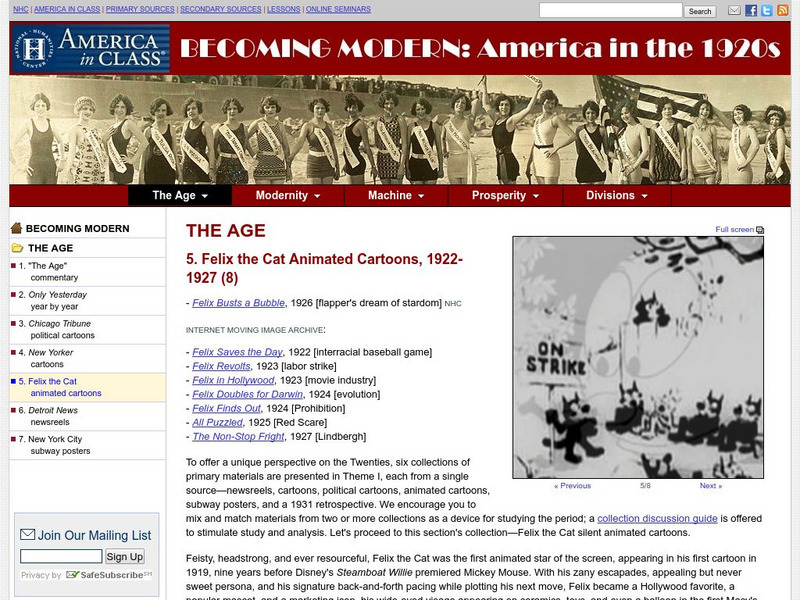
National Humanities Center: America in Class: America in the 1920s: Felix the Cat
The National Humanities Center presents collections of primary resources compatible with the Common Core State Standards - historical documents, literary texts, and works of art - thematically organized with notes and discussion...
Other
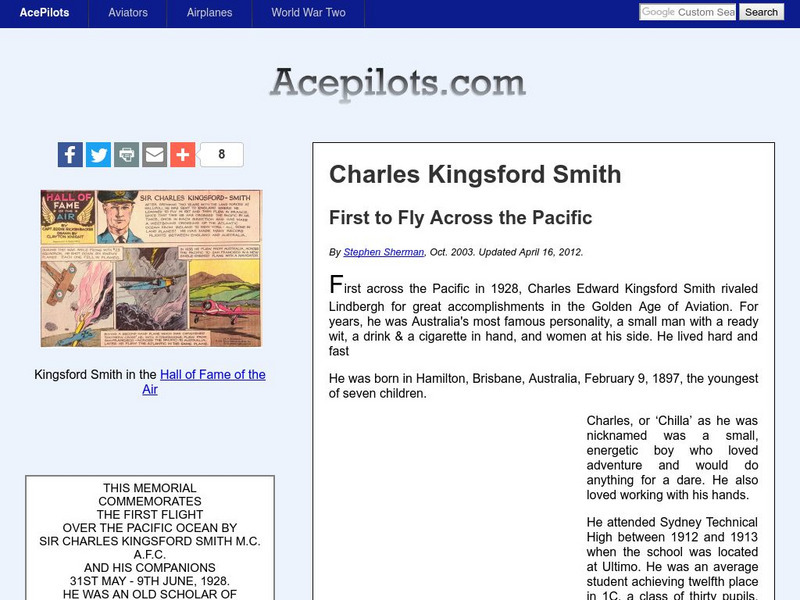
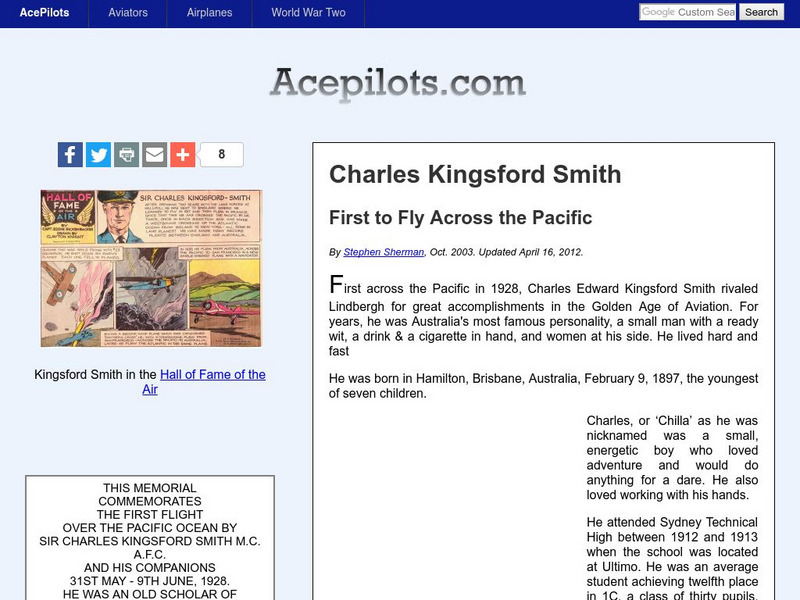
Charles Kingsford Smith: First Across the Pacific
A biographical profile of Charles Kingsford Smith, the aviator who made the first trans-Pacific flight in 1928.
Other
Charles Kingsford Smith: First Across the Pacific
This resource presents a biographical profile of Charles Kingsford Smith, the aviator who made the first trans-Pacific flight in 1928.
University of Houston
University of Houston: Engines of Our Ingenuity: No. 1342: Wright and Langley
Read about the controversy that emerged over the authenticity of Samuel Pierpoint Langley's flying machine, and the response of the Wright Brothers to attempts to usurp their place in history. This is a transcript of a radio broadcast.
Smithsonian Institution
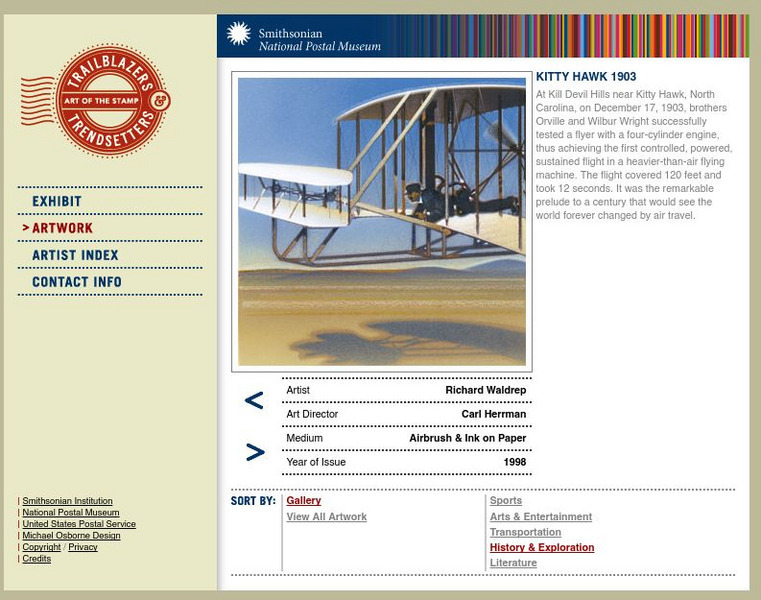
National Postal Museum: Art of the Stamp: Kitty Hawk (1903)
View the artwork for a U.S. postage stamp issued in 1998 to commemorate the Wright Brothers first flight near Kitty Hawk, North Carolina. Includes a detailed paragraph about the famous flight.

Royal British Colombia Museum (Canada)
First in the Air in British Columbia
The Royal British Columbia Museum traces the achievements of BC's first men to travel into the colony's atmosphere in the air. The site discusses the hot air balloon flight of Professor Leclaire in 1880 and the flight of Charles K....
Purdue University
George Palmer Putnam Collection of Amelia Earhart Papers
The world's largest collection of Amelia Earhart papers, memorabilia and artifacts.

Smithsonian Institution
National Air and Space Museum: America by Air:the Jet Age, 1958 Today
Learn about the changes that have occurred in commercial jet travel since 1958, when jet passenger service began in the United States.
NASA
Nasa, Human Space Flight: Apollo 11 Mission
The story of the Apollo 11 lunar landing is told with dramatic details, pictures, and mission highlights.
NASA
Kennedy Space Center: The Flights: Skylab
Here you can find information about each of the four Skylab missions from 1973-74.
Other
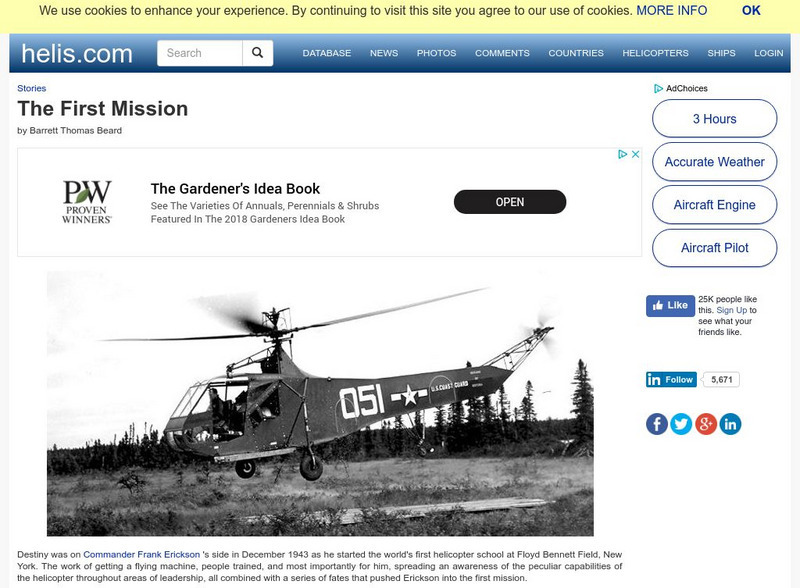
Helis.com: The First Mission
This helicopter history page provides the fascinating story of Commander Frank Erickson and the world's first helicopter school.
Other
Plane Writing
This resource contains quotations and information about aviation throughout history.
Other
Airship and Blimp Resources: History of Hot Air Airships
Describes the invention of the hot air airship by Don Cameron in the 1970s, and the evolution of its design and production over the years.

The Henry Ford
Henry Ford Museum & Greenfield Village: Wright Brothers
Brief history of the lives and accomplishments of Wilbur and Orville Wright. Includes a chronology of major events from Wilbur's birth in 1867 to Orville's death in 1948.
National Academy of Engineering
Greatest Achievements: Airplane
This page provides an overview of the history behind one of the greatest engineering innovations of all time:the airplane. There is also a timeline showing its development.
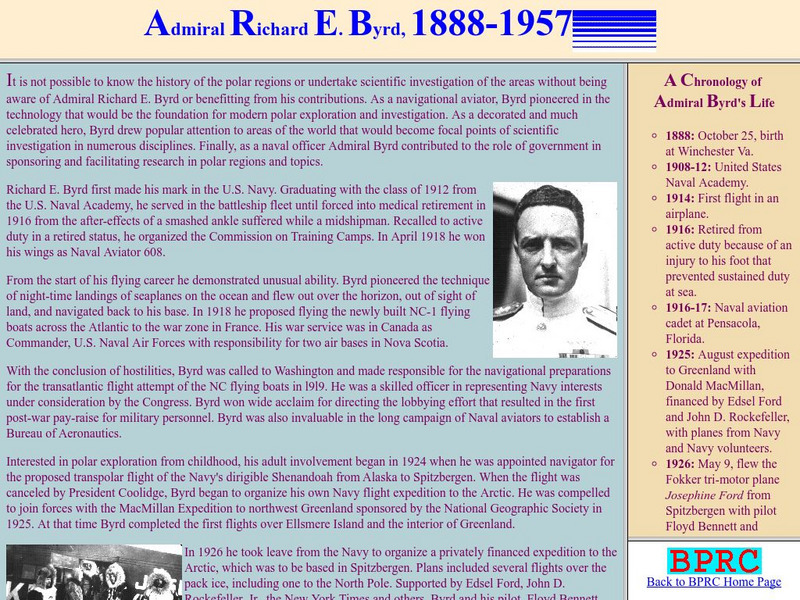
Ohio State University
Ohio State University: Admiral Richard E. Byrd
This concise site contains a brief history of Byrd's life along with an easy to read chronology of major events in his life.
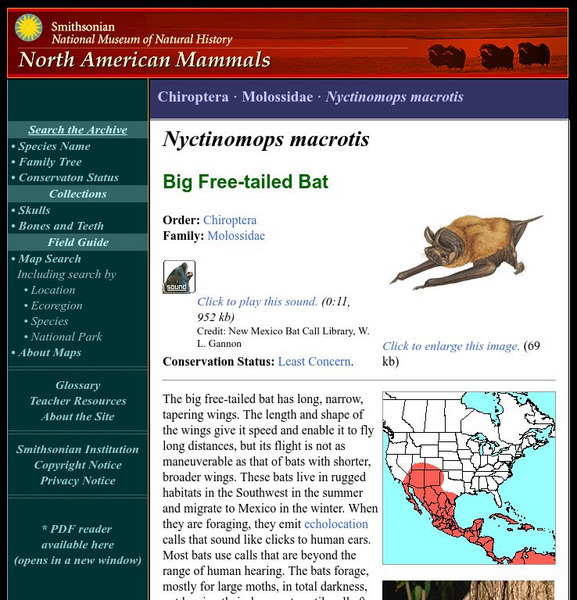
Smithsonian Institution
National Museum of Natural History: American Mammals: Big Free Tailed Bat
The big free-tailed bat has long, narrow, tapering wings. The length and shape of the wings give it speed and enable it to fly long distances, but its flight is not as maneuverable as that of bats with shorter, broader wings. Learn more...
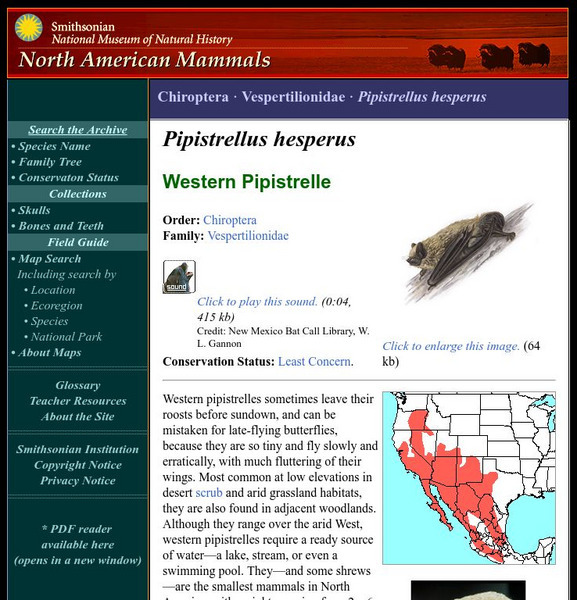
Smithsonian Institution
National Museum of Natural History: American Mammals: Western Pipistrelle
Western pipistrelles sometimes leave their roosts before sundown and can be mistaken for late-flying butterflies, because they are so tiny and fly slowly and erratically, with much fluttering of their wings. Most common at low elevations...
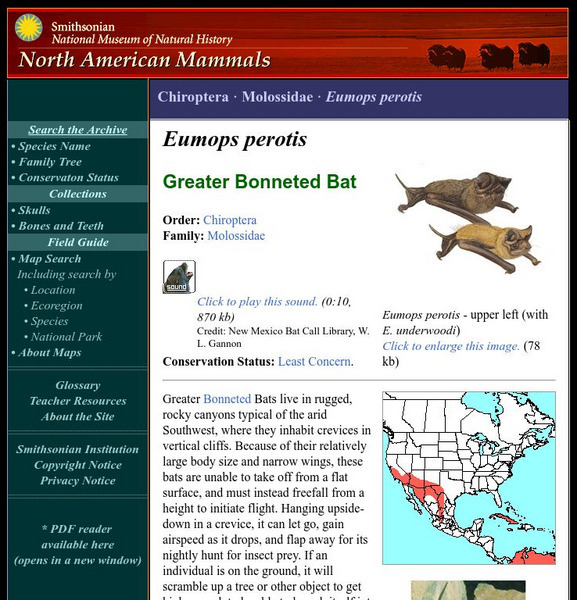
Smithsonian Institution
National Museum of Natural History: American Mammals: Greater Bonneted Bat
Greater Bonneted Bats live in rugged, rocky canyons typical of the arid Southwest, where they inhabit crevices in vertical cliffs. Because of their relatively large body size and narrow wings, these bats are unable to take off from a...

The Henry Ford
Henry Ford Museum & Greenfield Village: Wright Brothers
Biographical information on the Wright Brothers, including their childhoods, the Wright Cycle Shop, the world's first airplane, a chronology, and links to more information.
University of Houston
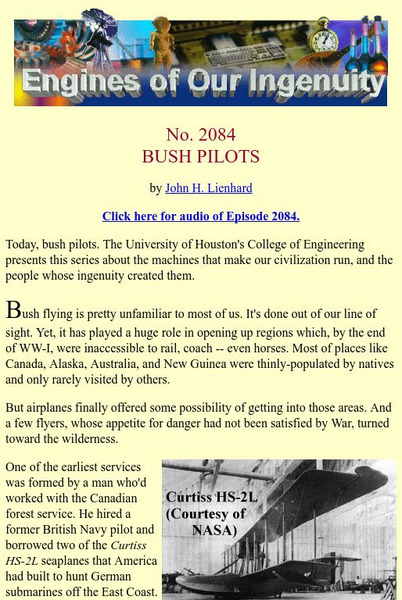
University of Houston: Engines of Our Ingenuity: No. 2084: Bush Pilots
A commentary on bush pilots and the development of flying to remote areas. The 3-minute discussion focuses on the history of the development of bush flying and how flight made accessing remote areas of a country possible. This is a...
Science Struck
Science Struck: Events That Led to the Invention of the Airplane
Discover the history of the first airplanes and flying machines, and how the Wright brothers constructed their first successful airplane.
Other popular searches
- History of Flight
- Space Flight History
- History of Space Flight
- The History of Flight
- The History of Flight Kwl