Hi, what do you want to do?





FT Exploring
Ft Exploring: The Flow of Energy Through Plants and Animals
Explore the different ecological roles of organisms in the ecosystem, and find out how the energy flows through them.
CK-12 Foundation
Ck 12: Earth Science: Flow of Energy in Ecosystems
[Free Registration/Login may be required to access all resource tools.] Describes how energy is transferred from one organism to another.

SMART Technologies
Smart: Energy Flow in an Ecosystem
Students learn about Abiotic and Biotic Factors and how they affect the ecosystem in which an animal might live in.

Open Curriculum
Open Curriculum: Flow of Energy in Ecosystems
Students will understand and describe food chains and food webs, and explain how energy is transferred between their trophic levels.

ClassFlow
Class Flow: What Animals Eat
[Free Registration/Login Required] To show the dependence of animals on the plant world, these flipchart pages contain examples of food chains and food webs, as well as other information about animals and habitats.
Science Education Resource Center at Carleton College
Serc: Creepy Critters
Students learn about aquatic life and the importance of a balanced aquatic habitat by collecting micro- and macro-organisms. By the end of the lesson, they will be able to identify and develop a pond food web.
Sophia Learning
Sophia: Producers and Consumers: Lesson 3
This lesson will review the difference between producers and consumers, and show how both play important roles in a food web. It is 3 of 4 in the series titled "Producers and Consumers."

Sophia Learning
Sophia: Producers and Consumers: Lesson 4
This lesson will review the difference between producers and consumers, and show how both play important roles in a food web. It is 4 of 4 in the series titled "Producers and Consumers."
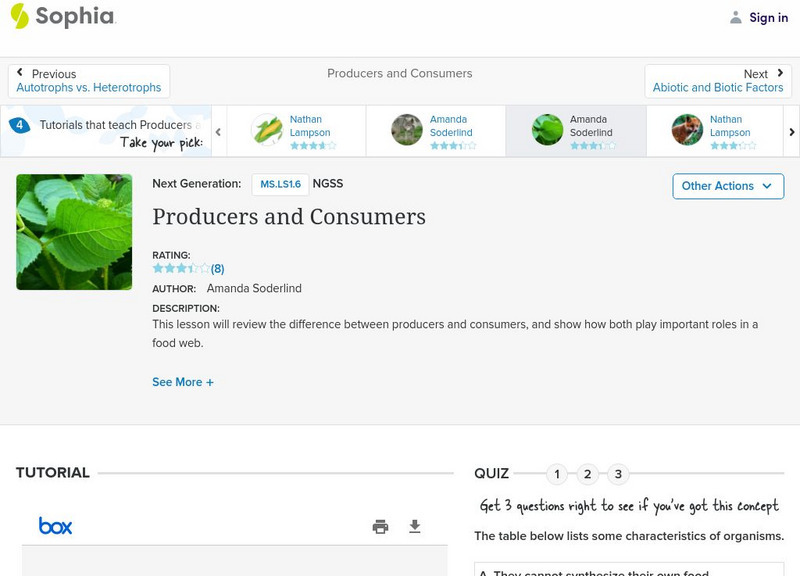
Sophia Learning
Sophia: Producers and Consumers: Lesson 2
This lesson will review the difference between producers and consumers, and show how both play important roles in a food web. It is 2 of 4 in the series titled "Producers and Consumers."
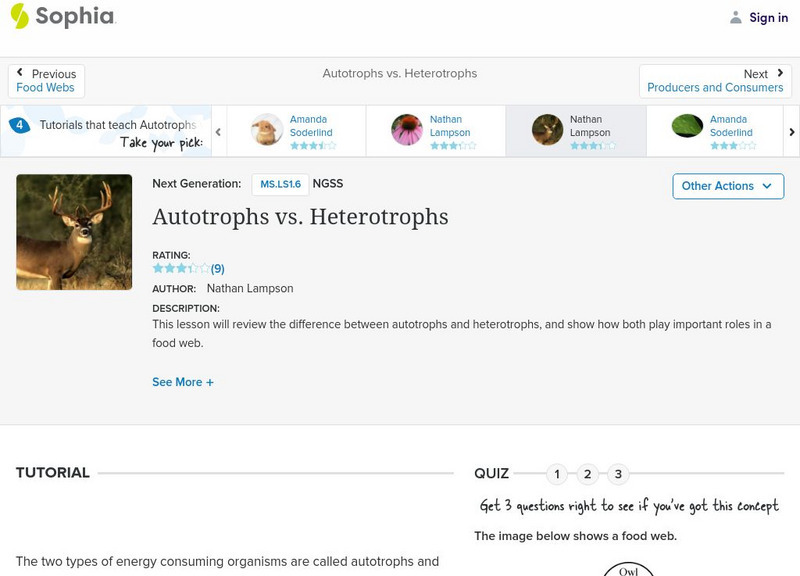
Sophia Learning
Sophia: Autotrophs vs. Heterotrophs: Lesson 3
This lesson will review the difference between autotrophs and heterotrophs, and show how both play important roles in a food web. It is 3 of 4 in the series titled "Autotrophs vs. Heterotrophs."
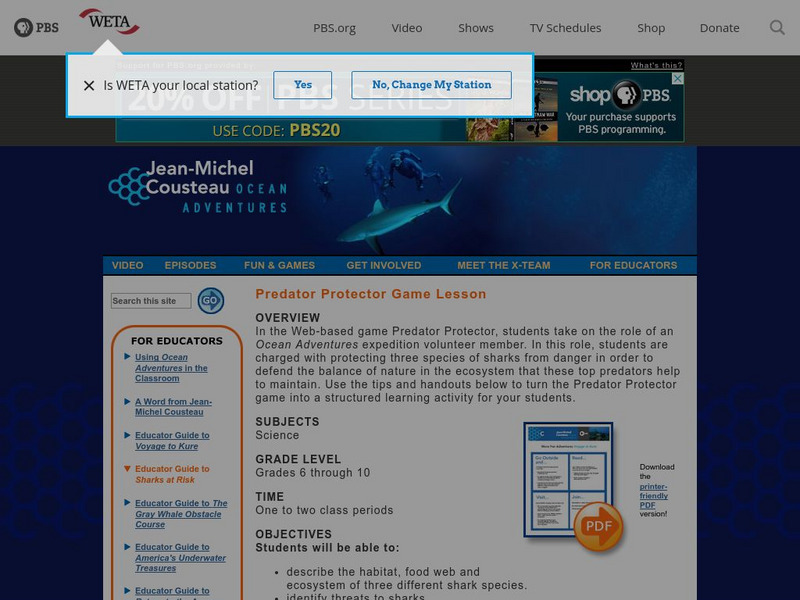
PBS
Pbs Teachers: Predator Protector Game Lesson
Describe the habitat, food web and ecosystem of shark species. Identify threats to sharks and explore how top predators help to maintain the balance of nature within ecosystems. This lesson plan also contains an interactive game.
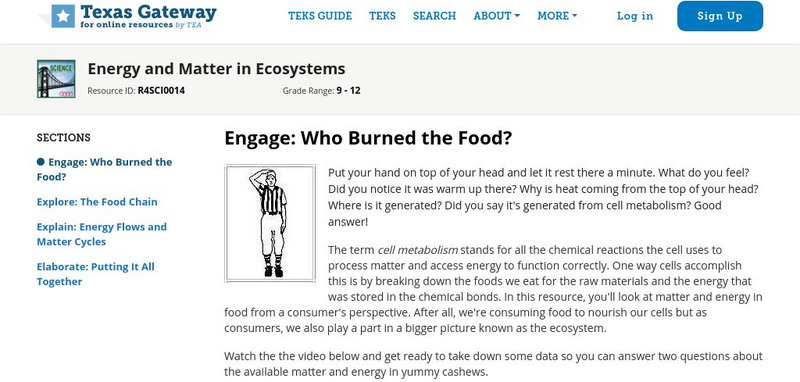
Texas Education Agency
Texas Gateway: Energy and Matter in Ecosystems
Learners analyze food chains, webs, and pyramids to determine how energy flows and matter cycles through ecosystems.
Other
Marietta College: Biology: Energy Flow Through the Ecosystem
Read to understand how energy and inorganic nutrients flow through a food chain in an ecosystem.
Science Struck
Science Struck: Examples of Tertiary Consumers
Explains what is meant by a tertiary consumer in a food chain and provides examples.
ArtsNow
Arts Now Learning: Ecosystems in Action [Pdf]
In this lesson, 4th graders explore animals and plants that inhabit ecosystems by using movement to deepen the retention of vocabulary. After reviewing the ecosystem players, students will play a call and response game by responding with...
CK-12 Foundation
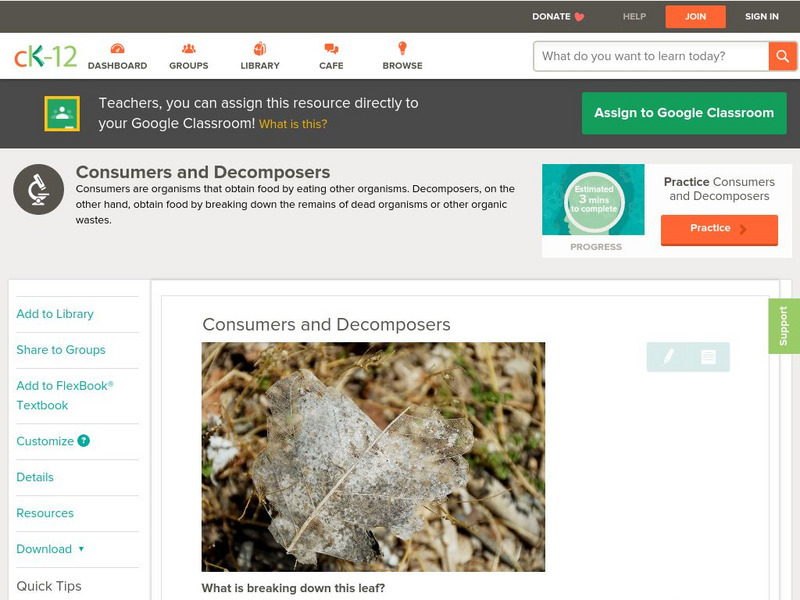
Ck 12: Life Science: Consumers and Decomposers
[Free Registration/Login may be required to access all resource tools.] Producers make their own food through photosynthesis. But many organisms are not producers and cannot make their own food, but must get their energy from other...
ArtsNow
Arts Now Learning: Using Tableau and Role Drama to Examine the Ecosystem [Pdf]
In this lesson plan, 4th graders use tableaux to dramatize their roles in the food chain of an ecosystem. Next, they write in role arguing why they are important to the ecosystem. This is followed by a debate in the format of a Character...
Teachers TryScience
Teachers Try Science: Breathing Yeasties
See how combining yeast, sugar, and water can demonstrate the carbon cycle and show how microorganisms work in the food chain.

BBC
Bbc Schools: Living Things: Food Chains Quiz
How are animals and plants linked? What is the difference between a producer and consumer? How is a predator different from prey? Take this food chain quiz to find out the answers to these questions and more. Links allow you to convert...
Other
Rutgers Marine & Coastal Sciences: Cool Classroom
Students and teachers can explore the work of marine scientists and observe the ocean from their computers. Learn about Rutgers Coastal Ocean Observation Laboratory, discover why oceanography is important, and see what life is like in...
TeachEngineering
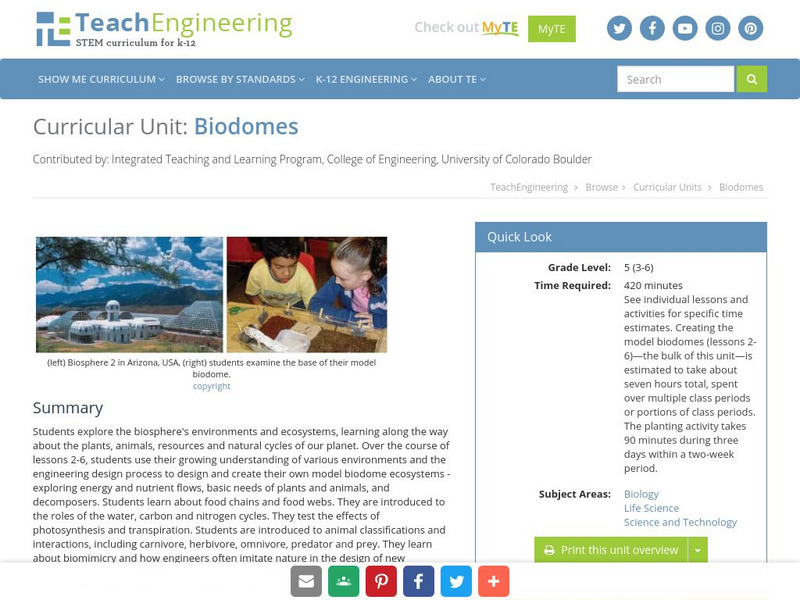
Teach Engineering: Biodomes
Students explore the biosphere's environments and ecosystems, learning along the way about the plants, animals, resources and natural cycles of our planet. Over the course of lessons 2-6, students use their growing understanding of...
Shmoop University
Shmoop: Ecosystem Energy Flow
Explains the processes by which energy flows through an ecosystem. Covers the meanings of key vocabulary, e.g., types of producers and consumers, trophic levels, food webs, and the energy pyramid.
Science Struck
Science Struck: Decomposers in the Ocean: Role and Examples
Describes five different types of decomposers that feed on decaying organic matter in the oceans and that are at the bottom of the ocean food chain.
BiologyWise
Biology Wise: Understanding the Process of Biological Magnification
Biological magnification is the term used to described the increasing accumulation of substances in organisms as one looks at higher trophic levels in a food chain. When that substance is a toxin, such as a heavy metal or a pesticide,...
Other popular searches
- Food Chains Food Webs
- Food Chains and Webs
- Food Chains and Food Webs
- Food Chain Food Web
- Food Chains, Food Webs
- Food Chains Webs
- Ecology Food Webs Chains
- Food Chain/ Food Web
- Food Chain Web
- Food Chain and Food Webs
- Food Chain and Webs
- Food Chain/web