Hi, what do you want to do?






TeachEngineering
Teach Engineering: Energy of Motion
By taking a look at the energy of motion all around us, students learn about the types of energy and their characteristics. They first learn about the two simplest forms of mechanical energy: kinetic and potential energy, as illustrated...
OpenStax
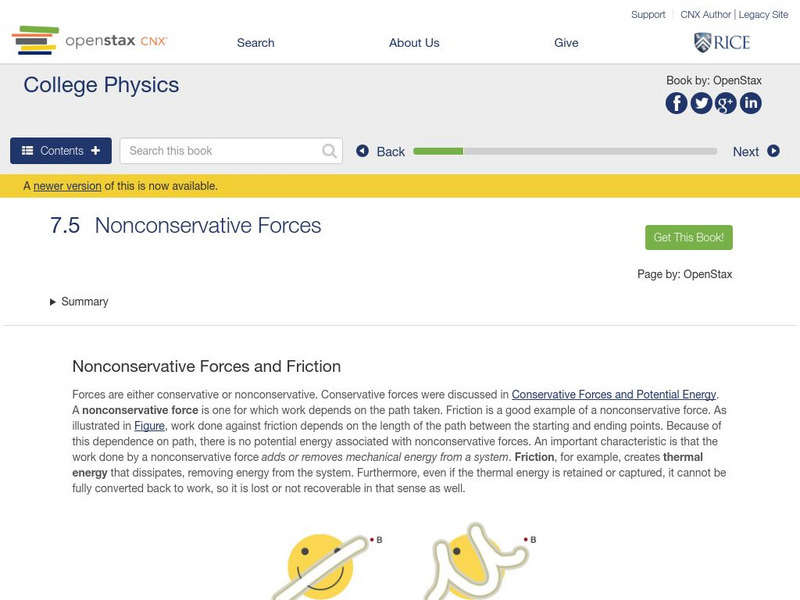
Open Stax: Nonconservative Forces
In the following interactive students will begin to define nonconservative forces and explain how they affect mechanical energy. They will show how the principle of conservation of energy can be applied by treating the conservative...
Physics Classroom
The Physics Classroom: Work, Energy, and Power: Application/practice Questions
Through illustrated examples and practice problems, students apply the relationship between work and mechanical energy change to a variety of motion scenarios in order to test our understanding.

PBS
Pbs Kids: Activities and Videos: Force/energy
Videos that accompany activities that are hands-on challenges that focus on the engineering design process. They use simple materials, allow for multiple solutions, and are ideal for ages 9-12.
CK-12 Foundation
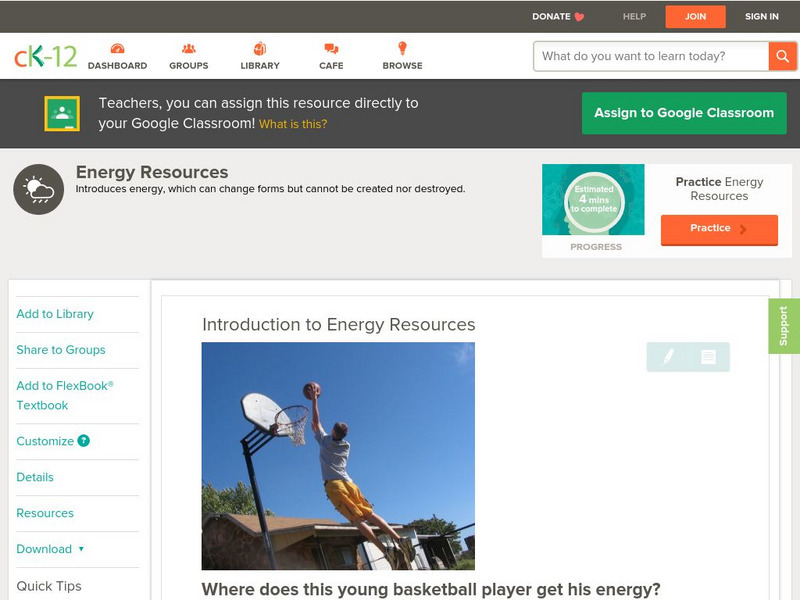
Ck 12: Earth Science: Introduction to Energy Resources
[Free Registration/Login may be required to access all resource tools.] Overview of the types of energy, and how it can be stored and released.
CK-12 Foundation
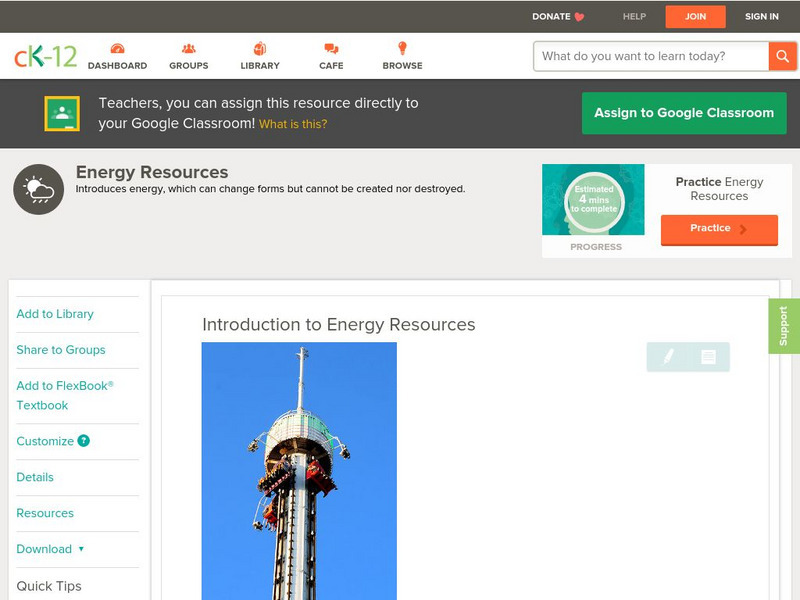
Ck 12: Earth Science: Introduction to Energy Resources
[Free Registration/Login may be required to access all resource tools.] Overview of the types of energy and how it can be stored and released.
Physics Classroom
The Physics Classroom: Work, Energy, and Power: Mechanical Energy Is Conserved
In this interactive exercise, explore the quantitative relationship between work and mechanical energy in situations in which there are no external forces doing work.
NC State University
The Engineering Place: Roller Coasters [Pdf]
A lesson where students construct a roller coaster and test it under different conditions to learn about force and motion.

Ducksters
Ducksters: Physics for Kids: Motion Glossary and Terms
Kids learn about glossary and terms in the science of physics and motion. Definitions for words such as momentum, force, work, energy, gravity, scalar, vector, power, and more.
Physics Classroom
The Physics Classroom: Motion of a Mass on a Spring
This tutorial investigates the motion of a mass on a spring and how a variety of quantities change over the course of time. Such quantities will include forces, position, velocity and energy - both kinetic and potential energy. Take the...
CK-12 Foundation
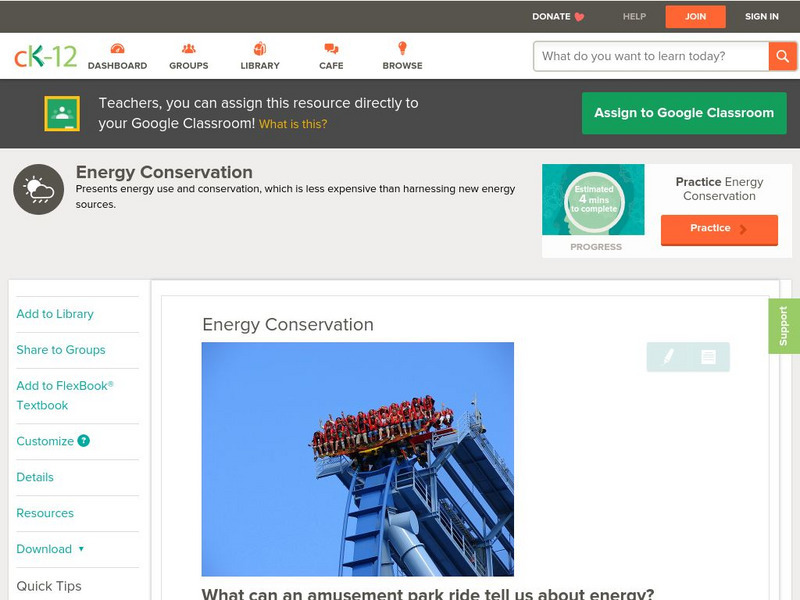
Ck 12: Earth Science: Energy Conservation
[Free Registration/Login may be required to access all resource tools.] Overview of how energy is used, and how it can be conserved.
New York University
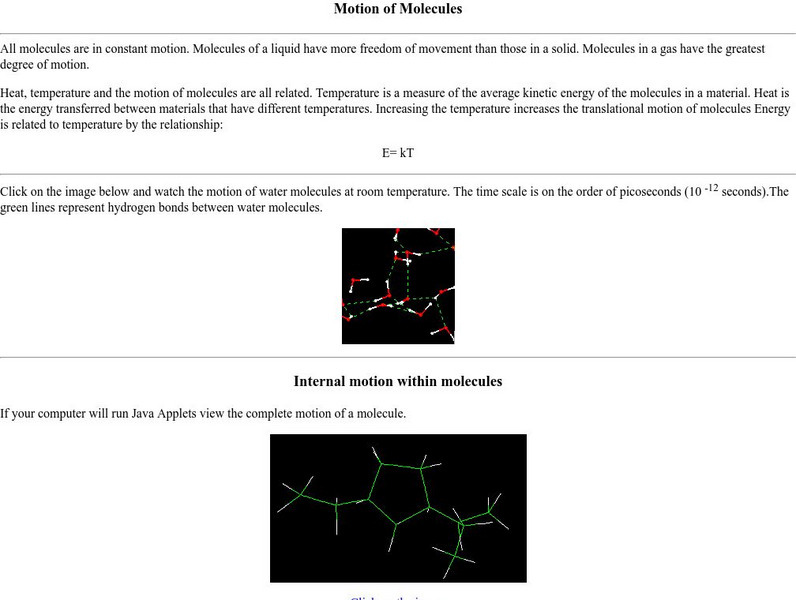
Nyu: Math Mol: Motion of Molecules
Examine the link between molecular motion and energy. Observe the movement of a molecule at room temperature. Learn about the different types of molecular motion.
Science Education Resource Center at Carleton College
Serc: Maximizing Kinetic Energy: An Investigation Using Marbles
Using marbles to construct a marble run, students will learn about projectile motion, kinetic energy, potential energy, final velocity, and forces.

NASA
Nasa: Kepler and His Laws
This site from NASA provides biographical details about the lives of Tycho Brahe and Johannes Kepler. Discusses Kepler's successes at developing laws of planeatry motion. States the three laws and discusses each one individually....
Science Education Resource Center at Carleton College
Serc: Using Your Marbles: Making Energy Work for You
This activity is based on the common experiment of running a marble down a ramp to do work on a cup. Learners will be able to see the relationship between mass and energy of the marble and the ramp height.
Physics Classroom
The Physics Classroom: Pendulum Motion
This tutorial investigates pendulum motion and how a variety of quantities change over the course of time. Such quantities will include forces, position, velocity and energy - both kinetic and potential energy. Take the interactive...
Physics Classroom
The Physics Classroom: Circular and Satellite Motion: Energy in Satellites
Through interactive practice problems and illustrated examples, students explore energy relationships for satellites.
Physics Classroom
The Physics Classroom: Circular and Satellite Motion: Roller Coaster Model
An interactive playground for students to explore the physics of roller coasters. Learners investigate by changing the variables of force, velocity, friction, and vectors. Energy bar charts are displayed as the coaster car moves along...
Other
Center for Education Partnerships: The Marble Roll
In this Science-athon, students try to make their marble roll the farthest across a flat surface, using their knowledge of forces, motion, and energy to guide them through their apparatus design. Teachers must enroll online.
My Science Site
Life Systems: Cells, Tissues, Organs
Extensive site for teachers provides some helpful resources that pertain to plant and animal cells. Includes a microscope diagram as well as plant, animal and pond labs. Also contains links to structures and mechanisms, matter and...
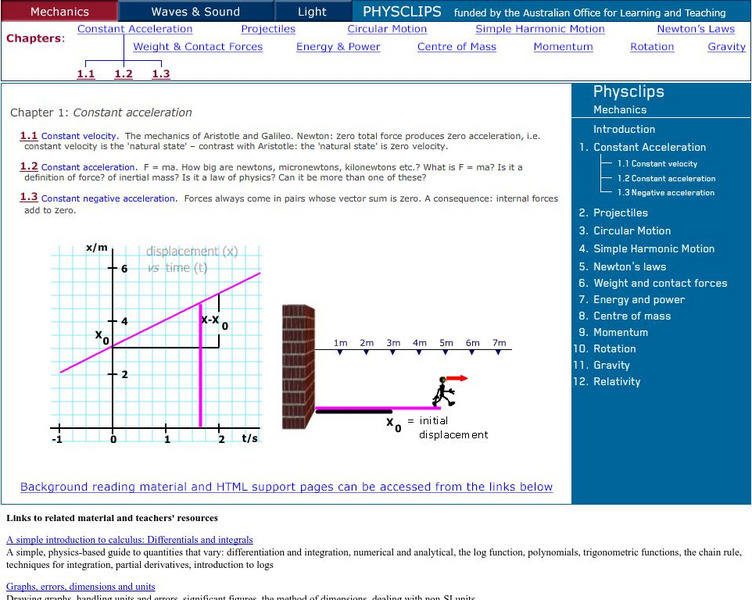
University of New South Wales (Australia)
University of New South Wales: School of Physics: Physclips
Physiclips thoroughly presents mechanics concepts with animations and film clips.
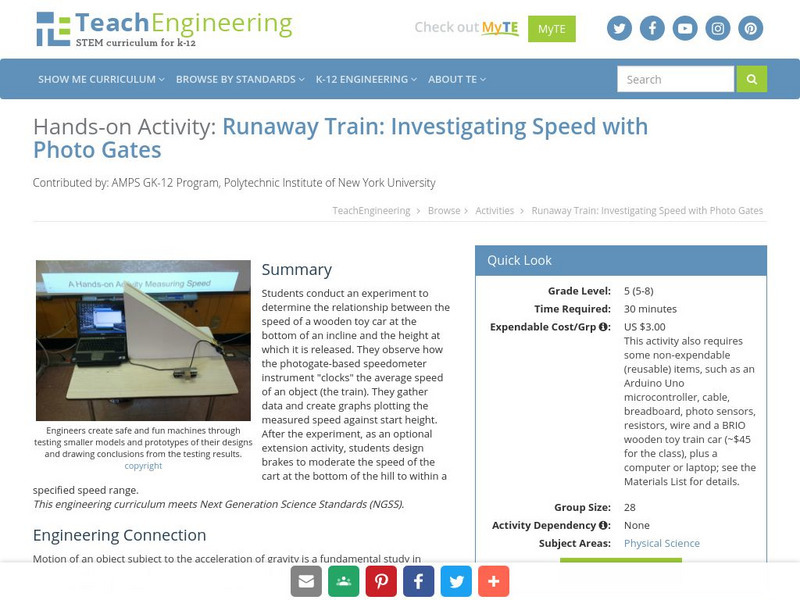
TeachEngineering
Teach Engineering: Runaway Train: Investigating Speed With Photo Gates
Students conduct an experiment to determine the relationship between the speed of a wooden toy car at the bottom of an incline and the height at which it is released. They observe how the photogate-based speedometer instrument "clocks"...
OpenStax
Open Stax: Work: The Scientific Definition
In the following interactive students will begin to explain how an object must be displaced for a force on it to do work. They will also explain how relative directions of force and displacement determine whether the work done is...
Concord Consortium
The Concord Consortium: Molecular Workbench: Forces and Systems
See how motion is converted and the energy associated with the motion is used to do work.