Hi, what do you want to do?






Scholastic
Scholastic: Study Jams! Science: Forces and Motion: Action and Reaction
A video and a short quiz on Newton's Third Law of Motion. It breaks down what action and reaction mean, and how mass and acceleration factor into the outcome of a collision.
Sophia Learning
Sophia: Mass & Acceleration: Lesson 1
This lesson explains why mass and acceleration are inversely proportional. It is 1 of 2 in the series titled "Mass & Acceleration."

Georgia Department of Education
Ga Virtual Learning: Physical Science: Force and Motion
In this student-paced module, students apply Newton's Laws of Motion to everyday life, calculate mathematical relationships involving force and motion using algebraic formulas, and understand the difference between mass and weight.
CK-12 Foundation
Ck 12: Physical Science: Newton's Second Law
[Free Registration/Login may be required to access all resource tools.] Newton's second law of motion and the effects of force and mass on acceleration. Direct and inverse relationships between force, mass and acceleration.
TeachEngineering
Teach Engineering: What Is Newton's Second Law?
After a review of force, types of forces, and Newton's first law, students are introduced to Newton's second law of motion: force = mass x acceleration.

Ducksters
Ducksters: Physics for Kids: Force
Kids learn about force in the science of physics and the laws of motion including units and measurement. How to calculate force from mass and acceleration.
Science Education Resource Center at Carleton College
Serc: Newton's Second Law: Constant Force Applied to a Skateboarder
In this lab activity, young scholars will become familiar with Newton's 2nd Law of Motion. By investigating the motion of different skateboarders pulled with a variety of constant force values, they will discover that bodies acted on by...
Science Education Resource Center at Carleton College
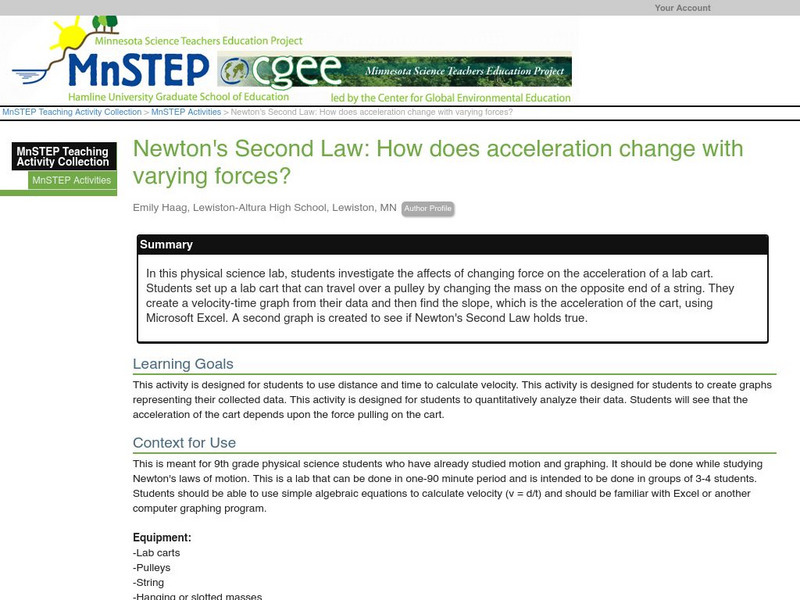
Serc: Newton's Second Law: How Does Acceleration Change With Varying Forces?
In this lab activity, young scholars investigate the effects of changing force on the acceleration of a lab cart testing Newton's Second Law of Motion. They will use distance and time to calculate velocity and create a graph representing...

Physics Classroom
The Physics Classroom: Newton's Laws: Finding Individual Forces
Through illustrated examples and interactive practice problems, students find the value of forces acting upon objects using force equations.
Physics Aviary
Physics Aviary: Practice Problems: Displaced Angle for Accelerating Car
Students must solve for the tension in the rope and the acceleration of the car based on the angle of displacement for a hanging mass.
Science Education Resource Center at Carleton College
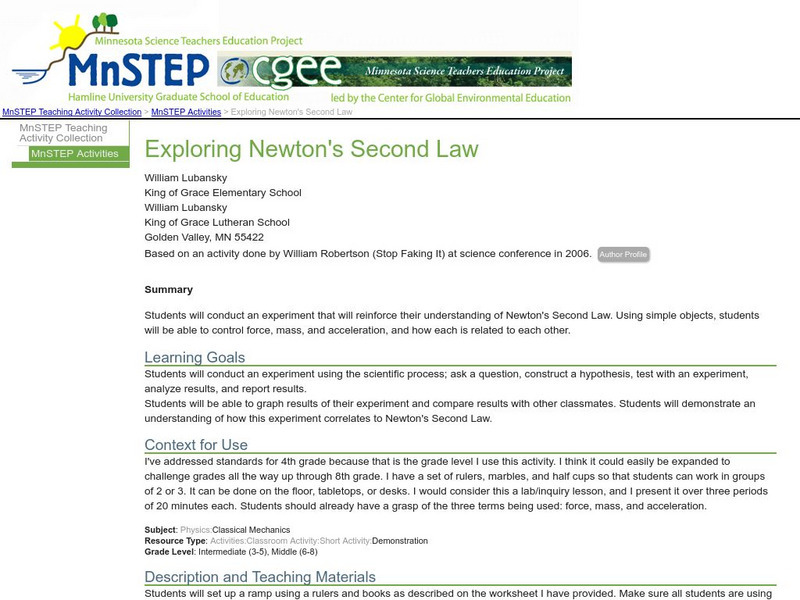
Serc: Exploring Newton's Second Law
Students conduct an experiment that will reinforce their understanding of Newton's Second Law. Using simple objects, students control force, mass, and acceleration, and how each is related to each other.
TeachEngineering
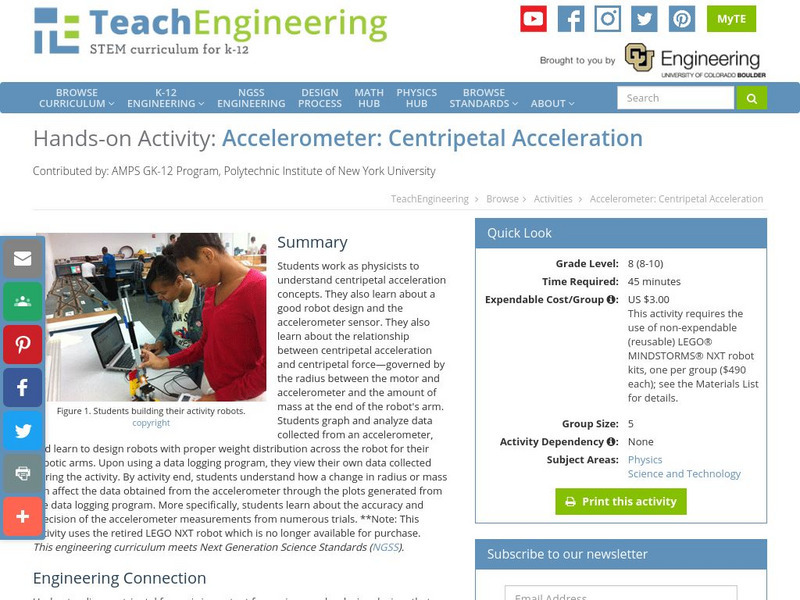
Teach Engineering: Accelerometer: Centripetal Acceleration
Students work as physicists to understand centripetal acceleration concepts. They also learn about a good robot design and the accelerometer sensor. They also learn about the relationship between centripetal acceleration and centripetal...
Other
Bscs: Forces and Motion Content Background Document
In this document, we will try to answer a fundamental question of physical science, "Why do things start to move, slow down, speed up, stop moving or change direction?" In answering these core questions we can develop concepts that can...
Physics Classroom
The Physics Classroom: Finding Individual Forces
Explore the world of finding individual forces. "The process of determining the value of the individual forces acting upon an object involve [sic] an application of Newton's Second law and an application of the meaning of the net force."
CK-12 Foundation
Ck 12: Universal Law of Gravity
[Free Registration/Login may be required to access all resource tools.] In this online tutorial students will learn to describe and calculate how the magnitude of the gravitational force between two objects depends on their masses and...
TeachEngineering
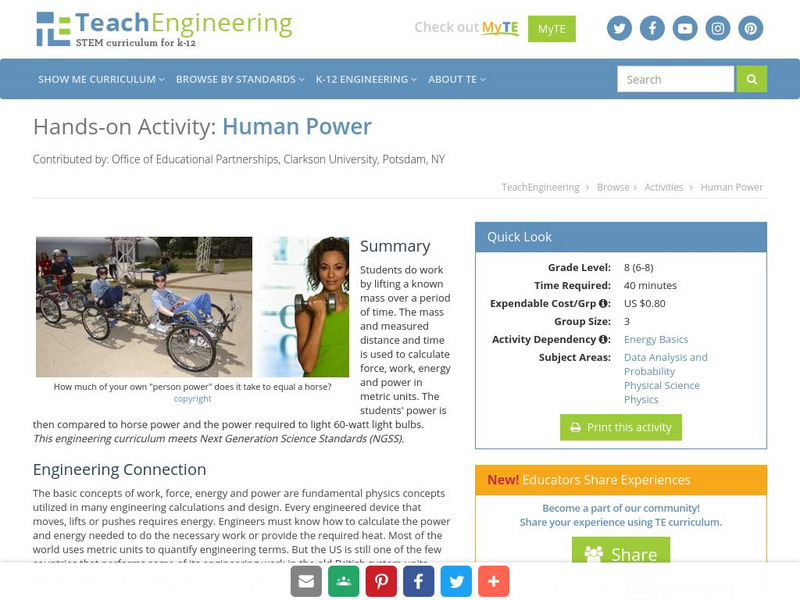
Teach Engineering: Human Power
Students do work by lifting a known mass over a period of time. The mass and measured distance and time is used to calculate force, work, energy and power in metric units. The students' power is then compared to horse power and the power...
Physics Classroom
The Physics Classroom: Newton's Second Law of Motion
Learn more about finding acceleration through the practices found in this lesson. "The process of determining the acceleration of an object demands that the mass and the net force are known." Check out this comprehensive site.
Sophia Learning
Sophia: Newton's Second Law: Lesson 3
This lesson introduces Newton's Second Law and explains that force is equal to mass times acceleration. It is 3 of 3 in the series titled "Newton's Second Law."
Sophia Learning
Sophia: Practice W/ Mass, Force, & Acceleration: Lesson 1
This lesson provides the learner with examples on the relationships between mass, force, and acceleration. It is 1 of 2 in the series titled "Practice w/ Mass, Force, & Acceleration."
Wikimedia
Wikipedia: Centripetal Force
Wikipedia's site on centripetal force provides a section explaining the difference between centripetal force and centrifugal force. Includes formulas and hyperlinked terms.
Physics Aviary
Physics Aviary: Practice Problems: Acceleration on Incline Problem Medium
Students must calculate the acceleration of an object down an incline when there is friction present. Mass, angle and coefficient of friction will be generated randomly.
CK-12 Foundation
Ck 12: Physics Simulation: Hot Air Balloon
[Free Registration/Login Required] Learn about Newton's 2nd Law - the relationship between force, mass, and acceleration for a hot air balloon using this interactive simulation. A PDF worksheet and a video tutorial are also available....
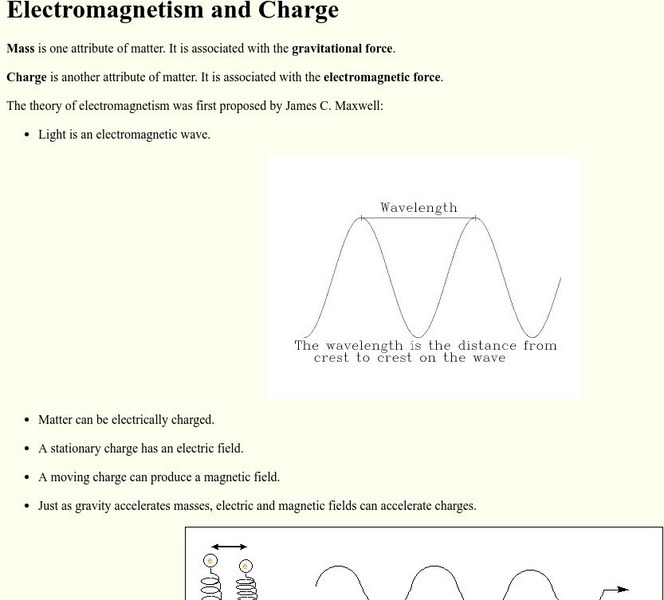
Cornell University
Cornell University: Astronomy: Electromagnetism and Charge
This site from Cornell University provides a very short, very telling comparison of matter and charge. This is a good site to check out on the subject, with a chart diagram to help with further information.
Texas Instruments
Texas Instruments: The Science of Racing: Newton Knew
For race car engineers, F = m a, is the backbone of the vast majority of calculations. The selection of gear ratios is one example. Investigate and create a mathematical model for the relationship between force, speed, mass, distance and...