Hi, what do you want to do?






TeachEngineering
Teach Engineering: Ramp and Review (For High School)
In this hands-on activity - rolling a ball down an incline and having it collide into a cup - the concepts of mechanical energy, work and power, momentum, and friction are all demonstrated. During the activity, students take measurements...

Physics Aviary
Physics Aviary: Practice Problems: Acceleration on Incline Problem Medium
Students must calculate the acceleration of an object down an incline when there is friction present. Mass, angle and coefficient of friction will be generated randomly.

Khan Academy
Khan Academy: What Is Newton's First Law?
Newton's First Law also called the law of inertia is the most important thing to realize about motion. This article offers more information on motion and explains solved problems involving Newton's First Law. Also included is a video...
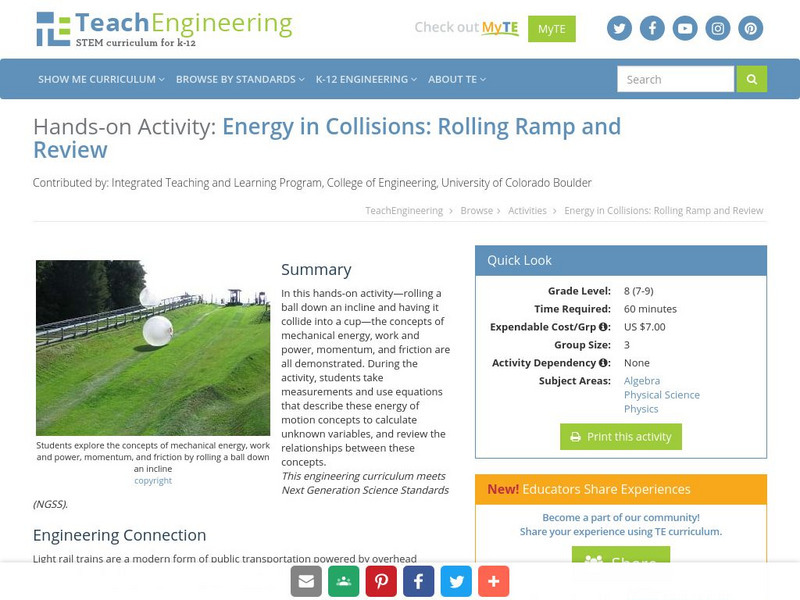
TeachEngineering
Teach Engineering: Ramp and Review
In this hands-on activity - rolling a ball down an incline and having it collide into a cup - the concepts of mechanical energy, work and power, momentum, and friction are all demonstrated. During the activity, students take measurements...
Other
Center for Education Partnerships: The Marble Roll
In this Science-athon, students try to make their marble roll the farthest across a flat surface, using their knowledge of forces, motion, and energy to guide them through their apparatus design. Teachers must enroll online.
Physics Aviary
Physics Aviary: Practice Problems: Motion on Incline Level 2
Students must calculate the distance an object will move up an incline using Newton's Laws. Mass, angle, gravitational field, coefficient of friction and initial speed will be generated randomly.
Physics Aviary
Physics Aviary: Practice Problems: Motion on Incline Level 3
Students must calculate the speed of a block when it returns to its original location on an incline using Newton's Laws. Mass, angle, gravitational field, coefficient of friction and initial speed will be generated randomly.
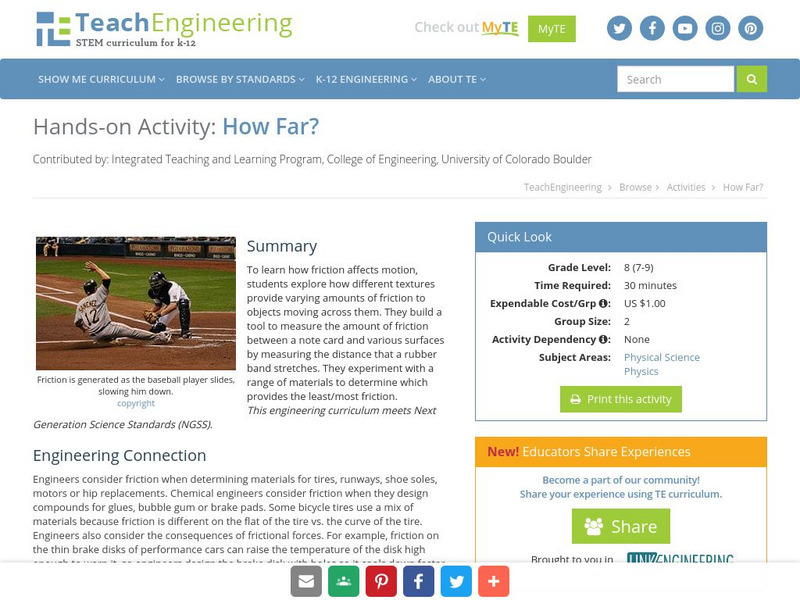
TeachEngineering
Teach Engineering: How Far?
To learn how friction affects motion, students explore how different textures provide varying amounts of friction to objects moving across them. They build a tool to measure the amount of friction between a note card and various surfaces...
TryEngineering
Try Engineering: Give Me a Brake
Activity investigates the concept of how bicycle brakes use force and friction to stop or slow mechanical motion. Students work in teams to devise a simple braking system while suggesting improvements to current bicycle brake design.
Physics Classroom
The Physics Classroom: Circular and Satellite Motion: Roller Coaster Model
An interactive playground for students to explore the physics of roller coasters. Learners investigate by changing the variables of force, velocity, friction, and vectors. Energy bar charts are displayed as the coaster car moves along...
Center of Science and Industry
Cosi Columbus: Hover Cup
Science experiment in which you make a hovercraft, a machine that uses compressed air to do work, from a paper cup. Includes full list of materials, procedures, and scientific explanation of how air flow can minimize friction and cause...
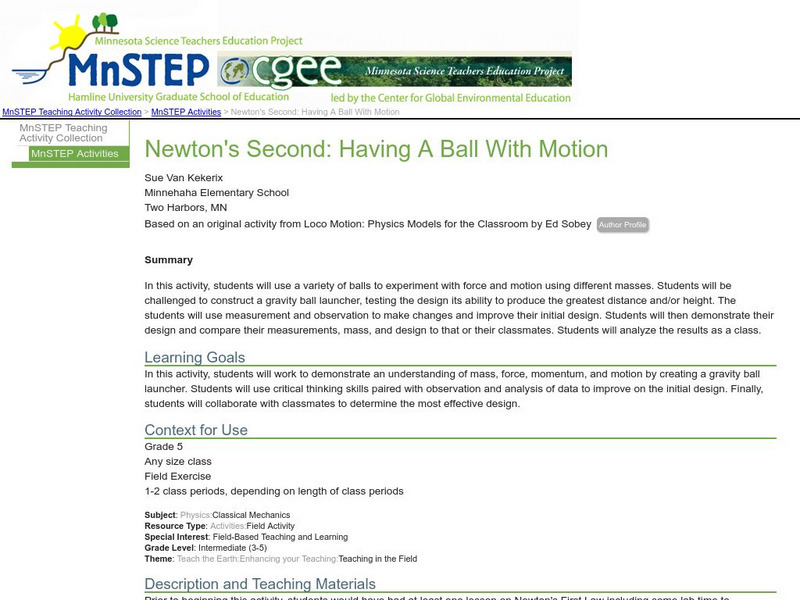
Science Education Resource Center at Carleton College
Serc: Newton's Second: Having a Ball With Motion
Learners will create a gravity ball launcher to demonstrate their understanding of mass, force, momentum, and motion. The students will use critical thinking, measurement, and observation and analysis of data to make changes and improve...
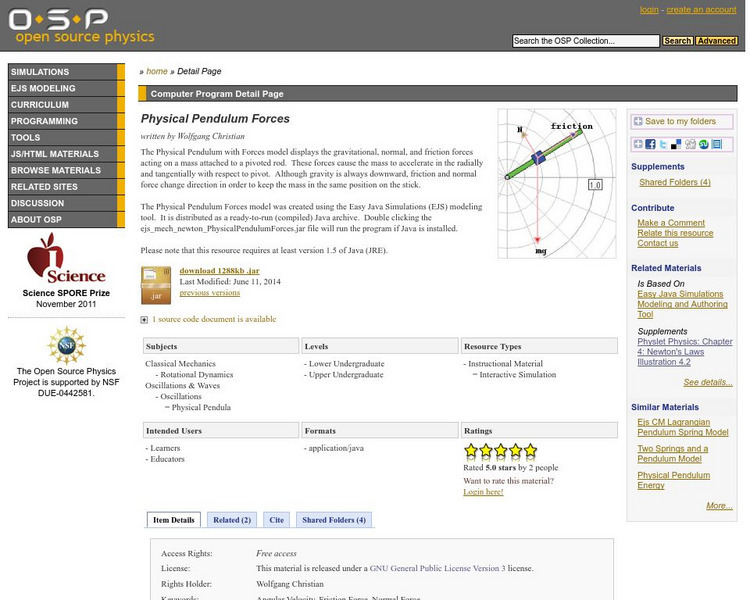
American Association of Physics Teachers
Com Padre Digital Library: Open Source Physics: Physical Pendulum Forces
This simulation of a pendulum will demonstrate how friction and force have to change to keep the mass in the same position on the pivoted rod.
TeachEngineering
Teach Engineering: Mechanics Mania
Through ten lessons and numerous activities, students explore the natural universal rules engineers and physicists use to understand how things move and stay still. Together, these rules are called "mechanics." The study of mechanics is...
Physics Classroom
The Physics Classroom: Newton's First Law of Motion
A clear explanation of Newton's First Law of Motion, the law of inertia, with diagrams and real-world examples. Useful for both students and teachers. Written by a high school physics teacher.
Science Education Resource Center at Carleton College
Serc: Investigating Motion: What Causes Objects to Move?
Students will have an opportunity to determine what makes everyday objects move. Students will be given objects and asked to make predictions on how far each object will move after they blow on it. Then they will measure the distance and...
TeachEngineering
Teach Engineering: Natural Disasters
Students are introduced to our planet's structure and its dynamic system of natural forces through an examination of the natural hazards of earthquakes, volcanoes, landslides, tsunamis, floods and tornados, as well as avalanches, fires,...
Texas Education Agency
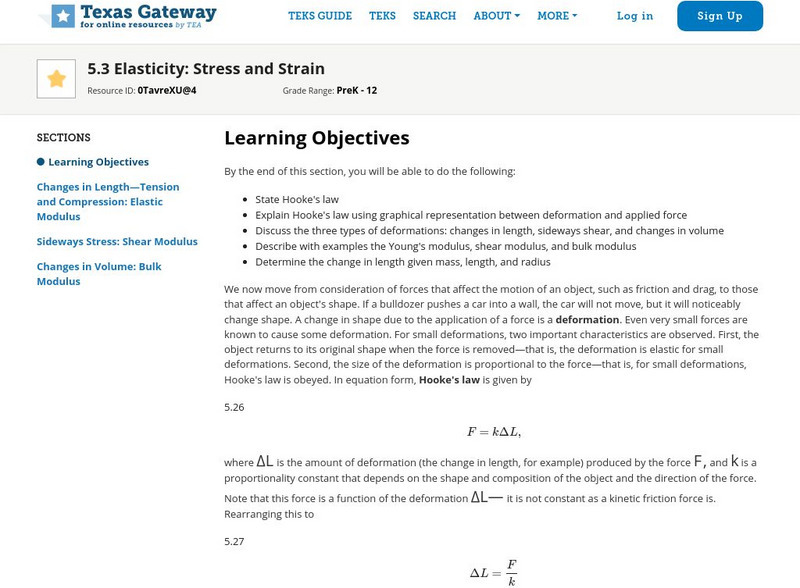
Texas Gateway: Further Applications of Newton's: Elasticity: Stress and Strain
By the end of this section, you will be able to state Hooke's law; explain Hook's law using graphical representations between deformation and applied force; discuss the three types of deformations: changes in length, sideways shear, and...
TeachEngineering
Teach Engineering: Energy of Motion
By taking a look at the energy of motion all around us, students learn about the types of energy and their characteristics. They first learn about the two simplest forms of mechanical energy: kinetic and potential energy, as illustrated...
Science Buddies
Science Buddies: Do Submarines Need Fins?
In this science project, you can investigate how submarines use stabilizing fins to move forward. Exploring friction and buoyant force you will get closer to understanding how these large ships function. Research resources are included...
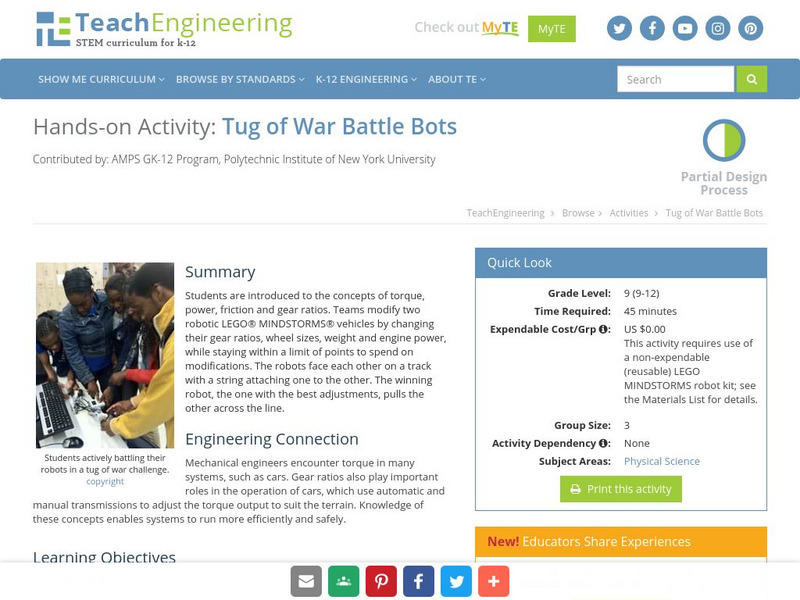
TeachEngineering
Teach Engineering: Tug of War Battle Bots
Students are introduced to the concepts of torque, power, friction and gear ratios. Teams modify two robotic LEGO vehicles by changing their gear ratios, wheel sizes, weight and engine power, while staying within a limit of points to...

University of Colorado
University of Colorado: Ph Et Interactive Simulations: The Ramp
Which object takes more energy to push up a ramp: a file cabinet, a refrigerator, a piano, or a sleepy dog? Find out in this ramp simulation when you change the angle of the incline, change the objects, or change the friction on the ramp.
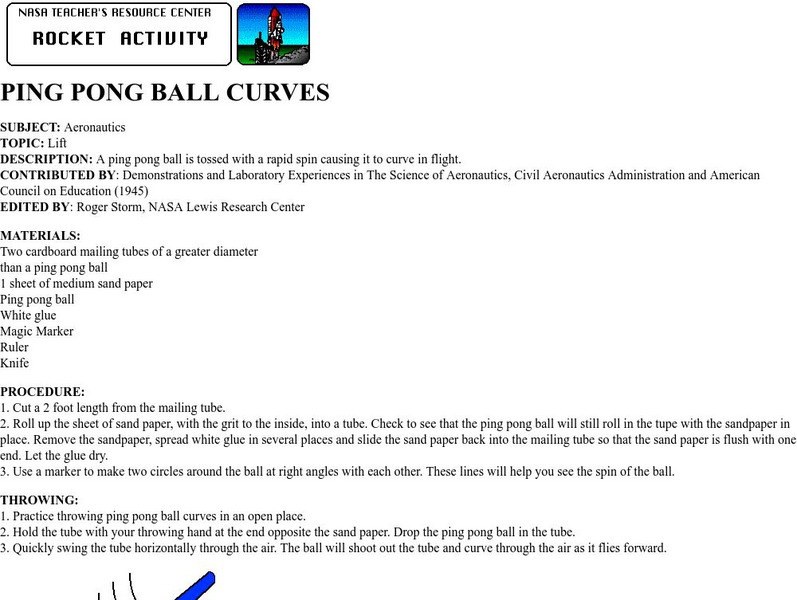
Michigan Reach Out
Reach Out Michigan: Ping Pong Ball Curves
This is an experiment that will allow observation on how friction will make a ping pong ball curve when it is thrown into the air.
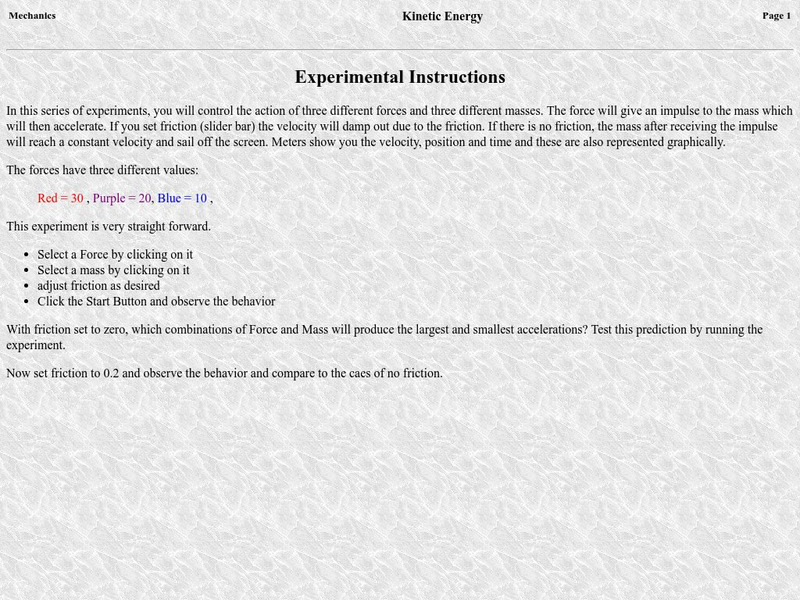
University of Oregon
University of Oregon: Experimental Instructions
Visit this summary of friction. Use the interactive JAVA window to run friction simulations.
Other popular searches
- Frictional Force
- Friction Force
- Motion Force and Friction
- Force Friction Effects
- Force Motion Friction Speed
- Science Force and Friction
- Force and Friction Luge
- Motion Friction Force
- Force Friction Work
- Gravity Force and Friction
- Gravity Force Friction
- Force Friction Videos