Hi, what do you want to do?





University of Virginia
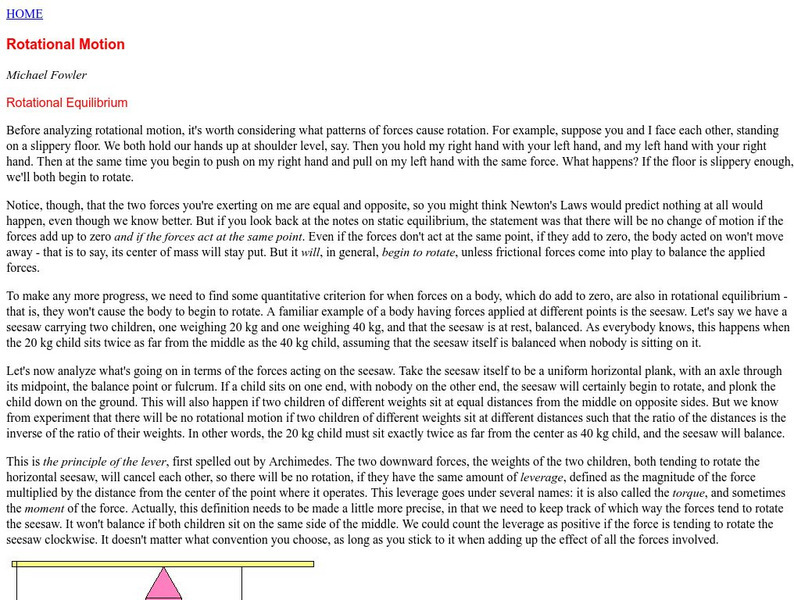
University of Virginia: Rotational Motion
A page describing rotational equilibrium and non-equilibrium situations. Includes graphics, equations, and many examples.

Physics Classroom
The Physics Classroom: Circular & Satellite Motion: Uniform Circular Motion
Manipulate variables while exploring principles and relationships related to moving in a circle at a constant speed. Students change the radius of the circle, the speed of the object, and the mass of the object and investigate the effect...
Physics Aviary
Physics Aviary: Newton's Law Lab
This lab was designed to have students investigate the factors that affect the acceleration of an object on a frictionless horizontal surface. The simulation will give the students position vs. time data and they will have to determine...
Texas Instruments
Texas Instruments: Spring Thing: Newton's Second Law
In this activity, students' use a force sensor and a motion detector to collect force and acceleration data for an object moving up and down hanging from a spring. They use the data to test Newton's second law, and to estimate the mass...
Math Is Fun
Math Is Fun: Unit Conversion Tool
Use this online tool to convert measurements of acceleration, area, density, electricity, energy, force, length, mass, and other measurable properties.
TeachEngineering
Teach Engineering: Move It!
Mechanical energy is the most easily understood form of energy for students. When there is mechanical energy involved, something moves. Mechanical energy is a very important concept to understand. Engineers need to know what happens when...
Wikimedia
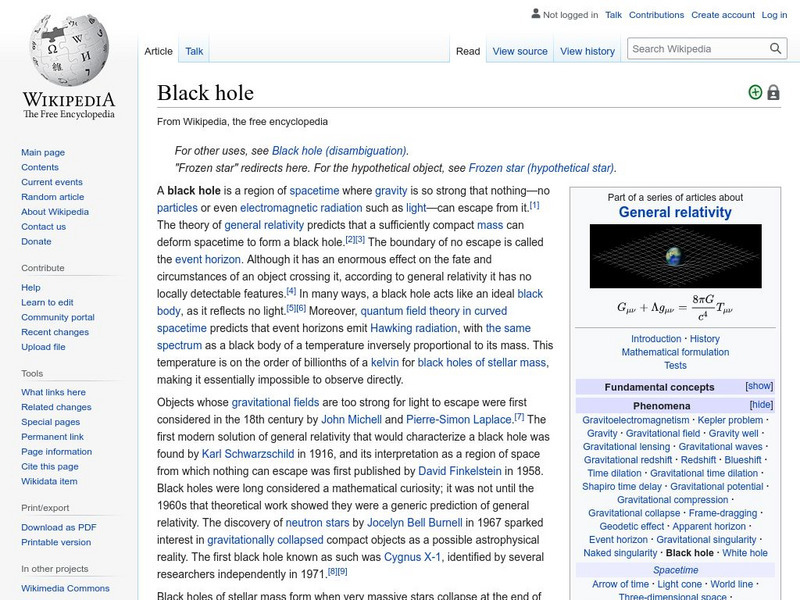
Wikipedia: The Black Hole
This site examines the black hole as an object in astrophysics. Delve into this comprehensive resource that covers this concept from its history, to qualitative physics, the reality of black holes, mathematical physics and more.

Other
Online Conversion
Conversion calculators galore! Convert just about anything from one measureable unit into another measureable unit here with over two dozen calculators. Each of the links is specific to a measureable quantity. Some examples include...
Walter Fendt
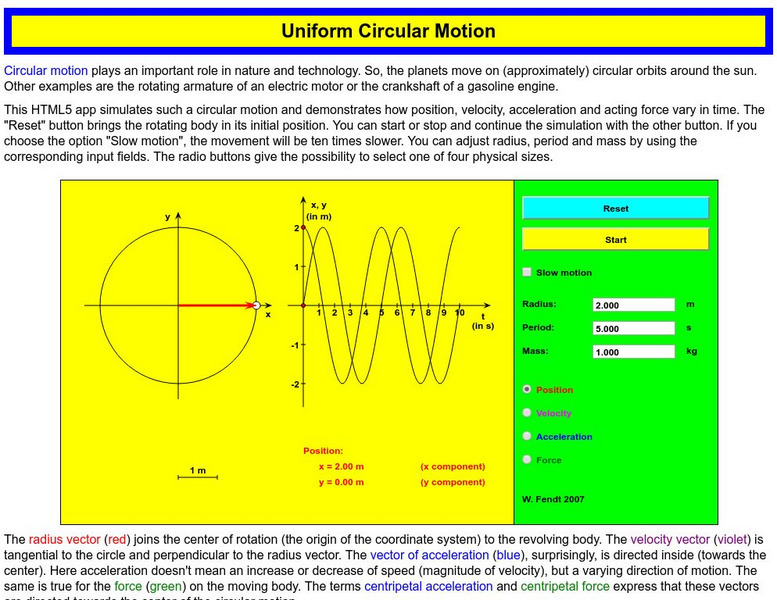
Walter Fendt: Uniform Circular Motion
This app simulates circular movement and demonstrates how the position, speed, acceleration, and the applied force vary depending on the time. You may choose the option "slow animation" to make the movement ten times slower. You can also...
Physics Classroom
The Physics Classroom: 1 D Kinematics: The Big Misconception
An introduction to the ideas behind the misconception and misunderstanding of why all objects accelerate at the same rate. This explanation involves the concepts of force and mass.
Science and Mathematics Initiative for Learning Enhancement (SMILE)
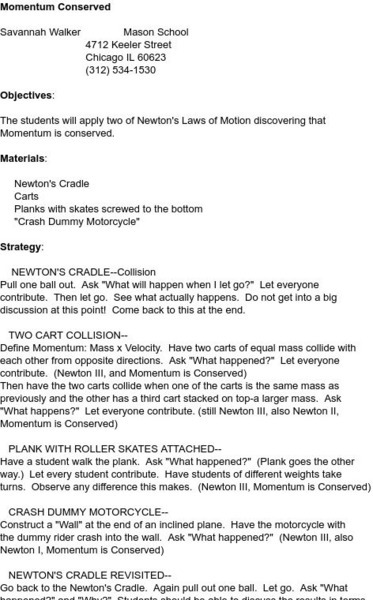
Smile: Momentum Conserved
This site by the Illinois Institute of Technology gives a Lab activity in which students use a variety of toys to discover Newton's second law and momentum conservation. Newton's cradle, skate boards, and a toy motorcycle are incoporated...
PBS
Pbs Learning Media: Defying Gravity
Students are asked how acceleration, mass, momentum and velocity are involved in mountain boarding. [0:32]
Quia
Quia: Newton's Laws Quiz
A short quiz on Newton's famous laws of motion. Has ten multiple-choice questions.
University of California
Understanding Science: Newton's 2nd Law: Inquiry Approach Lesson
For this lesson, students develop their own scientific experiment to test Newton's hypothesis that the acceleration of an object depends on the net force acting upon it and its mass. After completing their designed experiment, students...
Physics Classroom
The Physics Classroom: Newton's Laws of Motion
Use this outline to find out about Newton's Laws of Motion. Use the different lesson plans covering the laws of motion to learn more.