Hi, what do you want to do?






Curated OER
Friction Is a Force That Moves in an Opposite Direction to Movement.
This resource provides a brief overview of friction. Its' affects on solids, liquids and gases is described with diagrams. An explanation of how friction is measured is included in the discussion. An online quiz can be used to check your...
American Association of Physics Teachers
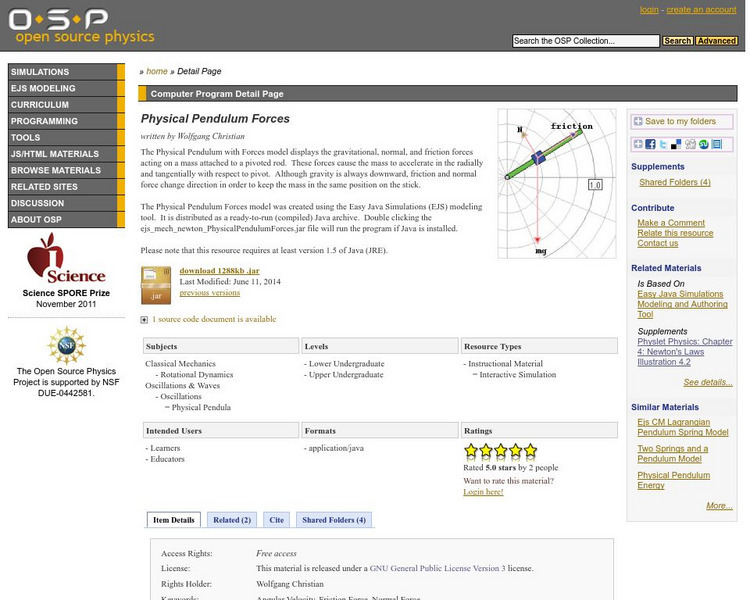
Com Padre Digital Library: Open Source Physics: Physical Pendulum Forces
This simulation of a pendulum will demonstrate how friction and force have to change to keep the mass in the same position on the pivoted rod.
TeachEngineering
Teach Engineering: Mechanics Mania
Through ten lessons and numerous activities, students explore the natural universal rules engineers and physicists use to understand how things move and stay still. Together, these rules are called "mechanics." The study of mechanics is...

PBS
Pbs Teachers: Tower of Coins Experiment
Demonstrate inertia by pushing a nickel out of the bottom of a stack without disturbing the rest of the stack.
Physics Aviary
Physics Aviary: Practice Problems: Car Stopping Distance
Students must calculate the time it takes for a car to come to a rapid stop and the distance the car covers when stopping.
University of Oregon
Uo: Cannon Simulator: Experimental Instructions
This virtual experiment is designed to let the student measure the relation between muzzle velocity (which determines projectile energy), gravitational potential and the effects of frictional drag caused by wind speed blowing opposite to...
TeachEngineering
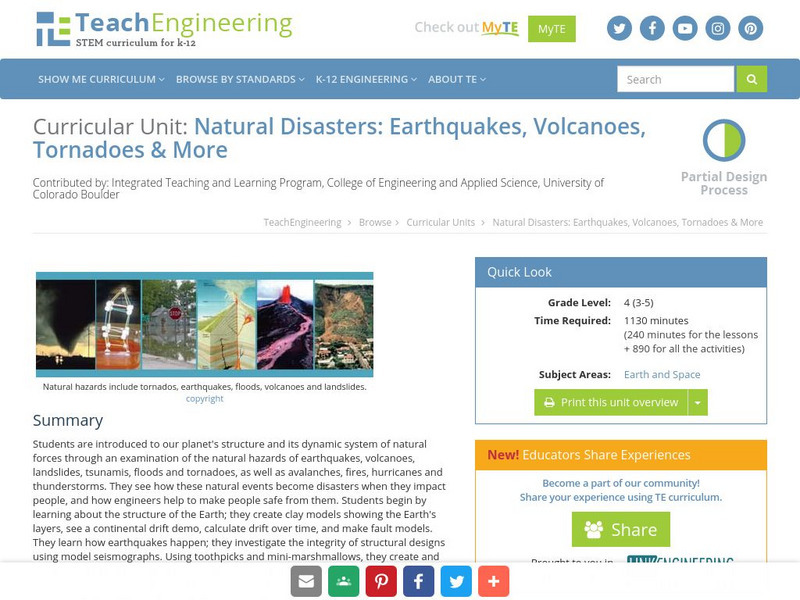
Teach Engineering: Natural Disasters
Students are introduced to our planet's structure and its dynamic system of natural forces through an examination of the natural hazards of earthquakes, volcanoes, landslides, tsunamis, floods and tornados, as well as avalanches, fires,...
TeachEngineering
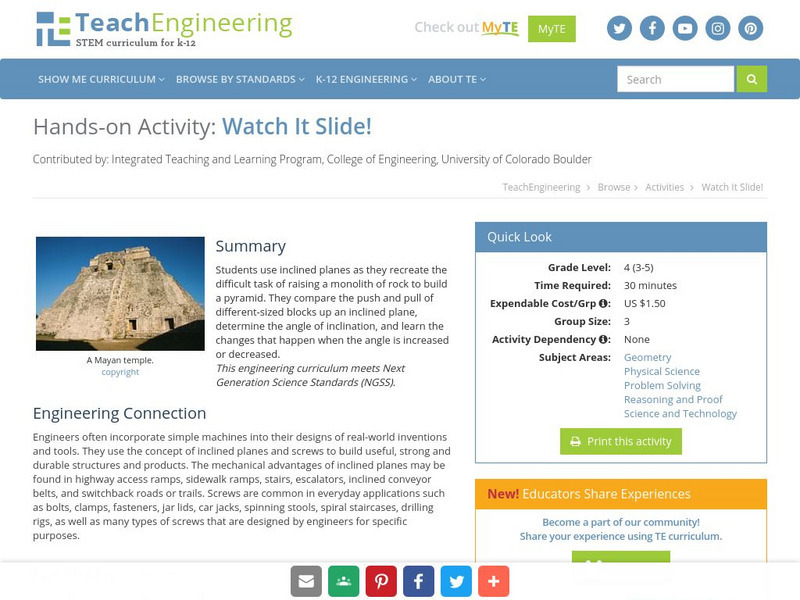
Teach Engineering: Watch It Slide!
Students use inclined planes as they recreate the difficult task of raising a monolith of rock to build a pyramid. They compare the push and pull of different-sized blocks up an inclined plane, determine the angle of inclination, and...
Cosmo Learning
Cosmo Learning: Newton's Laws
Do you need to review any of Newton's three laws? This website contains a video collection on Newton's Law from a physics course at East Los Angeles College. In twelve lectures, each law is explained with examples. Also discussed is...
Concord Consortium
The Concord Consortium: Molecular Workbench: Mass Connected to 2 Springs
Observe how friction affects a mass connected to two springs that are on opposite sides of the mass. Create a graph while the friction is on or off.
McREL International
Mc Rel: Whelmer #9 Learning Activity: Nickel Karate
An easy to do activity that investigates the basic theories of inertia. The activity is in lesson plan format that meets NSES standards.
University of Virginia
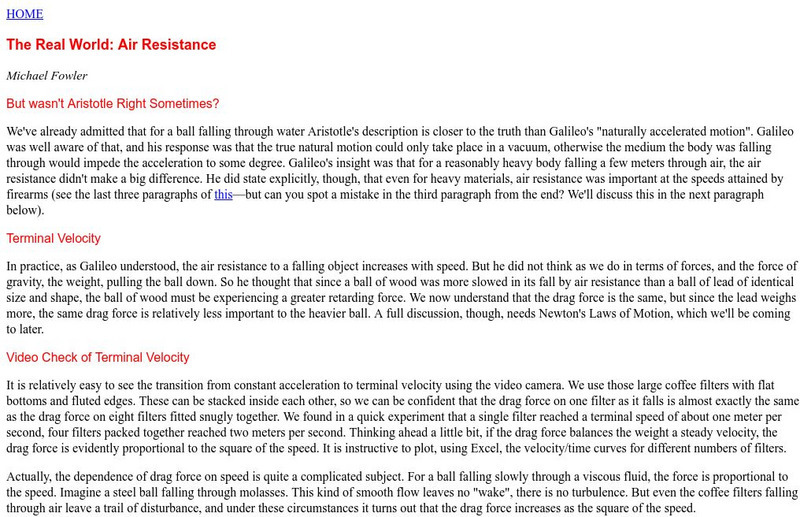
Uva: The Real World Air Resistance
A contrast of Galileo and Aristotle's view of inertia and motion. Describes air resistance force and how its reality seems to initially support Aristotle's view.
Concord Consortium
The Concord Consortium: Molecular Workbench: Weight Balance on a Pulley
Watch how the placement of two weights attached to a chain on different sides of a pulley affect the movement of the system. You can adjust the heaviness of the weights.

Exploratorium
Exploratorium: Science Snacks: Charge and Carry
This site from The Exploratorium Museum is a full description of a short activity. An electrophorus plate and a Leyden jar are made. The electrophorus is charged by induction. Its charge is transferred to the Leyden jar by conduction...

Khan Academy
Khan Academy: What Are Inclines?
A webpage with equations and examples of how to solve inclined planes problems. Learn how to deal with slopes when surfaces usually aren't perfectly horizontal.
Science and Mathematics Initiative for Learning Enhancement (SMILE)
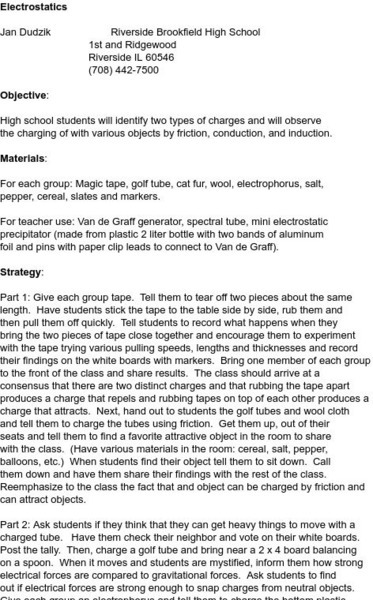
Smile: Electrostatics
A teacher lesson plan which includes activities pertaining to common methods of charging objects - induction, conduction, and friction.
CK-12 Foundation
Ck 12: Physics: Newton's Laws Study Guide
This study guide on Newton's Laws covers key terms, the three laws, free body diagrams, friction coefficients and tension. Includes equations and an example problem with solution. It is available for download with free registration.
Sophia Learning
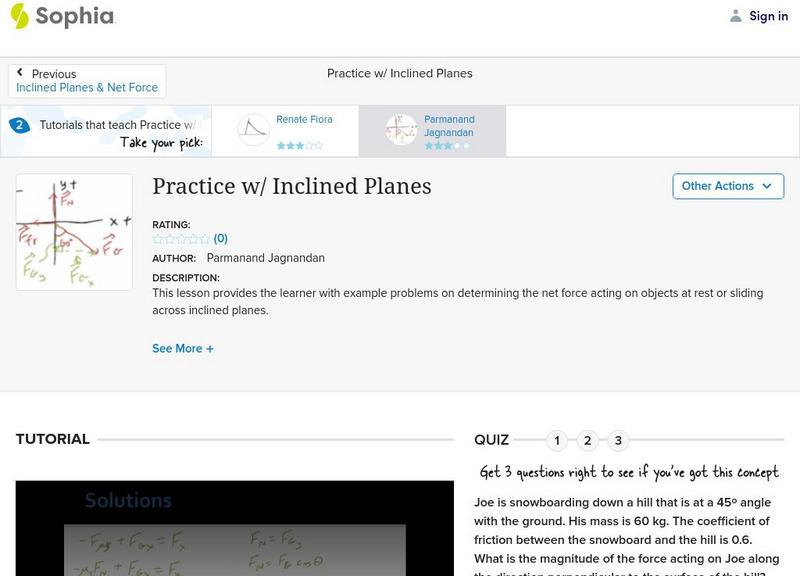
Sophia: Practice With Inclined Planes
A video presentation providing example problems on finding the net force acting on objects at rest or sliding across inclined planes. [13:08]
TryEngineering
Try Engineering: Engineered Sports
Young scholars work in teams to investigate how aerospace engineering relates to sports, especially golf ball design and the physics of bounce. They use this information to determine whether these aerospace principles can be applied to...
BBC
Bbc: Gcse Bitesize: What Is Electric Charge? Ocr 21 C
This lesson focuses on electric charges. Electric current is the flow of electric charge. Some insulating materials become electrically charged when they are rubbed together. A substance that gains electrons becomes negatively charged,...

American Association of Physics Teachers
Com Padre Digital Library: Open Source Physics: Sliding Down an Incline Plane
Here is a simulation demonstrating an object placed on an inclined plane. The user will vary the slope of the plane to see the relationship the slope has on the gravity of the object and the static friction.
Center of Science and Industry
Cosi Columbus: Hover Cup
Science experiment in which you make a hovercraft, a machine that uses compressed air to do work, from a paper cup. Includes full list of materials, procedures, and scientific explanation of how air flow can minimize friction and cause...
Science Education Resource Center at Carleton College
Serc: Newton's Second: Having a Ball With Motion
Students will create a gravity ball launcher to demonstrate their understanding of mass, force, momentum, and motion. The students will use critical thinking, measurement, and observation and analysis of data to make changes and improve...
Science Education Resource Center at Carleton College
Serc: Investigating Gravity: Predicting Time to Hit the Ground
Students will drop and shoot horizontally "Nerf" balls from a variety of known heights then record the amount of time it takes for the ball to hit the ground for each trial. They will plot height vs. time data and create a trend line for...