Hi, what do you want to do?





CK-12 Foundation
Ck 12: Universal Law of Gravity
[Free Registration/Login may be required to access all resource tools.] Using Newton's Law of Gravity and the equations of uniform circular motion, students solve problems involving the force of gravity.

University of Colorado
University of Colorado: Ph Et Interactive Simulations: Gravity and Orbits
An interactive simulation that teaches about gravitational force, circular motion, and astronomy by manipulating the sun, earth, moon, and a space station to observe the effects of gravity and orbital paths. This simulation can either be...

Science Struck
Science Struck: What Is Gravity and How Does It Work
A very detailed look at gravitational force and the many theories that have been put forward to try to explain it. Includes lots of illustrations.

CK-12 Foundation
Ck 12: Physical Science: Gravity
[Free Registration/Login may be required to access all resource tools.] Definition of gravity and how it relates to weight. Includes a video. [3:54]
PBS
Pbs Learning Media: Centripetal Force: Roller Coaster Loops
This video segment explains centripetal force and illustrates how roller coasters rely on it to give you a thrilling ride. Includes background reading material and discussion questions. [4:40]
PBS
Pbs Learning Media: Centripetal Force: Pulling Cs and Gs
In this interactive activity from NOVA, discover how centripetal force can affect you when riding in a car or flying at high speeds in a fighter jet.

University of Colorado
University of Colorado: Ph Et Interactive Simulations: My Solar System
An interactive simulation that teaches about motion, acceleration, and velocity by allowing students to build their own solar system and watch the effects of gravitational pull and how that changes with initial position, velocity, and...

TeachEngineering
Teach Engineering: Forces and Graphing
This activity can be used to explore forces acting on an object, to practice graphing experimental data, and/or to introduce the algebra concepts of slope and intercept of a line. A wooden 2x4 beam is set on top of two scales. Students...
PBS
Pbs Learning Media: Why Doesn't the Moon Fall Down?
In this animated video segment adapted from NASA, astronomer Doris Daou explains how the forces of speed and gravity keep the moon in a constant orbit around Earth. [1:36]
Science Buddies
Science Buddies: Tightening the Turns in Speed Skating
Fast turns around the track can become your laboratory tests in these experiments, whether you skate on ice, wood, or pavement. The goal is to determine which type of turns are best in a race - tight, medium, or wide - and then to figure...
Ohio State University
Beyond Penguins and Polar Bears: The Forces That Change the Face of Earth
Learn how different types of Earth processes change Earth's surface.

MadSci Network
Mad Scientist Network: How Can a Gyroscope Defy Gravity
Explanation of the seemingly gravity-defying feats of a gyroscope. Focuses on the reason behind its operation. Includes illustrations.
University of Southern California
University of Southern California: Ocean Currents and Climate
The climate of our planet is greatly affected by Earth's oceans. Learn here about the different oceanic currents and the role those currents play on climate.
Utah Education Network
Uen: Tissue Parachutes
Third graders create their own parachutes to understand the concept of gravity and the effect it has on objects.
Texas Education Agency
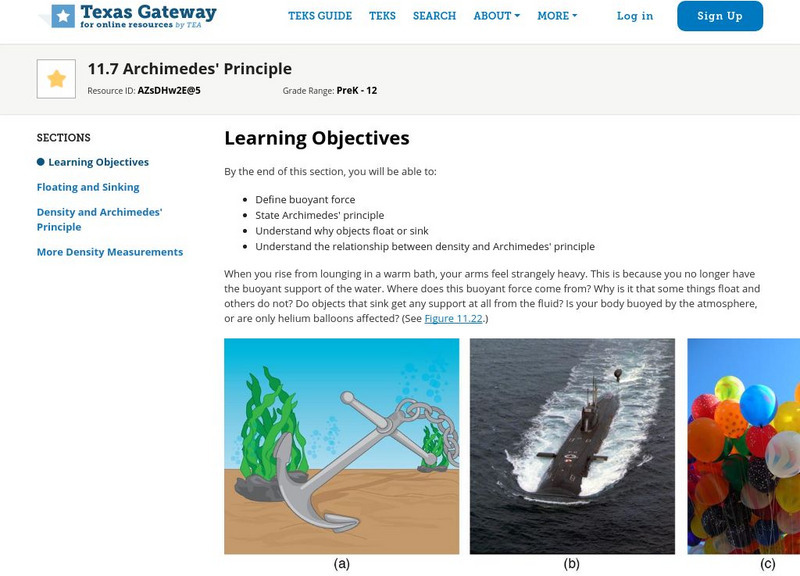
Texas Gateway: Ap Physics: Fluid Statics: Archimedes' Principle
By the end of this section, you will be able to define buoyant force, state Archimedes' principle, understand why objects float or sink, and understand the relationship between density and Archimedes' principle.
TeachEngineering
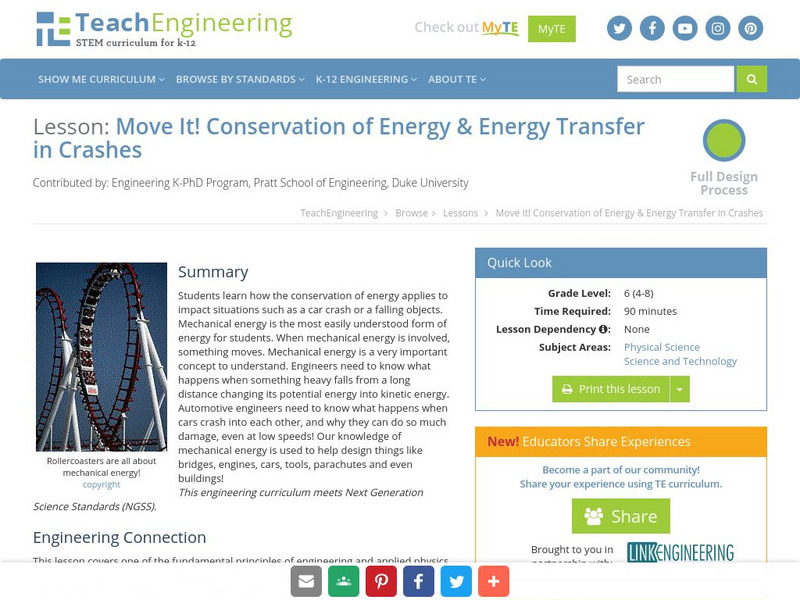
Teach Engineering: Move It!
Mechanical energy is the most easily understood form of energy for students. When there is mechanical energy involved, something moves. Mechanical energy is a very important concept to understand. Engineers need to know what happens when...
Other
Personal: The Laws of Motion
This personal site explains the physics of angular momentum and their application to flight. Part of a much larger site on the procedures, principles, and perceptions of flight.
Physics Classroom
The Physics Classroom: Satellite Motion
An animation depicting the path of projectiles launched at various launch speeds from the fictional Newton's Mountain. Accompanying text discusses satellite motion and the requirements of orbital motion. Links to further information is...
PBS
Pbs Learning Media: Newton's Third Law: Action Reaction
An early astronaut's experiences teach students that Newton's third law of motion-for every action, there is an equal and opposite reaction-applies both on Earth and in outer space.
Physics Classroom
The Physics Classroom: Energy Relationships for Satellites
The orbits of satellites are described and an energy analysis is performed. Kinetic, potential and total mechanical energy are explained and applied to the motion of satellites.
Encyclopedia of Earth
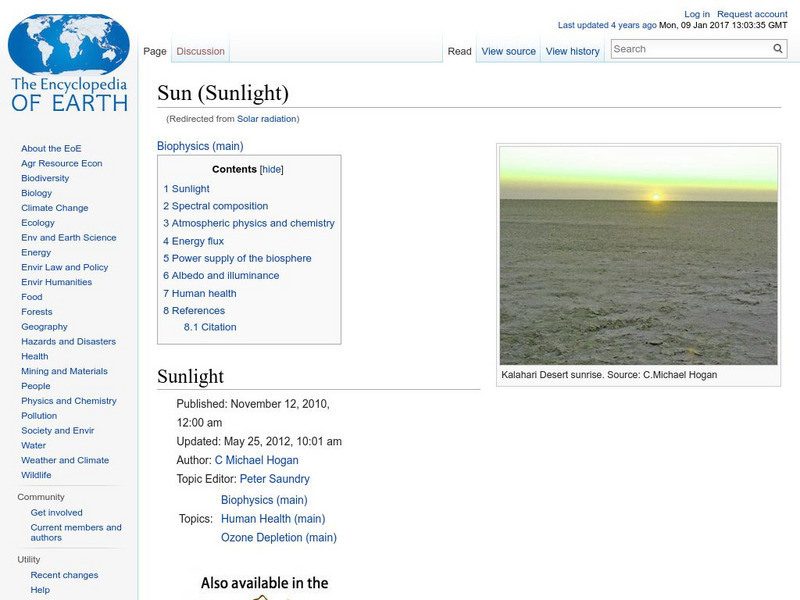
Encyclopedia of Earth: Solar Radiation
Almost all of the energy that drives the various systems (climate systems, ecosystems, hydrologic systems, etc.) found on the Earth originates from the sun. Solar energy is created at the core of the sun when hydrogen atoms are fused...
Utah Education Network
Uen: Mr. And Miss Big Feet
Gravity is affected by the magnitude or size of the gravitational force between two objects and the masses and distance between them.
PBS
Pbs Learning Media: Spin a Spiral Galaxy
This interactive activity from NOVA Online lets you spin a spiral galaxy, including our own Milky Way. It demonstrates that what you can learn from visible light observations of a galaxy is largely determined by the angle from which you...
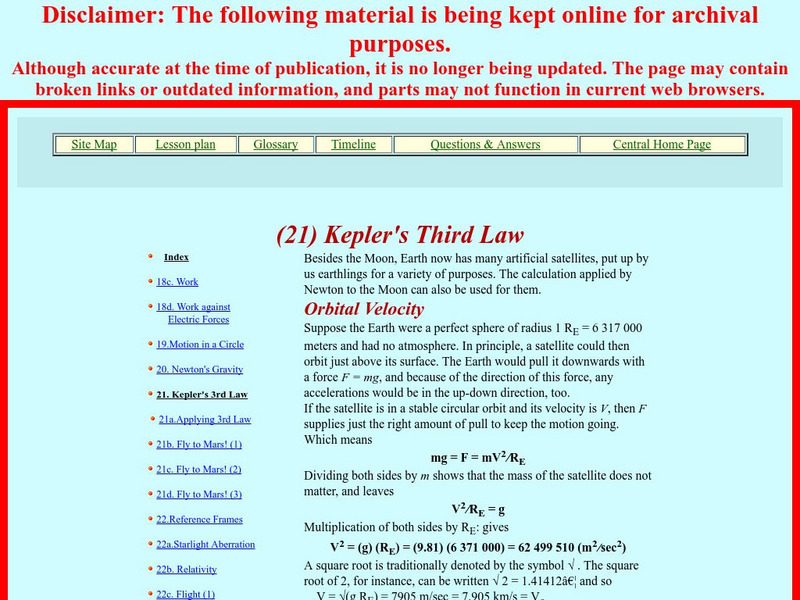
NASA
Nasa: Kepler's Third Law
This site from NASA states Kepler's third law of motion and extends it to develop an equation for the velocity of an orbiting planet.
Other popular searches
- Calculating Force of Gravity
- Force of Gravity Formula
- Force of Gravity Photos
- Force of Gravity Lessons
- Force of Gravity Powerpoint