Hi, what do you want to do?






University of Colorado
University of Colorado: Ph Et Interactive Simulations: Projectile Motion
An interactive simulation that teaches about kinematics, air resistance, and parabolic curve by shooting a car out of a cannon while trying to hit a target. Observe how changes in angle, initial speed, mass, air resistance, and drag...

Physics Classroom
The Physics Classroom: Resultants
A tutorial that describes what a resultant is and how a resultant is determined.
Physics Classroom
The Physics Classroom: Horizontally Launched Projectile Problems
In the case of projectiles, students use information about the initial velocity and position of a projectile to predict such things as how much time the projectile is in the air and how far the projectile will go. They do this to make...
Massachusetts Institute of Technology
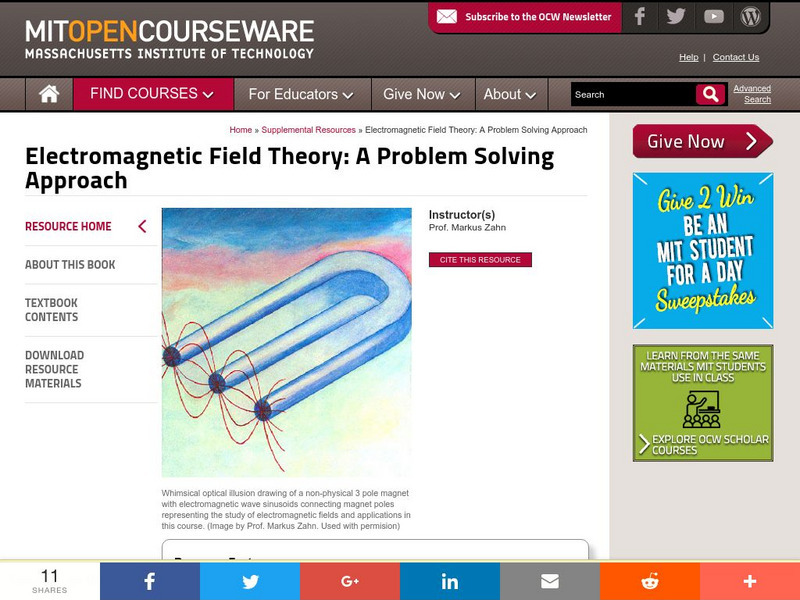
Mit: Open Course Ware: Resources: Electromagnetic Field Theory
College-level electrical engineering textbook starting from the Coulomb-Lorentz force law on a point charge. Sample problems that reinforce the content are found at the end of each chapter. Includes downloadable excerpts of the textbook...
Physics Classroom
The Physics Classroom: Circular and Satellite Motion: Roller Coaster Model
An interactive playground for students to explore the physics of roller coasters. Learners investigate by changing the variables of force, velocity, friction, and vectors. Energy bar charts are displayed as the coaster car moves along...
Concord Consortium
Concord Consortium: Molecular Workbench: Shock Wave Propagation
Adjust variables in this shock wave propagation simulation. Observe the density and pressure waves.
Physics Classroom
The Physics Classroom: Circular and Satellite Motion: Principles for Satellites
Students explore how a satellite's motion is governed by the same physics principles and described by the same mathematical equations.

Khan Academy
Khan Academy: Start: How Do Computers Simulate the Motion of Virtual Particles?
In this instructional activity we'll explore how we use fairly simple physics to draw particles which move according to the forces we feel in the real world (such as wind & gravity).
Physics Classroom
The Physics Classroom: Describing Motion With Words
This lesson from the Glenbrook South High School gives a nice review and detailed explanation of velocity, speed, distance, displacement, and acceleration. A good introduction to the "language of Kinematics."
Sophia Learning
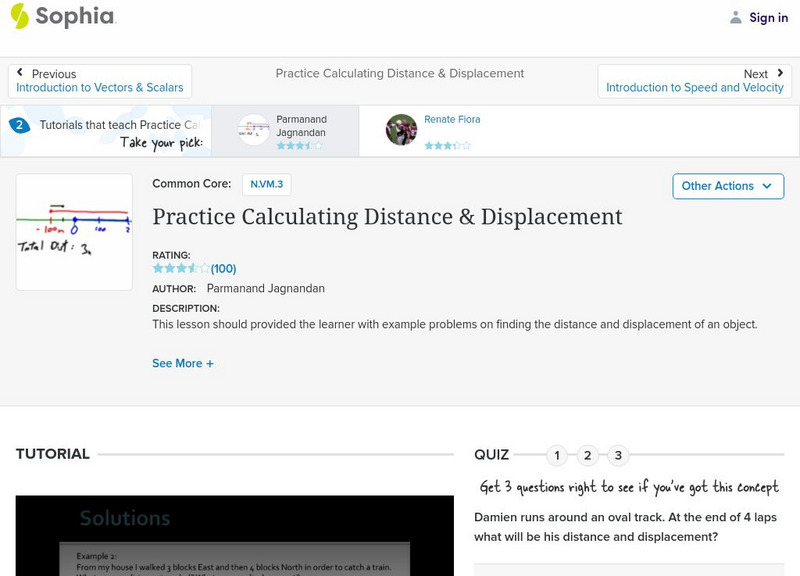
Sophia: Practice Calculating Distance & Displacement: Lesson 1
This lesson should provided the learner with example problems on finding the distance and displacement of an object. It is 1 of 2 in the series titled "Practice Calculating Distance & Displacement."
Physics4kids
Physics 4 Kids: Motion/mechanics Overview Quiz
Take this ten question multiple choice quiz on motion and mechanics.
Physics Classroom
The Physics Classroom: Satellite Motion
An animation depicting the path of projectiles launched at various launch speeds from the fictional Newton's Mountain. Accompanying text discusses satellite motion and the requirements of orbital motion. Links to further information is...
Concord Consortium
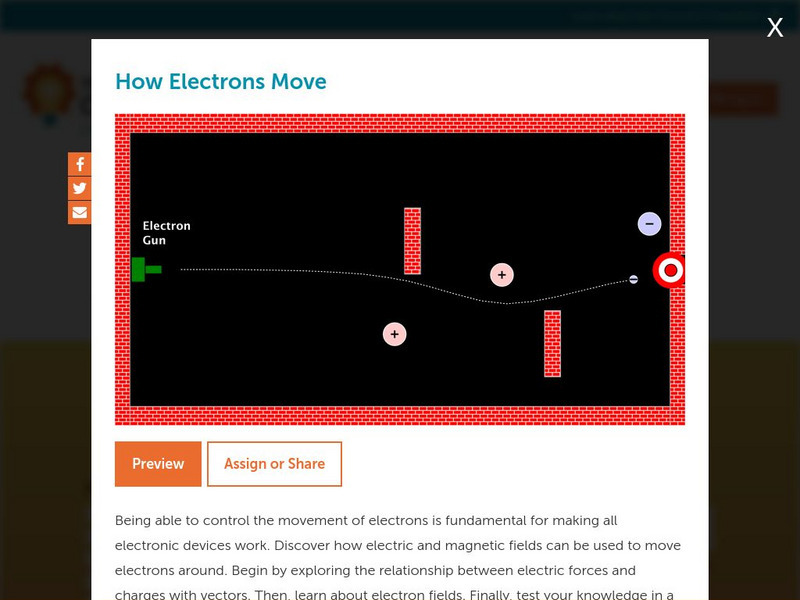
Concord Consortium: How Electrons Move
Being able to control the movement of electrons is fundamental for making all electronic devices work. Discover how electric and magnetic fields can be used to move electrons around. Begin by exploring the relationship between electric...
Walter Fendt
Walter Fendt: Apps Zur Physik
This site, in German, offers numerous apps that illustrate common physics principles. Apps are organized into categories: mechanics, oscillations and waves, electrodynamics, optics, thermodynamics, the theory of relativity, physics of...
US Department of Energy
Fermilab: Questions About Physics: Big Bang & Bosons
What are serious scientists are saying about bosons? This site provides text correspondence between two scientists in question-answer format. Shows why bosons are so important in particle physics.
Other
Fearof Physics: Videos
Looking for some more explanantion on a topic covered in physics class? This site contains videos that explore some physics concepts. Videos are broken down by topics. Some videos also give examples on how to solve problems.
NASA
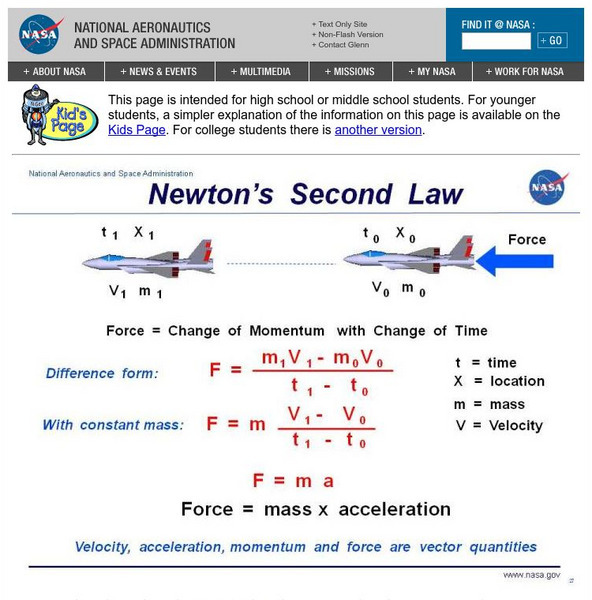
Nasa: Beginner's Guide to Aerodynamics
This site from NASA provides a graphic depicting Newton's second law. Graphic is accompanied by an explanation. Part of a larger site with additional information on Newton's laws.