Hi, what do you want to do?





Science Education Resource Center at Carleton College
Serc: Using Your Marbles: Making Energy Work for You
This activity is based on the common experiment of running a marble down a ramp to do work on a cup. Students will be able to see the relationship between mass and energy of the marble and the ramp height.

CK-12 Foundation
Ck 12 Exploration Series: Simulations: Physics: Ramp and Piano
[Free Registration/Login Required] This module has students using a simple machine to learn about the relationship between work, force, and energy.
CK-12 Foundation
Ck 12 Exploration Series: Simulations: Physics: Block and Tackle
[Free Registration/Login Required] A video module where students learn about the relationship between force, work, energy, and mechanical advantage using a simple machine.

TED Talks
Ted: Ted Ed: How Does Work, Work?
In this video, Peter Bohacek explains the interplay between work and power and how it can be seen in the functioning of a clock. [4:31] Followed by a short quiz and a list of additional resources to explore.
Texas Education Agency
Texas Gateway: Ap Physics: Conservative Forces and Potential Energy
By the end of this section, you will be able to define conservative force, potential energy, and mechanical energy; explain the potential energy of a spring in terms of its compression when Hooke's law applies; and use the work-energy...
OpenStax
Open Stax: Nonconservative Forces
In the following interactive students will begin to define nonconservative forces and explain how they affect mechanical energy. They will show how the principle of conservation of energy can be applied by treating the conservative...
OpenStax
Open Stax: Kinetic Energy and the Work Energy Theorem
In the following interactive students will begin to explain work as a transfer of energy and net work as the work done by the net force. They will also explain and apply the work-energy theorem.
Texas Education Agency
Texas Gateway: Ap Physics: Gravitational Potential Energy
By the end of this section, you will be able to explain gravitational potential energy in terms of work done against gravity, show that the gravitational potential energy of an object of mass m at height h on Earth is given by PEg = mgh,...
OpenStax
Open Stax: Work: The Scientific Definition
In the following interactive students will begin to explain how an object must be displaced for a force on it to do work. They will also explain how relative directions of force and displacement determine whether the work done is...
Physics Classroom
The Physics Classroom: Work, Energy, and Power: Internal vs. External Forces
Through illustrated examples and interactive examples, students learn about the two categories of forces are referred to as internal forces and external forces.
Texas Education Agency
Texas Gateway: Kinetic Energy and the Work Energy Theorem
By the end of this section, you will be able to explain work as a transfer of energy and net work as the work done by the net force and to explain and apply the work-energy theorem.
Massachusetts Institute of Technology
Mit: Open Course Ware: Force and Potential Energy
The activity investigates conservation of energy. Some topics explored are friction, kinetic energy, conservation of energy, and potential energy. The resource consists of video clips, lecture notes, practice problems, and exam...
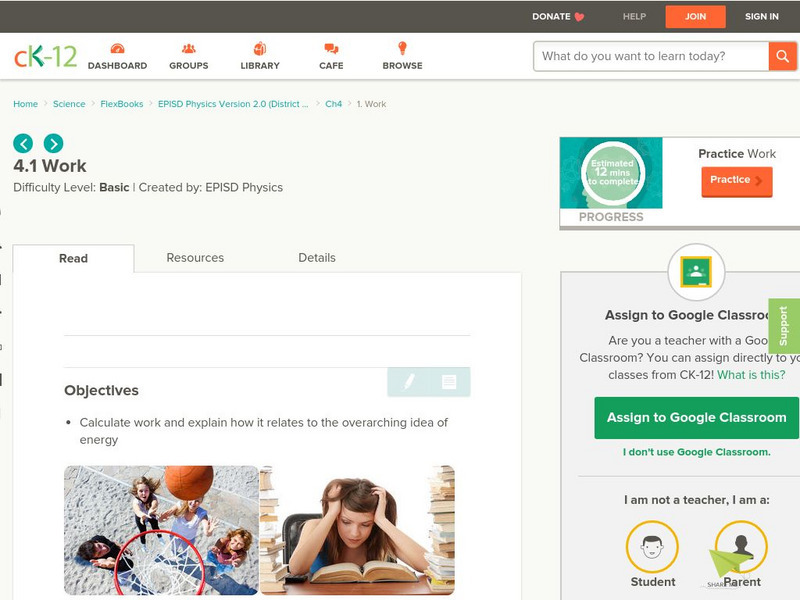
CK-12 Foundation
Ck 12: Work
[Free Registration/Login may be required to access all resource tools.] In this online lesson students will learn to calculate work and explain how it relates to the overarching idea of energy.
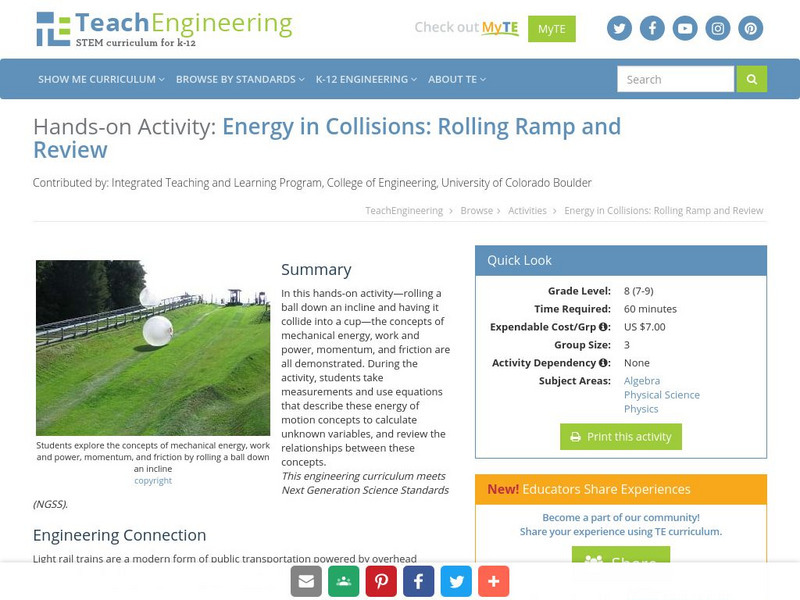
TeachEngineering
Teach Engineering: Ramp and Review
In this hands-on activity - rolling a ball down an incline and having it collide into a cup - the concepts of mechanical energy, work and power, momentum, and friction are all demonstrated. During the activity, students take measurements...

TeachEngineering
Teach Engineering: Ramp and Review (For High School)
In this hands-on activity - rolling a ball down an incline and having it collide into a cup - the concepts of mechanical energy, work and power, momentum, and friction are all demonstrated. During the activity, students take measurements...

Georgia State University
Georgia State University: Hyper Physics: Potential Energy
This site from Georgia State University Physics Department defines and explains the concept of potential energy. Using equations and graphics to illustrate the idea, it discusses the many types of potential energy (gravitational,...

TeachEngineering
Teach Engineering: Energy Basics
Demos and activities in this activity are intended to illustrate the basic concepts of energy science--work, force, energy, power etc., and the relationships among them. The "lecture" portion of the activity includes many demonstrations...
Other
Mechanical Systems
A collection of resources on how humans use machines and tools to meet their needs. Covers simple and complex machines, subsystems that transfer forces, mechanical advantage, speed ratio, the effect of friction, efficiency, the science...
Physics Classroom
The Physics Classroom: Work, Energy, and Power: Mechanical Energy Is Conserved
In this interactive exercise, explore the quantitative relationship between work and mechanical energy in situations in which there are no external forces doing work.
Physics Classroom
The Physics Classroom: Work, Energy, and Power: Application/practice Questions
Through illustrated examples and practice problems, students apply the relationship between work and mechanical energy change to a variety of motion scenarios in order to test our understanding.
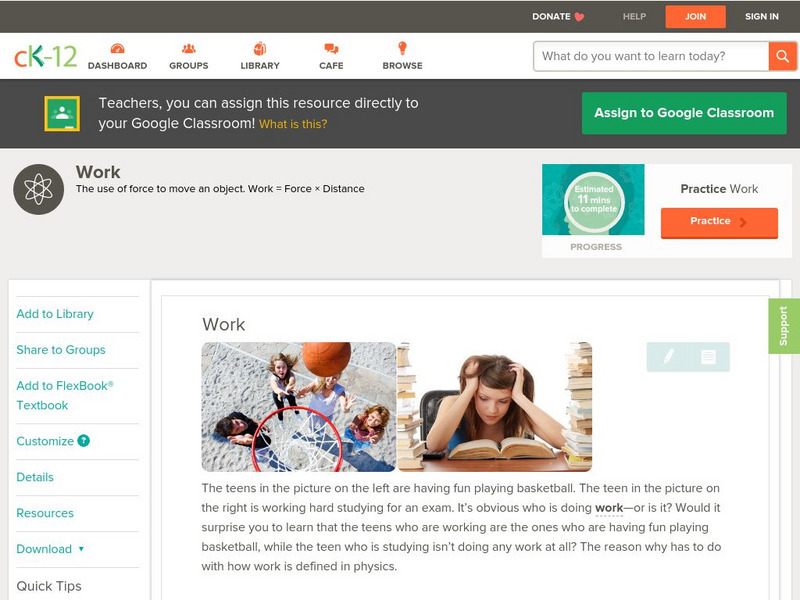
CK-12 Foundation
Ck 12: Physical Science: Work
[Free Registration/Login may be required to access all resource tools.] Definition of work and how it relates to force and distance.
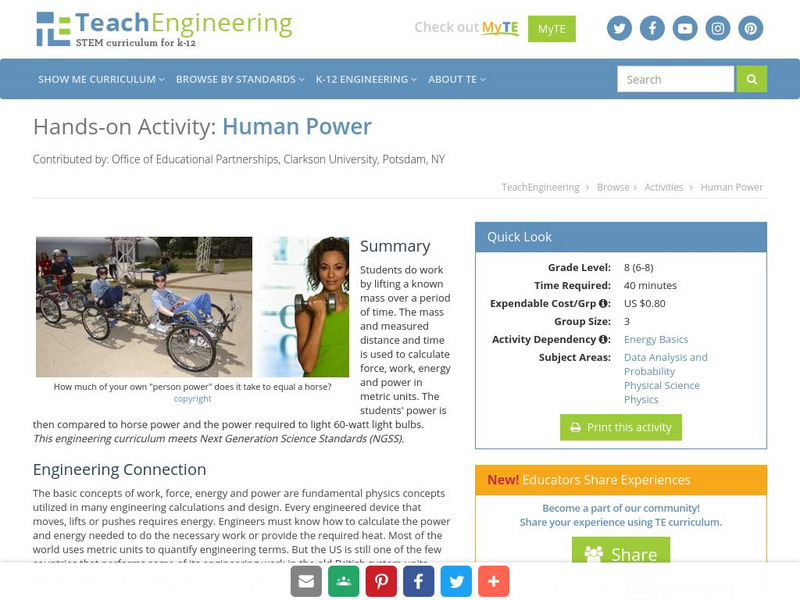
TeachEngineering
Teach Engineering: Human Power
Students do work by lifting a known mass over a period of time. The mass and measured distance and time is used to calculate force, work, energy and power in metric units. The students' power is then compared to horse power and the power...
TryEngineering
Try Engineering: Working With Watermills
Teams of students design, build, test, and evaluate a working watermill made from everyday materials. Lesson explores how watermills generate energy from water, while students gain an understanding of the structural engineering design...
Physics Classroom
The Physics Classroom: Work, Energy, Power: Situations Involving External Forces
Through interactive exercises and illustrated examples, students analyze situations involving external forces.