Hi, what do you want to do?






Curated OER
Super Scientists Code
In this science worksheet, middle schoolers use the key code on the right to unscramble each of the scientists. They also match each of the scientists found to their correct description.

Curated OER
The Nutrients Public Transportation System
Students investigate the human circulatory system by experimenting with hoses. In this human body lesson, students create a system of hoses simulating the circulatory system which they utilize to pass objects through....

Curated OER
Cell Organelles
Students explore biology by researching living cells. In this living organism lesson, students participate in a role-playing activity in which all the students in class form one plant cell by portraying specific parts of a cell. Students...

Curated OER
Sentence Completion
In this grammar instructional activity, students finish ten sets of unfinished sentences by joining them together with a variety of -ing expressions.

Curated OER
Ionocraft Lifter
Students explore the different types of lifters through a series of activities. In this physics lesson, students explain the mechanics involved in the lifter designs. They compare aluminum versus zinc lifters.
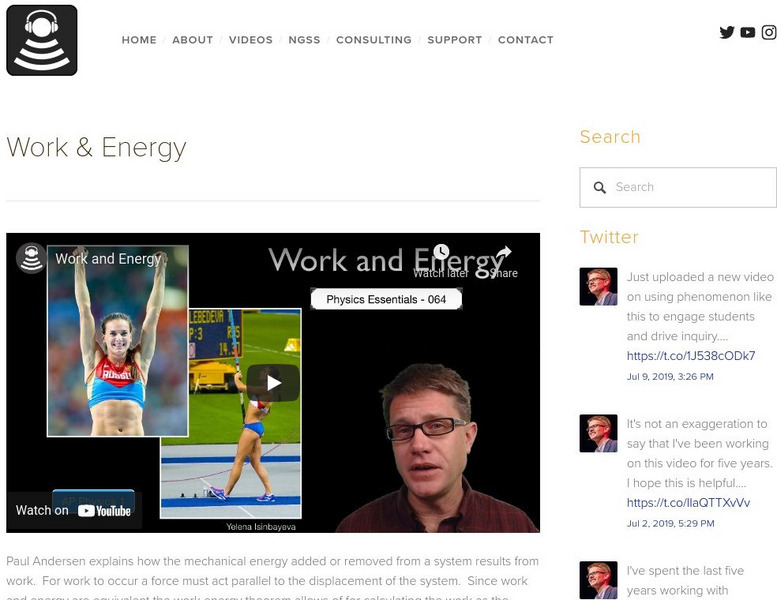
Bozeman Science
Bozeman Science: Work and Energy
In the following video Paul Andersen explains how the mechanical energy added or removed from a system results from work. For work to occur a force must act parallel to the displacement of the system. Since work and energy are equivalent...
![Harvard University: Math 21a Supplement 1 on Work and Energy [Pdf] Handout](https://static.lp.lexp.cloud/images/attachment_defaults/resource/large/FPO-knovation.png "Harvard University: Math 21a Supplement 1 on Work and Energy [Pdf] Handout")
Harvard University
Harvard University: Math 21a Supplement 1 on Work and Energy [Pdf]
A handout for a university calculus course. It looks at the application of Newton's Laws to calculate work and energy for a particle of mass with a force being exerted on it.
University of California
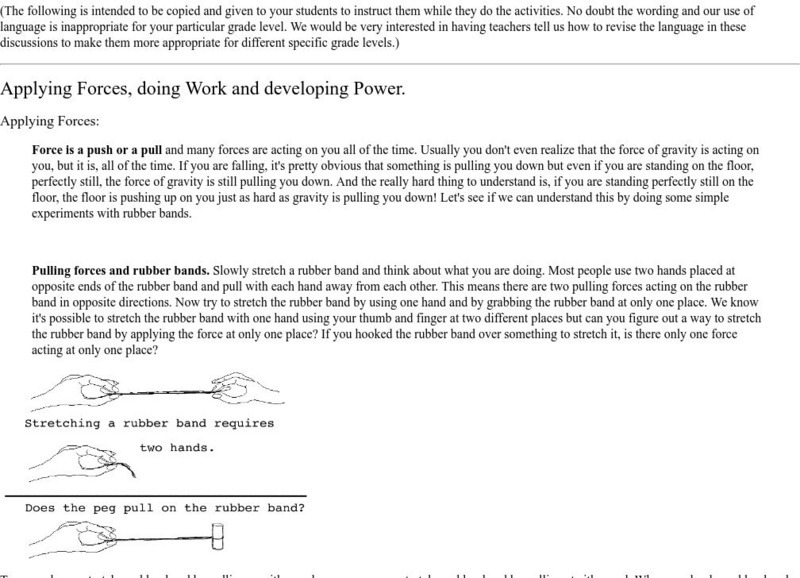
University of California Los Angeles: Force, Work and Power
Describes the definition and relationships between force, work and power. Includes nice drawings to increase conceptual understanding.
Physics Classroom
The Physics Classroom: Work and Energy: Energy Transformation Downhill Skiing
The intricate relationship between work and mechanical energy is depicted in the animation for students to be able to visualize.
Physics Classroom
The Physics Classroom: Work and Energy: Which Path Requires the Most Energy?
Suppose that a car traveled up three different sloped roadways from the base of a mountain to the summit of the mountain. Which path would require the most energy? See this animation and explanation for help.
Texas Education Agency
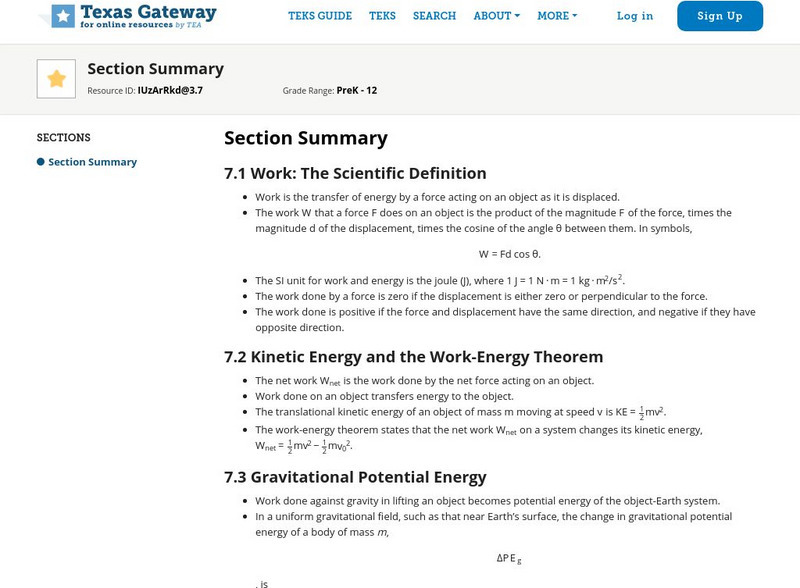
Texas Gateway: Work, Energy, and Energy Resources: Summary
This is a summary of the information in Chapter 7: Work, Energy, and Energy Resources for the AP Physics I course online.
Texas Education Agency
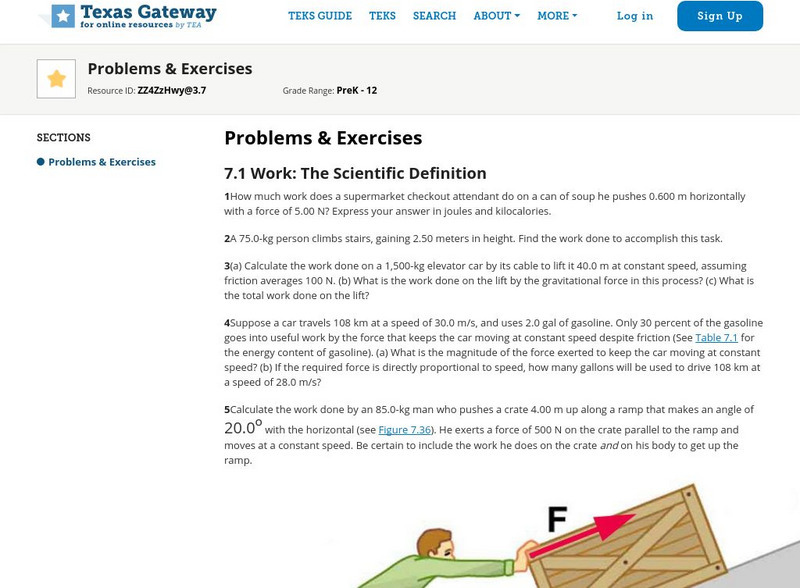
Texas Gateway: Work, Energy, and Energy Resources: Problems & Exercises
This is a list of 74 problems/exercises to solve over the content of Chapter 7: Work, Energy, and Energy Resources from the AP Physics online text.
Texas Education Agency
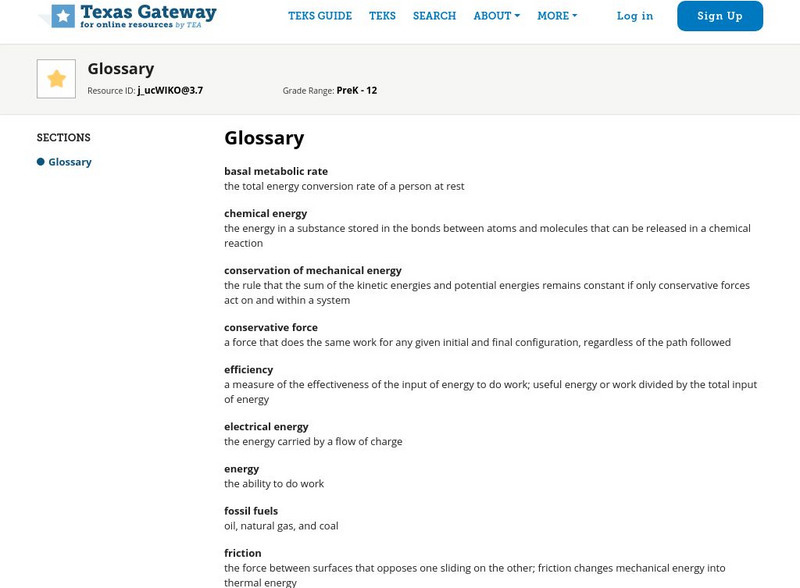
Texas Gateway: Work, Energy, and Energy Resources: Glossary
This is a glossary of words and definitions of terms having to do with work, energy, and energy resources.

Science Education Resource Center at Carleton College
Serc: Com Padre: Introduction to Work and Energy: The Hopper Popper Surprise
This activity will provide students with a qualitative understanding of the Work-Energy Theorem, especially on how the energy transferred depends on the distance over which the force is applied.

Georgia Department of Education
Ga Virtual Learning: Ap Physics 1: Work, Energy, and Power
The mathematical model for the relationships between work and energy serves to model physical problems and, more importantly, predict natural and man-made phenomena. Students discover the relationships which serve as a powerful...
CK-12 Foundation
Ck 12: Work
[Free Registration/Login may be required to access all resource tools.] In this module, calculate work and explain how it relates to the overarching idea of energy.
Physics Classroom
The Physics Classroom: Work, Energy, and Power: Power
In this interactive module, students learn the basic terminology and concepts of power as it has to do with work and energy.
Physics Classroom
The Physics Classroom: The Work Energy Theorem
This page explores the quantitative relationship between work and mechanical energy in situations in which there are no external forces doing work. It is a basic analysis of situations in which mechanical energy is conserved. Examples...
TeachEngineering
Teach Engineering: Energy of Motion
By taking a look at the energy of motion all around us, students learn about the types of energy and their characteristics. They first learn about the two simplest forms of mechanical energy: kinetic and potential energy, as illustrated...
TeachEngineering
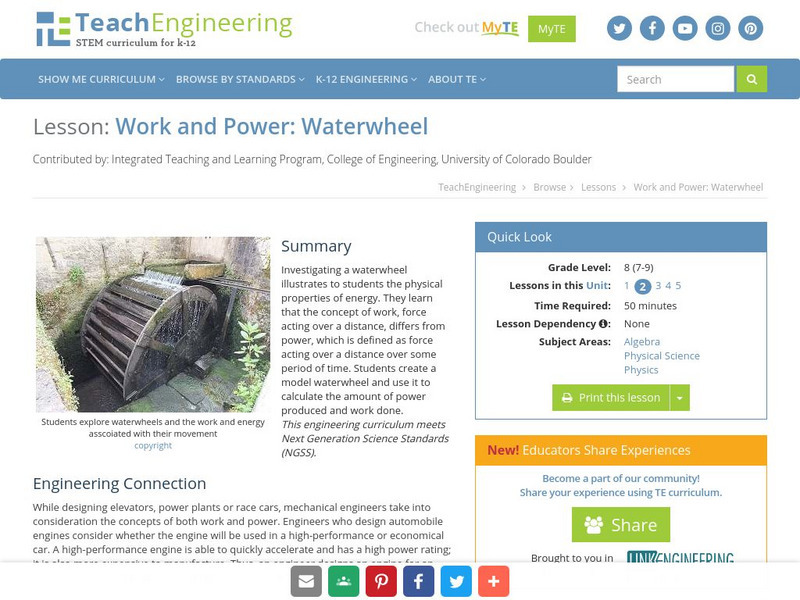
Teach Engineering: Work and Power: Waterwheel
Investigating a waterwheel illustrates to middle schoolers the physical properties of energy. They learn that the concept of work, force acting over a distance, differs from power, which is defined as force acting over a distance over...
Texas Education Agency
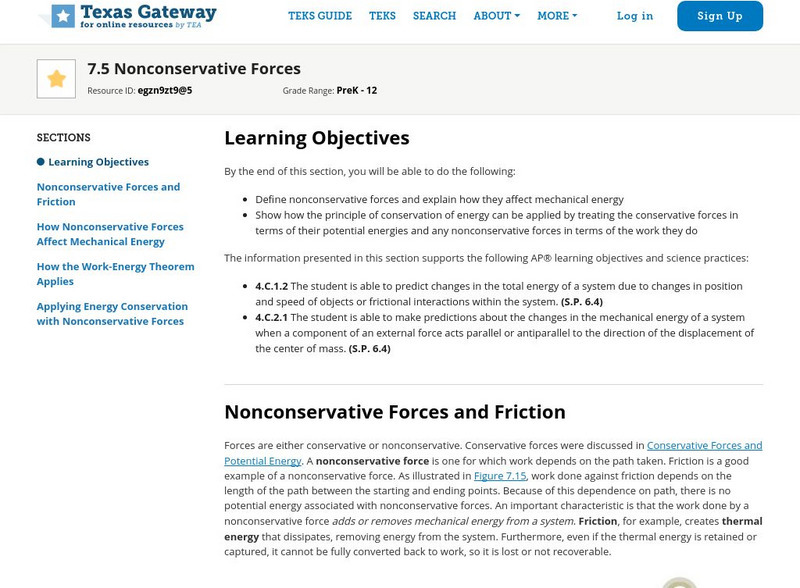
Texas Gateway: Nonconservative Forces
By the end of this section, you will be able to define nonconservative forces and explain how they affect mechanical energy, and to show how the principle of conservation of energy can be applied by treating the conservative forces in...
OpenStax
Open Stax: Potential Energy and Conservative Forces
In the following interactive students will define conservative force, potential energy, and mechanical energy. They will explain the potential energy of a spring in terms of its compression when Hooke's Law applies. Students will also...
Texas Education Agency
Texas Gateway: Work Energy Theorem
Using diagrams, illustrations, and relevant data, students will calculate the net work done on an object, the change in an object's velocity, and the change in an object's kinetic energy.
Physics Classroom
The Physics Classroom: Work, Energy, and Power: Calculating Work Done by Forces
Through interactive practice problems and examples, students calculate the amount of work done by forces.