Hi, what do you want to do?





Texas Education Agency
Texas Gateway: What Is Force?
You have probably heard the word "force" before in conversations. Here are a few examples: "the rocket had a lot of force at blast off" or "the force of the storm blew the roof off the building." What is force? Force is defined as a push...
Science Buddies
Science Buddies: You Nailed It! Hammering Force for Different Types of Wood
This Science Buddies project explains how to build a mechanism that will reproducibly swing a hammer so you can determine the amount of force needed to hammer a nail through various densities of wood. The Science Buddies project ideas...

Sophia Learning
Sophia: Friction: Lesson 4
This lesson will introduce the concept of friction and explain how it can affect forces. It is 4 of 5 in the series titled "Friction."

Discovery Education
Discovery Education: Friction in Our Lives
Students observe objects in motion down a ramp to discover how the force of friction affects an object's motion. Includes the lesson plan, vocabulary list, and extensions for students.
University of Minnesota
University of Minnesota: Mechanics Problems: Force Problems
This University of Minnesota site provides a series of contextually rich, real-world problems demonstrating force and Newton's second law of motion.
Science Education Resource Center at Carleton College
Serc: Newton's Second Law: Constant Force Applied to a Skateboarder
In this lab activity, students will become familiar with Newton's 2nd Law of Motion. By investigating the motion of different skateboarders pulled with a variety of constant force values, they will discover that bodies acted on by a...
Texas Education Agency
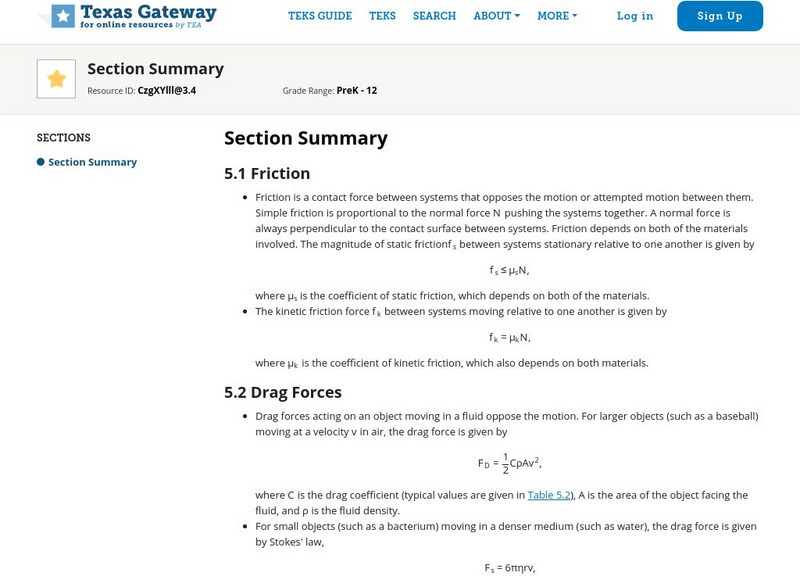
Texas Gateway: 5 Newton's Laws: Friction, Drag, and Elasticity: Summary
This page summarizes each section of Chapter 5: Further Applications of Newton's Laws: Friction, Drag, and Elasticity from the AP Physics online text. These include friction, drag force, and elasticity: stress and strain.
Texas Instruments
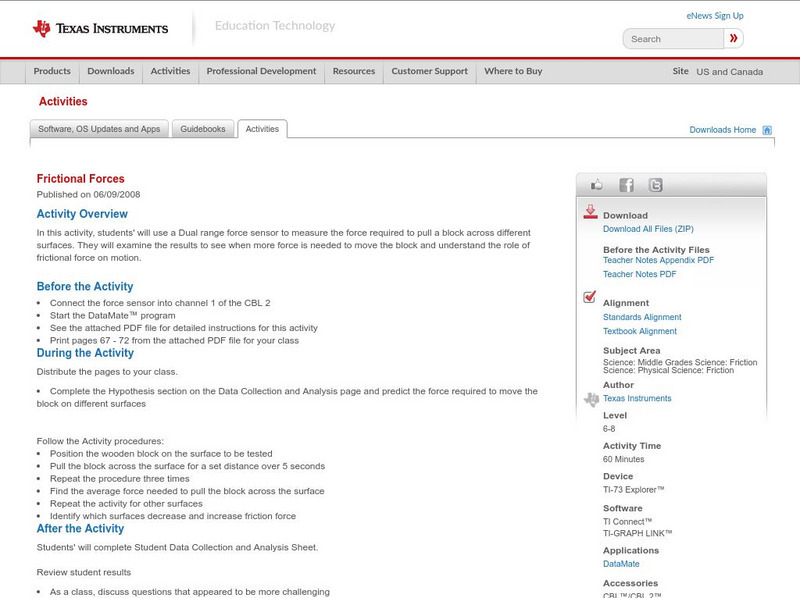
Texas Instruments: Frictional Forces
In this activity, students' will use a Dual range force sensor to measure the force required to pull a block across different surfaces. They will examine the results to see when more force is needed to move the block and understand the...
Science Education Resource Center at Carleton College
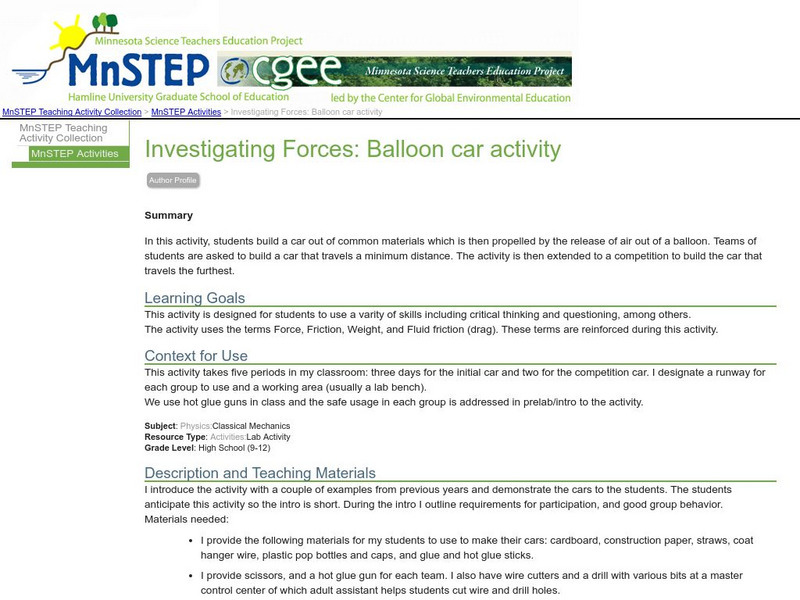
Serc: Investigating Forces: Balloon Car Activity
In this activity, teams of students build a car out of common materials which is then propelled by the release of air out of a balloon and must travel a minimum distance. The activity is then extended to a competition to build the car...

Massachusetts Institute of Technology
Mit: Open Course Ware: Force and Potential Energy
The activity investigates conservation of energy. Some topics explored are friction, kinetic energy, conservation of energy, and potential energy. The resource consists of video clips, lecture notes, practice problems, and exam...
CK-12 Foundation
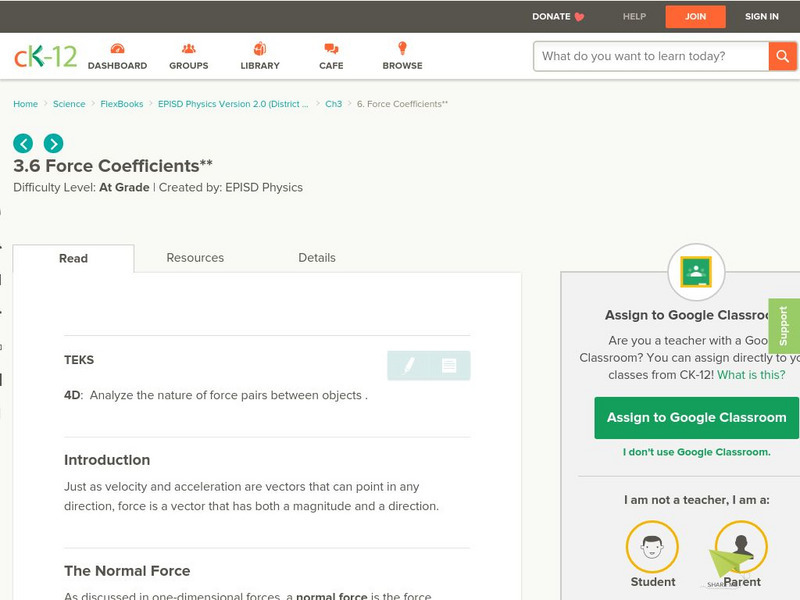
Ck 12: Episd: Force Coefficients
[Free Registration/Login may be required to access all resource tools.] Understand the effects of magnitude of force pairs between objects. Know the differences between kinetic and static friction.
TeachEngineering
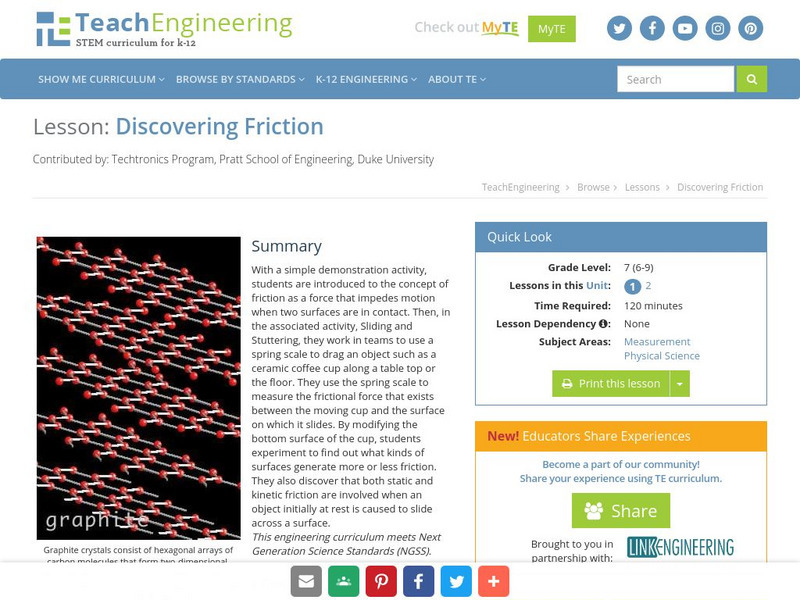
Teach Engineering: Discovering Friction
With a simple demonstration activity, students are introduced to the concept of friction as a force that impedes motion when two surfaces are in contact. Then, in the Associated Activity (Sliding and Stuttering), they work in teams to...
TeachEngineering
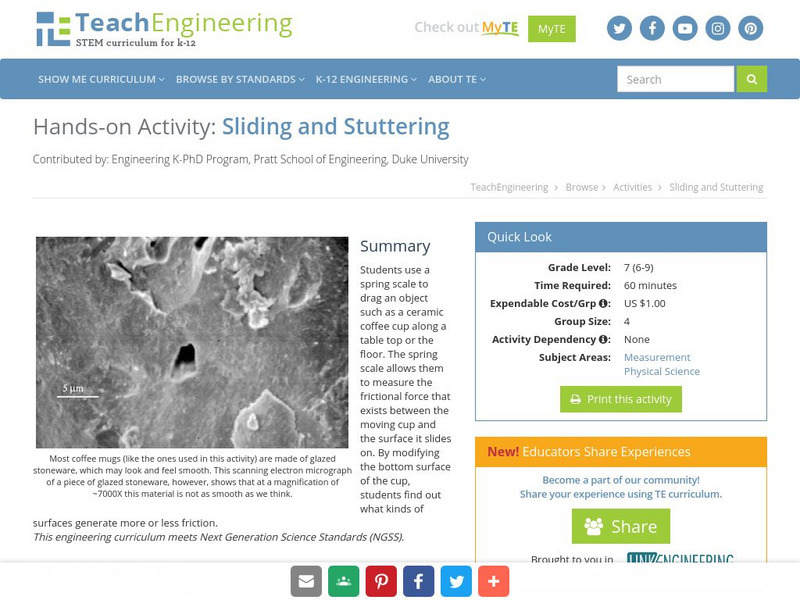
Teach Engineering: Sliding and Stuttering
Students use a spring scale to drag an object such as a ceramic coffee cup along a table top or the floor. The spring scale allows them to measure the frictional force that exists between the moving cup and the surface it slides on. By...
University of Alaska
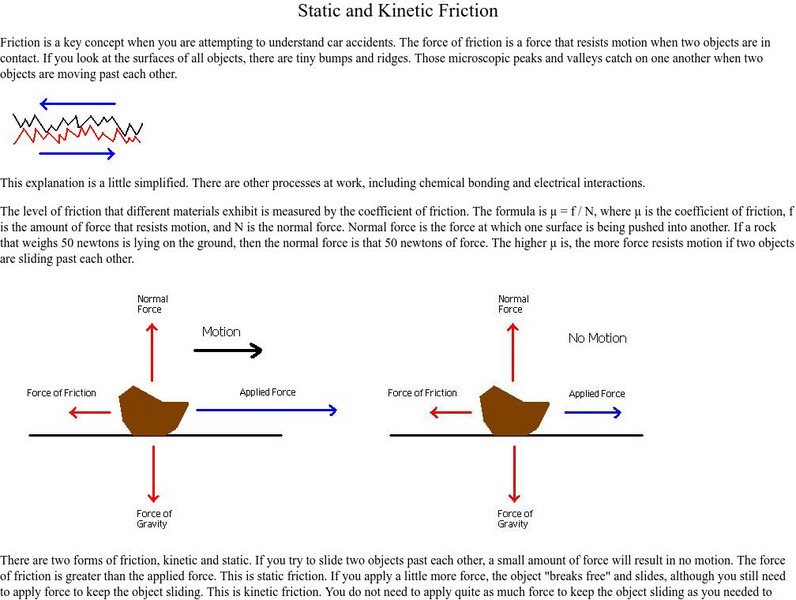
University of Alaska Fairbanks: Static and Kinetic Friction
Explains what static and kinetic friction are, what their coefficients of friction are in different scenarios, and how these concepts are applied when looking at automobile braking distances and vehicle control when driving.

BBC
Bbc Schools: Ks2 Bitesize: Science: Physical Processes: Friction
Use your knowledge about friction to help Carrie get to the Invigatron before someone steals it. Following the activity, read more about friction and resistance, and then take a quick quiz to check for understanding.

Oklahoma Mesonet
University of Oklahoma: High and Low Pressure
This University of Oklahoma meteorology tutorial explores both high and low pressure systems--how they form and the different forms they take.
TeachEngineering
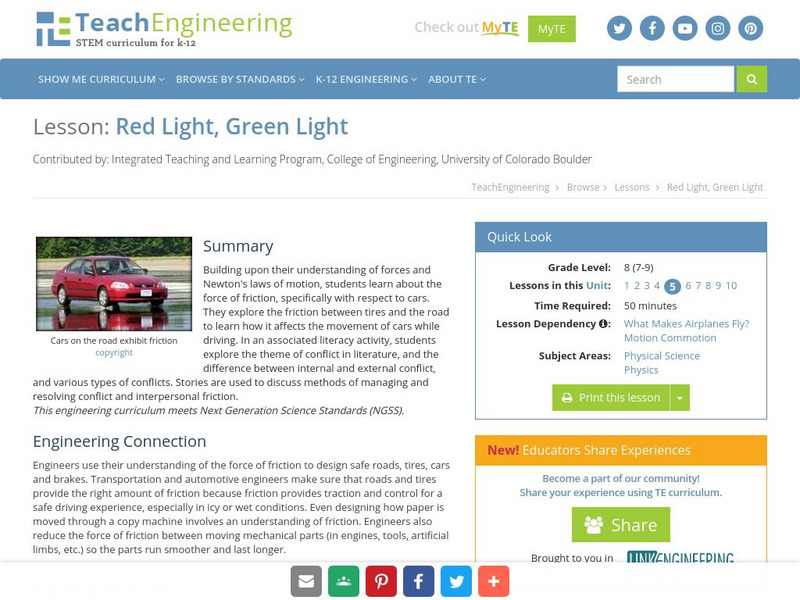
Teach Engineering: Red Light, Green Light
Building upon their understanding of forces and Newton's laws of motion, students learn about the force of friction, specifically with respect to cars. They explore the friction between tires and the road to learn how it affects the...
TeachEngineering
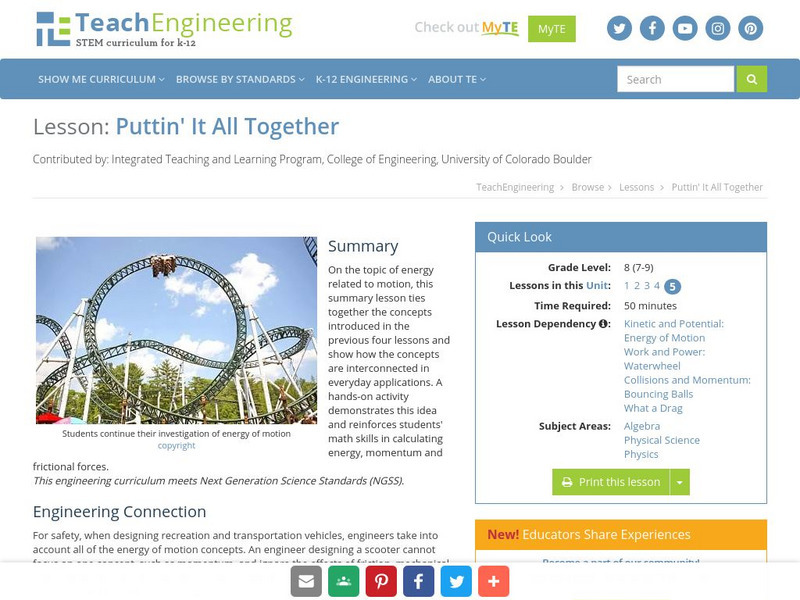
Teach Engineering: Puttin' It All Together
On the topic of energy related to motion, this summary lesson is intended to tie together the concepts of work, power, collisions, momentum and drag. A hands-on activity demonstrates this idea and reinforces students' math skills in...
University of Minnesota
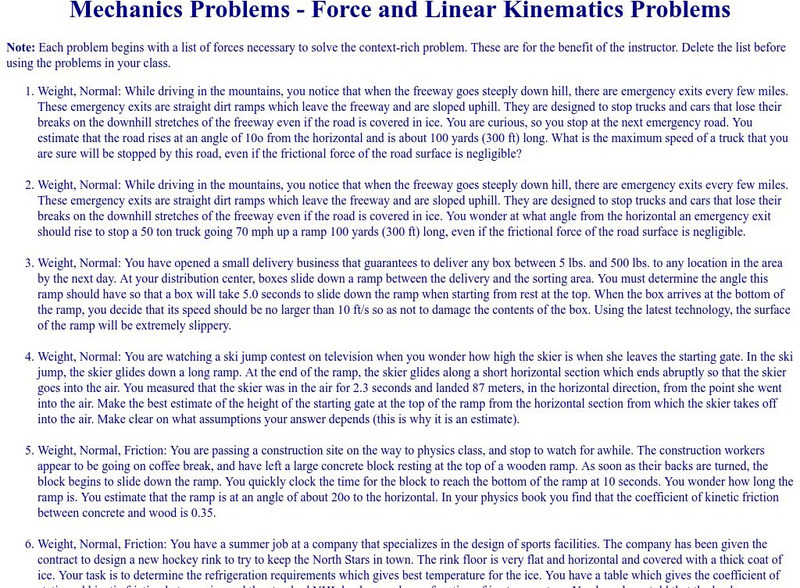
University of Minnesota: Mechanics Problems: Force and Linear Kinematics Problem
This University of Minnesota site provides a series of contextually rich problems pertaining to force, Newton's second law of motion, and linear kinematics.
TeachEngineering
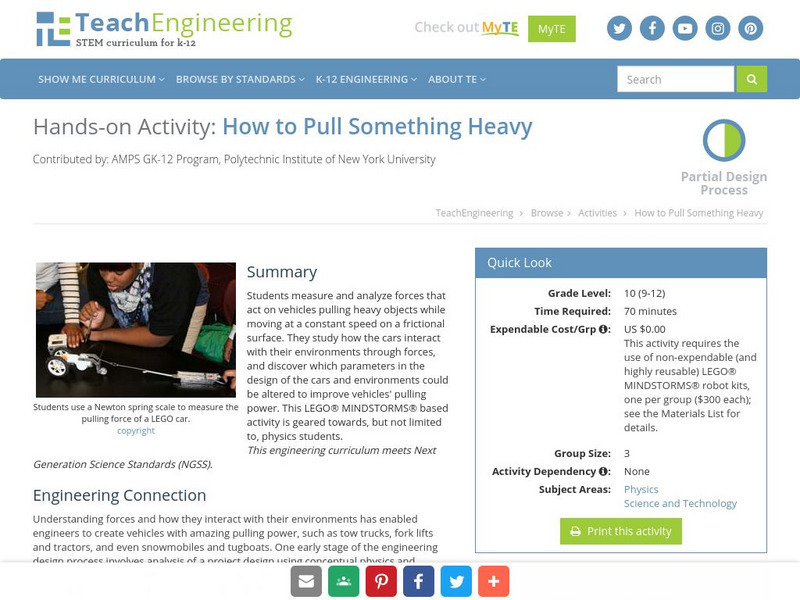
Teach Engineering: How to Pull Something Heavy
Students measure and analyze forces that act on vehicles pulling heavy objects while moving at a constant speed on a frictional surface. They study how the cars interact with their environments through forces, and discover which...
TeachEngineering
Teach Engineering: Measuring Pressure
Students learn first-hand the relationship between force, area and pressure. They use a force sensor built from a LEGO MINDSTORMS NXT kit to measure the force required to break through a paper napkin. An interchangeable top at the end of...
Texas Education Agency
Texas Gateway: Further Applications of Newton's: Elasticity: Stress and Strain
By the end of this section, you will be able to state Hooke's law; explain Hook's law using graphical representations between deformation and applied force; discuss the three types of deformations: changes in length, sideways shear, and...