Hi, what do you want to do?





University of Colorado
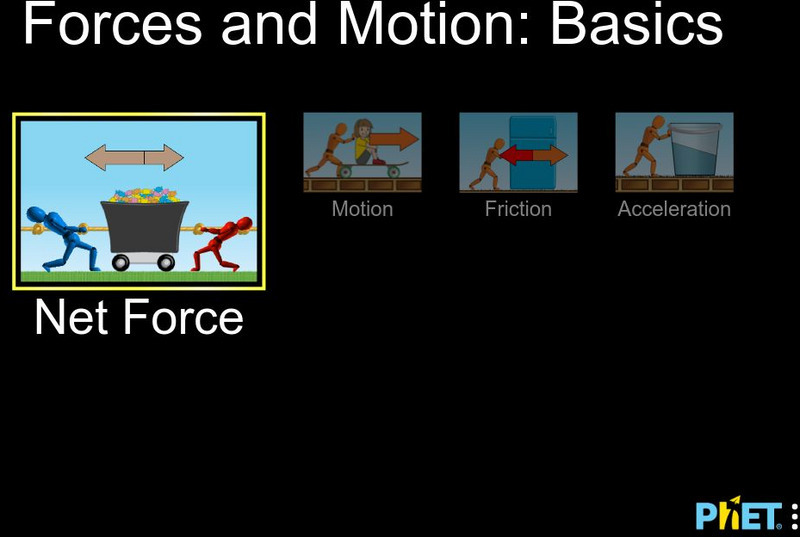
University of Colorado: Ph Et Interactive Simulations: Forces and Motion: Basics
Explore the forces at work when pulling against a cart, and pushing a refrigerator, crate, or person. Create an applied force and see how it makes objects move. Change friction and see how it affects the motion of objects.

Georgia Department of Education
Ga Virtual Learning: Physical Science: Force and Motion
In this student-paced module, students apply Newton's Laws of Motion to everyday life, calculate mathematical relationships involving force and motion using algebraic formulas, and understand the difference between mass and weight.
University of Colorado
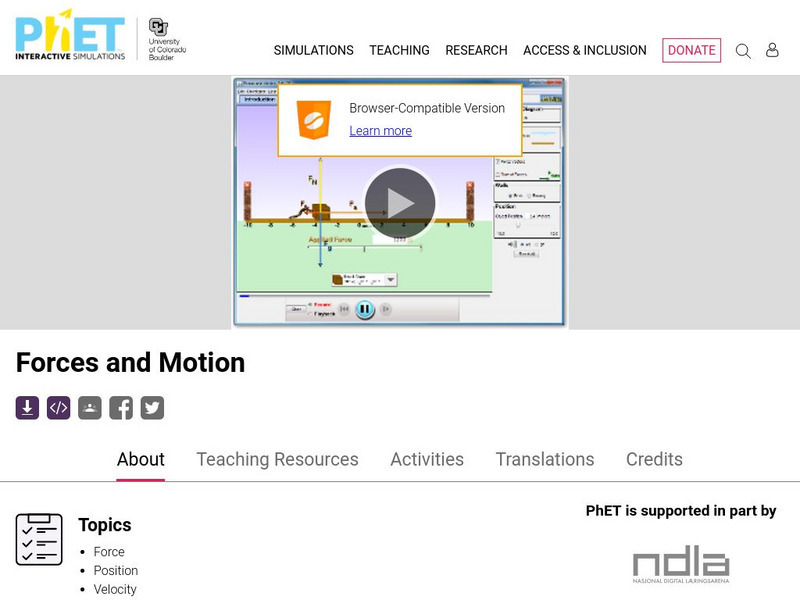
University of Colorado: Ph Et Interactive Simulations: Forces and Motion
Explore the forces at work when you try to push a filing cabinet. Create an applied force and see the resulting friction force and total force acting on the cabinet. Charts show the forces, position, velocity, and acceleration vs. time.

CK-12 Foundation
Ck 12 Exploration Series: Simulations: Physics: Irwin and Ruthie
[Free Registration/Login Required] Learn about the relationship between position, velocity, and acceleration for two objects in one-dimensional motion. Experiment with varying approaches to the race for both Irwin and Ruthie to see how...

Scholastic
Scholastic: Study Jams! Science: Forces and Motion: Action and Reaction
A video and a short quiz on Newton's Third Law of Motion. It breaks down what action and reaction mean, and how mass and acceleration factor into the outcome of a collision.

Scholastic
Scholastic: Study Jams! Science: Forces and Motion: Acceleration
A video and a short quiz on acceleration.
TeachEngineering
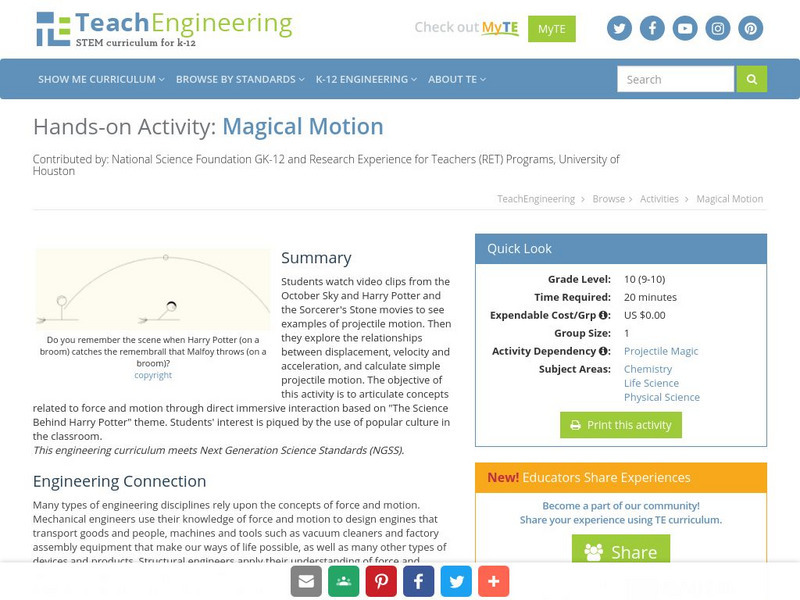
Teach Engineering: Magical Motion
Students watch video clips from the October Sky and Harry Potter and the Sorcerer's Stone movies to see examples of projectile motion. Then they explore the relationships between displacement, velocity and acceleration, and calculate...
Better Lesson
Better Lesson: Force and Motion Investigation
Conduct an investigation collaboratively on the effect of force applied on an object to produce data to serve as the basis for evidence, by using fair tests in which variables are controlled and the number of trials are considered.
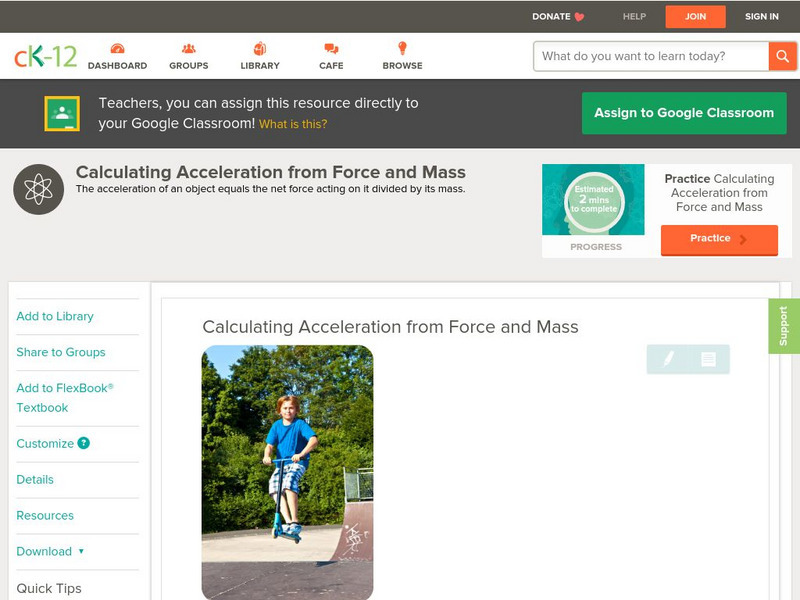
CK-12 Foundation
Ck 12: Physical Science: Calculating Acceleration From Force and Mass
[Free Registration/Login may be required to access all resource tools.] How to calculate acceleration from force and mass, and force from mass and acceleration.
My Science Site
Forces and Motion [Pdf]
This resource provides reproducibles that aide in student learning of force and motion. Also offers hands-on and cooperative learning activity ideas as well as an ESL/ELD activity. This resource is in PDF form; requires Adobe Reader.
OpenStax
Open Stax: Normal, Tension, and Other Examples of Forces
In the following interactive students will begin to define normal and tension forces. They will apply Newton's laws of motion to solve problems involving a variety of forces and use trigonometric identities to resolve weight into...
PBS
Pbs Learning Media: The Ruff Ruffman Show: Fish Force
Use science inquiry to predict and investigate forces and motion to help rescue Ruff's plushie from the penguins' ice rink in this sports science game.
Science Education Resource Center at Carleton College
Serc: Force and Motion: Gravity and Wind Resistance
Young scholars investigate the effects of force on objects in motion particularly as it relates to gravity and wind resistance by performing a classroom egg-drop activity.
OpenStax
Open Stax: Nonconservative Forces
In the following interactive students will begin to define nonconservative forces and explain how they affect mechanical energy. They will show how the principle of conservation of energy can be applied by treating the conservative...
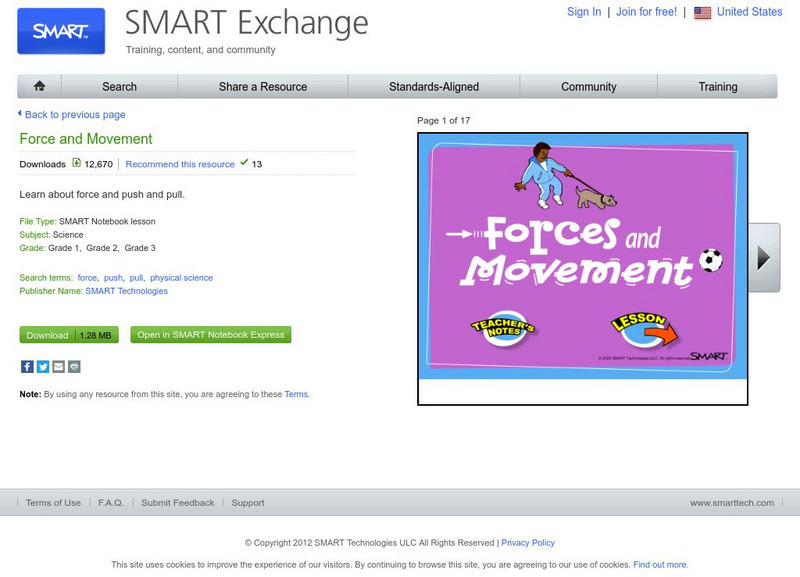
SMART Technologies
Smart: Force and Movement
Learn how pushes and pulls relate to theconcept of force and motion.
Physics Classroom
The Physics Classroom: Vectors Motion and Forces in Two Dimensions
Three complete tutorials on vectors and two dimension forces and motion. Lessons include informational text, interactive activities, animations, and quick, interactive comprehension checks along the way.
OpenStax
Open Stax: Extended Topic : The Four Basic Forces an Introduction
In the following interactive students will begin to understand the four basic forces that underlie the processes in nature.
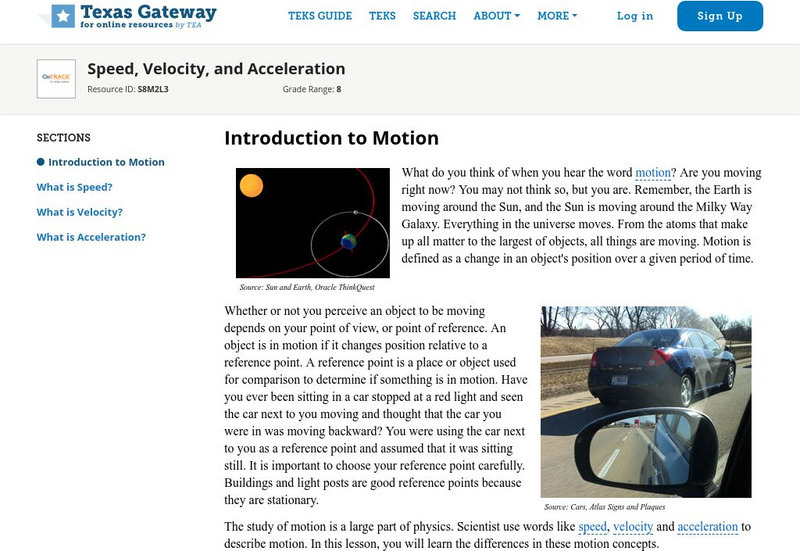
Texas Education Agency
Texas Gateway: Introduction to Motion
What do you think of when you hear the word motion? Are you moving right now? You may not think so, but you are. Remember, the Earth is moving around the Sun, and the Sun is moving around the Milky Way Galaxy. Everything in the universe...

Scholastic
Scholastic: Study Jams! Science: Force and Motion: Simple Machines
A slideshow and a short quiz on simple machines and how they reduce the amount of work or effort needed to complete a task.
Science Education Resource Center at Carleton College
Serc: Investigating Motion With Marbles
In this guided inquiry activity, students will use 2 marbles of different size and a box to investigate what makes the marbles move and what will cause the marbles to change speed and direction.
CK-12 Foundation
Ck 12: Episd: Inertial Frames and Relative Motion
[Free Registration/Login may be required to access all resource tools.] Relative motion is always measured with a frame of reference. Evaluate a variety of frames of reference and inertial frames to understand relative motion.

ClassFlow
Class Flow: Forces in Action
[Free Registration/Login Required] This flipchart explains weight and gravity and engages students in activities using force and motion.

E-learning for Kids
E Learning for Kids: Science: Pirates: What Are Some Forces Around Us?
Covers the meanings of force, friction, and gravity, and the differences between magnetic and elastic spring force, and between weight and mass. The effect of air resistance on an object's motion is also touched upon.
BBC
Bbc: Gcse Bitesize: Forces
Forces are responsible for all the interactions between particles and objects. They can be put into two categories: contact forces and non-contact forces. Forces can be added up as vectors.