Hi, what do you want to do?





Texas Education Agency
Texas Gateway: Force and Newton's Laws: Conceptual Questions
This page offers 27 questions to test students' knowledge of the major concepts in each section of Chapter 4: Dynamics: Force and Newton's Laws of Motion from the AP Physics online text.
Texas Education Agency
Texas Gateway: Force and Newton's Laws: Section Summary
This page summarizes each section of Chapter 4: Dynamics: Force and Newton's Laws of Motion in the AP Physics online text. These include Newton's three laws of motion and application of those and other forces.
Science Education Resource Center at Carleton College
Serc: Analyzing Forces and Motion Graphs by Riding an Elevator
A high school physics lab on classical mechanics in which young scholars study force versus time and acceleration versus time. Students need access to an elevator to complete the experiments. A lab handout is provided.
Texas Education Agency
Texas Gateway: 4.3 Newton's Second Law of Motion: Concept of a System
By the end of this section, you will be able to define net force, external force, and system; understand Newton's second law of motion; and apply Newton's second law to determine the weight of an object.
Texas Education Agency
Texas Gateway: 4.5 Normal, Tension, and Other Examples of Force
By the end of this section, you will be able to define normal and tension forces, apply Newton's laws of motion to solve problems involving a variety of forces, and use trigonometric identities to resolve weight into components.

Texas Education Agency
Texas Gateway: Dynamics of Rotational Motion: Rotational Inertia
By the end of this section, you will be able to understand the relationship between force, mass, and acceleration; study the turning effect of force; study the analogy between force and torque, mass and moment of inertia, and linear...
Texas Education Agency
Texas Gateway: Kinematics: Graphical Analysis of One Dimensional Motion
By the end of this section, you will be able to describe a straight-line graph in terms of its slope and y-intercept, determine average velocity or instantaneous velocity from a graph of position vs. time, determine average or...
BioEd Online
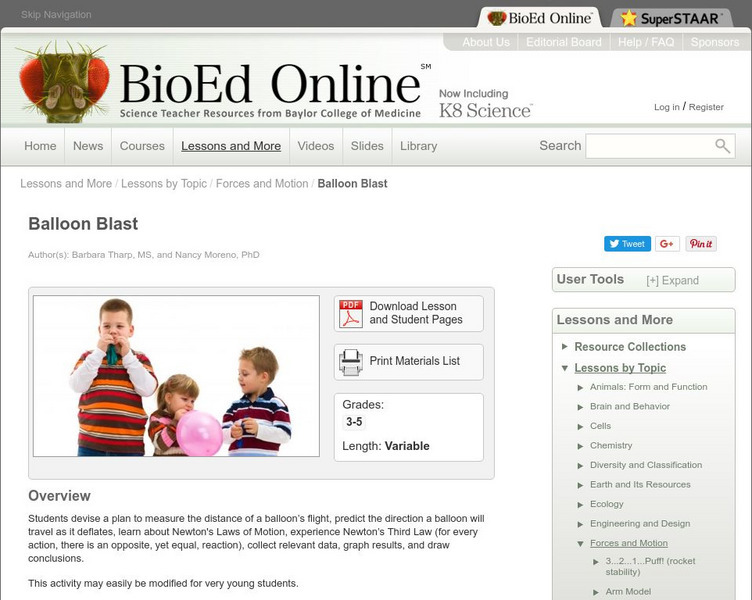
Bio Ed Online: Balloon Blast
In the following lesson students are asked to devise a plan to measure the distance of a balloon's flight, predict the direction a balloon will travel as it deflates, learn about Newton's Laws of Motion, experience Newton's Third Law,...
Massachusetts Institute of Technology
Mit: Open Course Ware: Forces: Moving Charges in Magnetic Fields
Learners investigate moving charges in magnetic fields. Some topics explored in the activities are Lorentz force, motion of a charge, and magnetic fields. The resource consists of video clips, lecture notes, online textbook chapters,...
Texas Education Agency
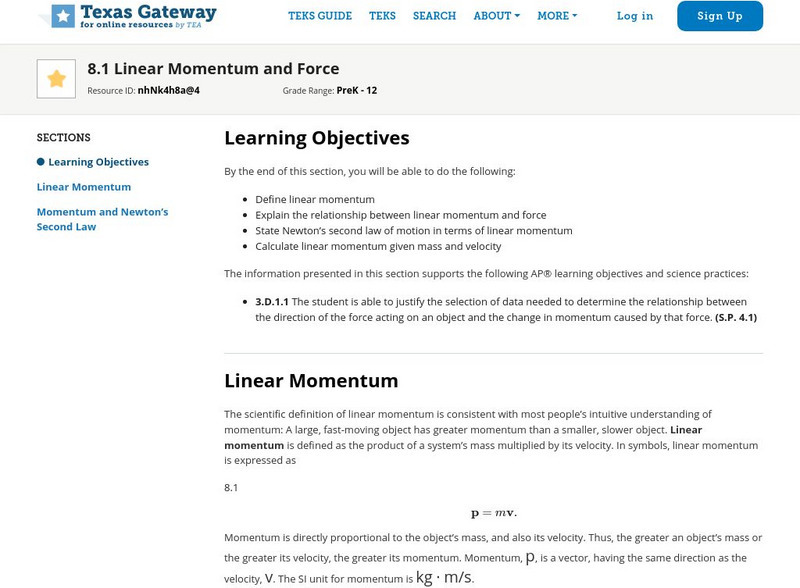
Texas Gateway: Linear Momentum and Force
By the end of this section, you will be able to define linear momentum, explain the relationship between linear momentum and force, state Newton's second law of motion in terms of linear momentum, and calculate linear momentum given mass...
Texas Education Agency
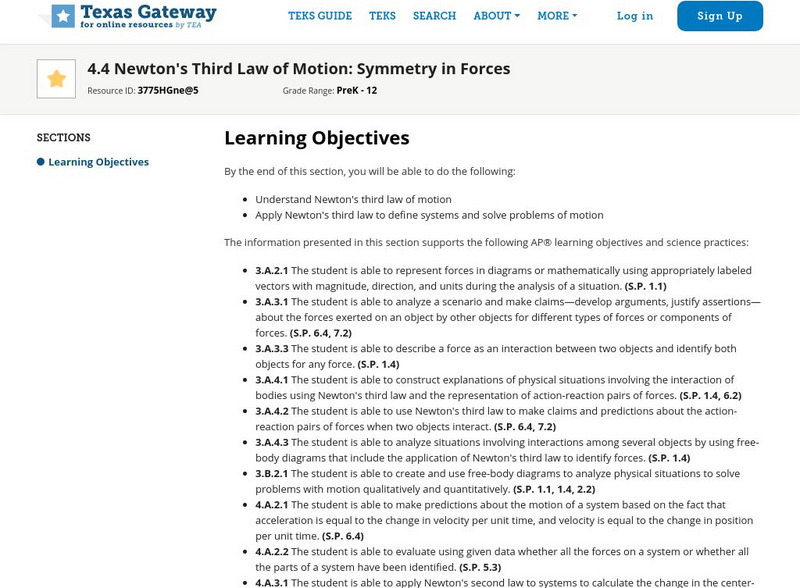
Texas Gateway: 4.4 Newton's Third Law of Motion: Symmetry in Forces
By the end of this section, you will be able to understand Newton's third law of motion and apply Newton's third law to define systems and solve problems of motion.
Texas Education Agency
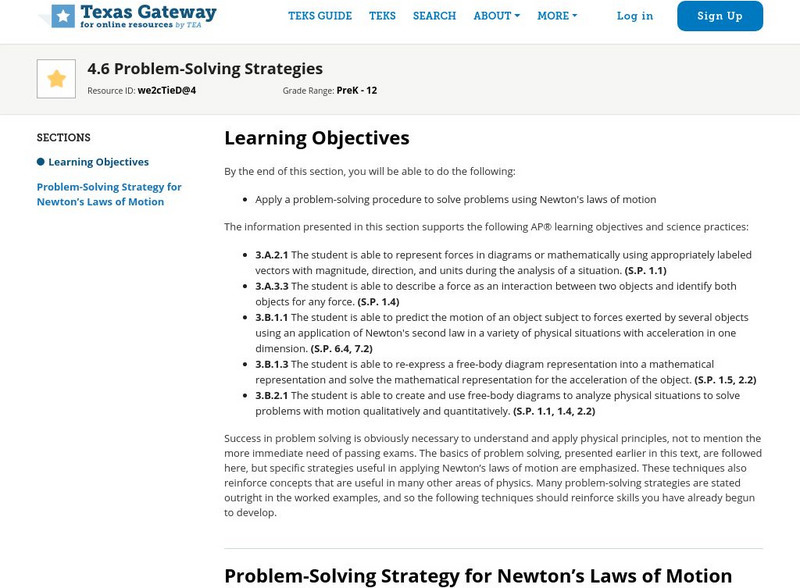
Texas Gateway: Problem Solving Strategies for Newton's Laws of Motion
By the end of this section, you will be able to apply a problem-solving procedure to solve problems using Newton's laws of motion.
Georgia Department of Education
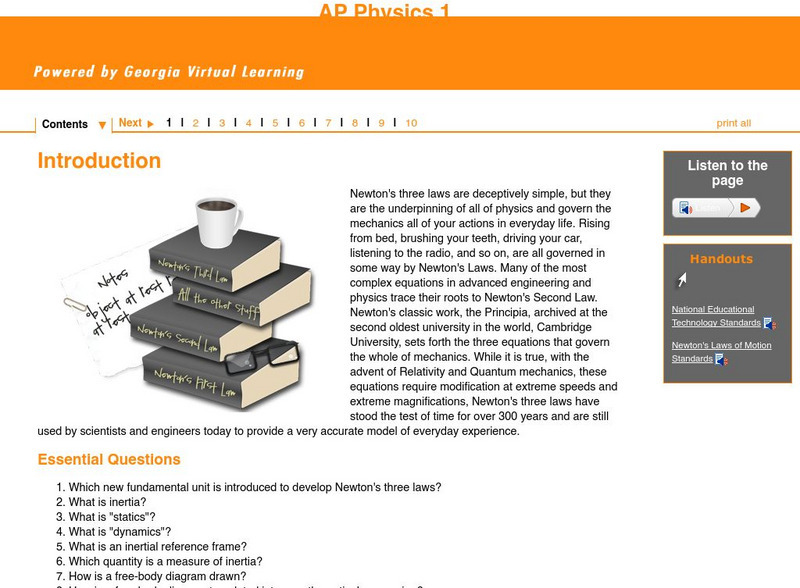
Ga Virtual Learning: Ap Physics 1: Newton's Laws of Motion
Newton's three laws are deceptively simple, but they are the underpinning of all of physics and govern the mechanics all of your actions in everyday life. Take an in-depth look at these laws in this learning module.
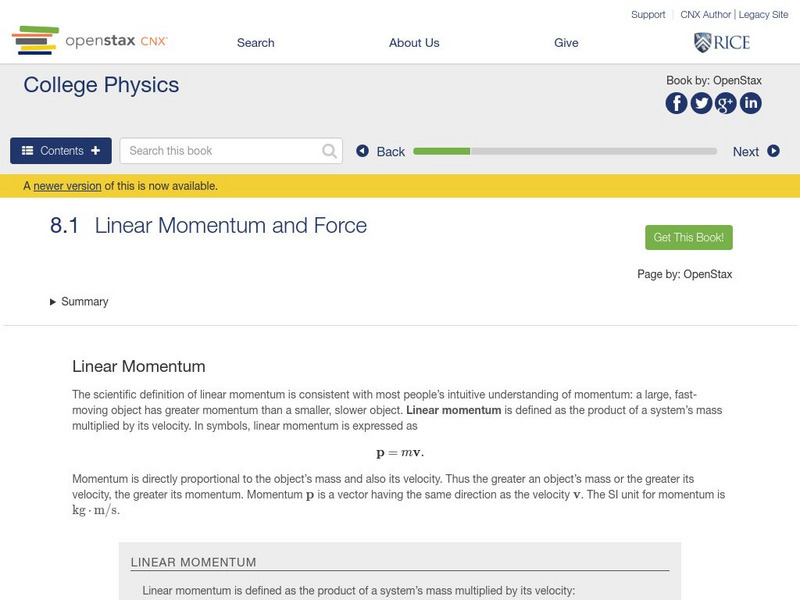
OpenStax
Open Stax: Linear Momentum and Force: Linear Momentum
From a chapter on Linear Momentum and Collisions in a Physics textbook. This section of the chapter covers linear momentum, how momentum and force are related, how momentum fits into Newton's second law of motion, and how to calculate...

City College of New York
City Technology: Fantastic Elastic
Explore engineering technology with this unit. Students will study how to design and execute two types of homemade vehicles using elastic.
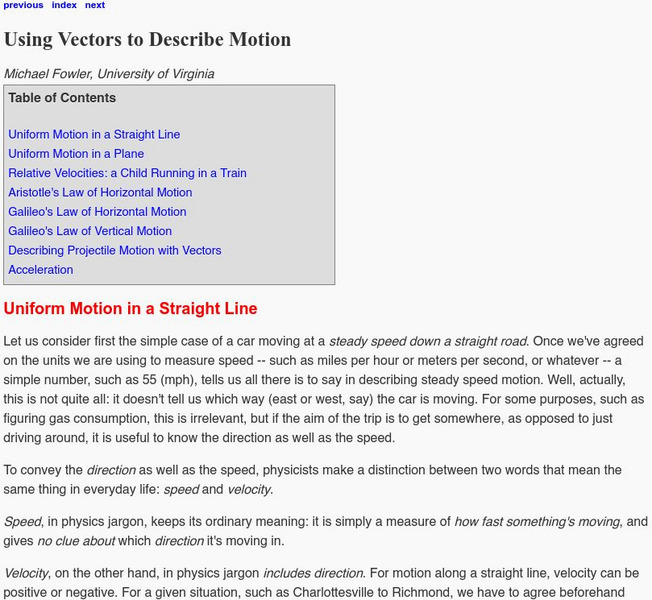
University of Virginia
Uva Physics: Using Vectors to Describe Motion
Background information on vectors and their use in describing motion in two dimensions. A comparison of Aristotle's and Galileo's perspectives on force and motion is given.

US Geological Survey
Usgs: Understanding Plate Motions
The U.S. Geological Survey provides descriptions and illustrations for the plate boundaries of the Earth's surface.
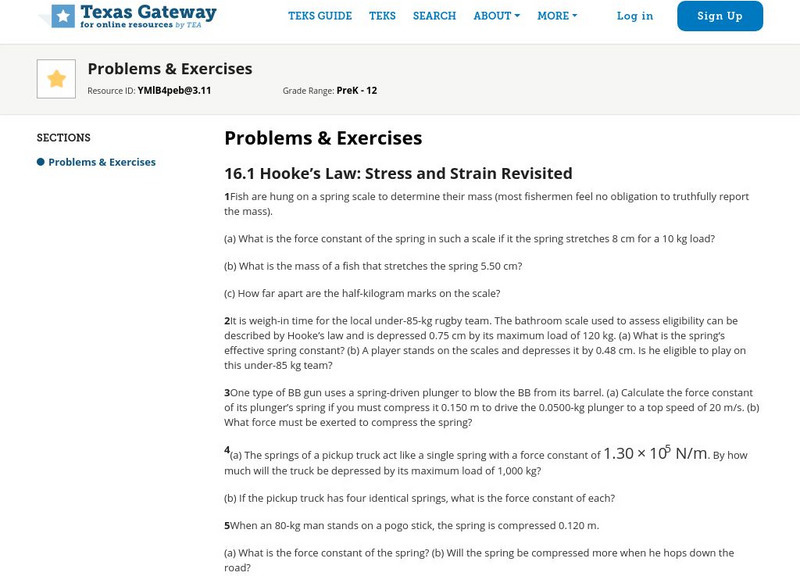
Texas Education Agency
Texas Gateway: Oscillatory Motion and Waves: Problems and Exercises
This is a list of problems and exercises to solve based on the content of Chapter 16: Oscillatory Motion and Waves from the AP Physics online text.
TryEngineering
Try Engineering: Give Me a Brake
Activity investigates the concept of how bicycle brakes use force and friction to stop or slow mechanical motion. Students work in teams to devise a simple braking system while suggesting improvements to current bicycle brake design.

University of St. Andrews (UK)
University of St. Andrews: Orbits and Gravitation
A page describing the physics, mathematics, and historical figures associated with planetary motion, satellite motion, and universal gravitation.
TryEngineering
Try Engineering: Engineering Ups and Downs
Engineering design lesson examines the principles behind working elevators. Teams of students explore how elevators work, then design, build, and evaluate their own elevator to service a toy car garage.

Discovery Education
Discovery Education: Friction in Our Lives
Students observe objects in motion down a ramp to discover how the force of friction affects an object's motion. Includes the lesson plan, vocabulary list, and extensions for students.

NASA
Nasa: Vectors
This site from NASA provides an excellent tutorial on vectors and their use in physics to describe the motion of objects. Vector addition and resolution are illustrated.
Physics Classroom
The Physics Classroom: Horizontally Launched Projectile Problems
In the case of projectiles, students use information about the initial velocity and position of a projectile to predict such things as how much time the projectile is in the air and how far the projectile will go. They do this to make...