Hi, what do you want to do?






Curated OER
AC Motor Theory
For this electrical circuit worksheet, students answer a series of 20 open-ended questions about AC motor circuits. This worksheet is printable and the answers are revealed online.

Curated OER
Mystery Card 3
Students will make a circuit on a mystery card. They will connect wires, bulbs, and battery to form an electrical tester. After students learn how to make one following the directions, they can create their own mystery card by...

Curated OER
Measurement: Length, volume, and temperature
Students determine the temperature of the water in a cup, measure the length of a piece of cardboard, and measure out an appropriate volume of water. This task assesses student's abilities to perform measurement and reporting skills.

Curated OER
Tree Study
Students measure the lengths of provided leafs to the nearest millimeter. Students identify trends in the data as well as sourced of inaccuracy and formulate additional questions that could be investigated to enhance their understanding.

Curated OER
Block and Tackle
Students simulate block and tackles to lift heavy objects. They lift cargo by hand with the whip and the two-fold purchase to simujlate what crew members do aboard ships. They measure the effort and distance pulled for a gun tackle, luff...

Curated OER
Black Hawk Island Hike
Students explore Wisconsin's natural and cultural history through hands-on exploration of Upham Woods. They are shown the basic paddling skills and they work in teams to paddle across the river on barge. Students describe cultural...

Curated OER
IS MASS THE SAME AS WEIGHT?
Students see the difference between weight and mass when they examine the method of measuring each of them.
Science Buddies
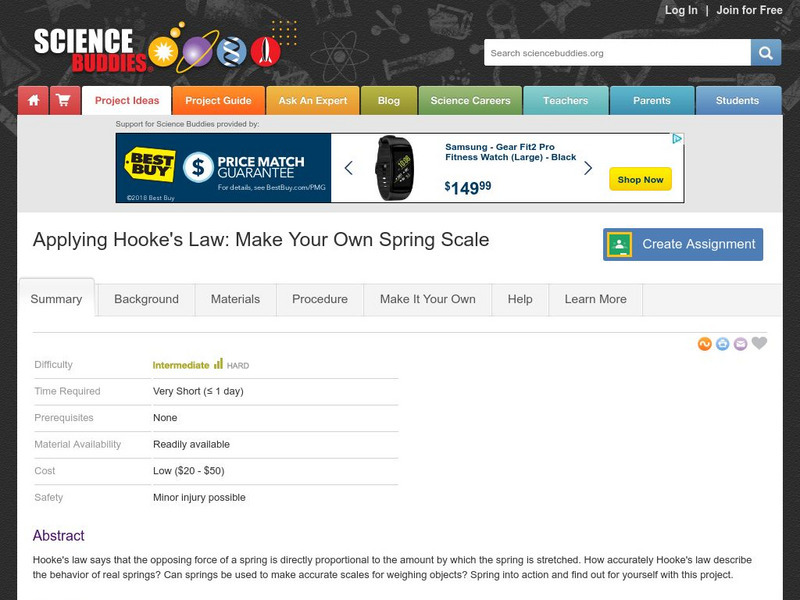
Science Buddies: Applying Hooke's Law: Make Your Own Spring Scale
Hooke's law says that the opposing force of a spring is directly proportional to the amount by which the spring is stretched. How accurately Hooke's law describe the behavior of real springs? Can springs be used to make accurate scales...
TeachEngineering
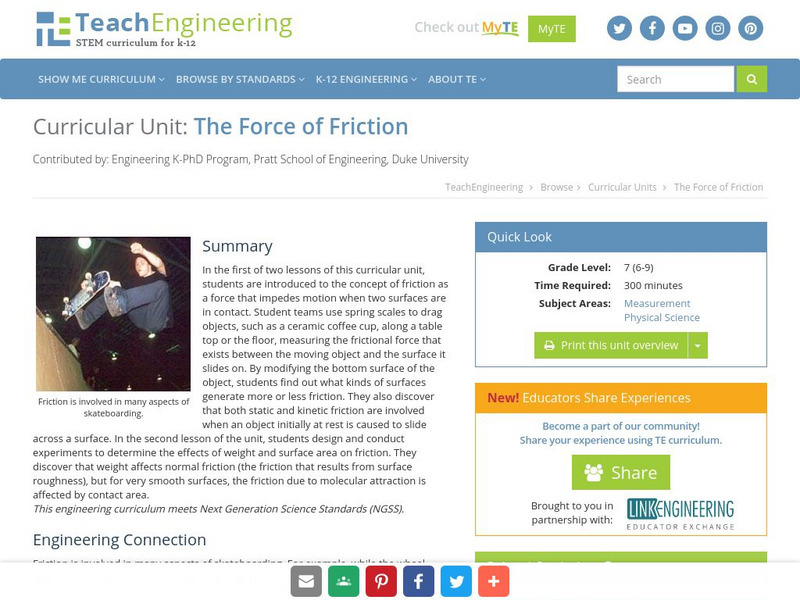
Teach Engineering: The Force of Friction
In the first of two lessons of this curricular unit, students are introduced to the concept of friction as a force that impedes motion when two surfaces are in contact. Student teams use spring scales to drag objects, such as a ceramic...
TeachEngineering
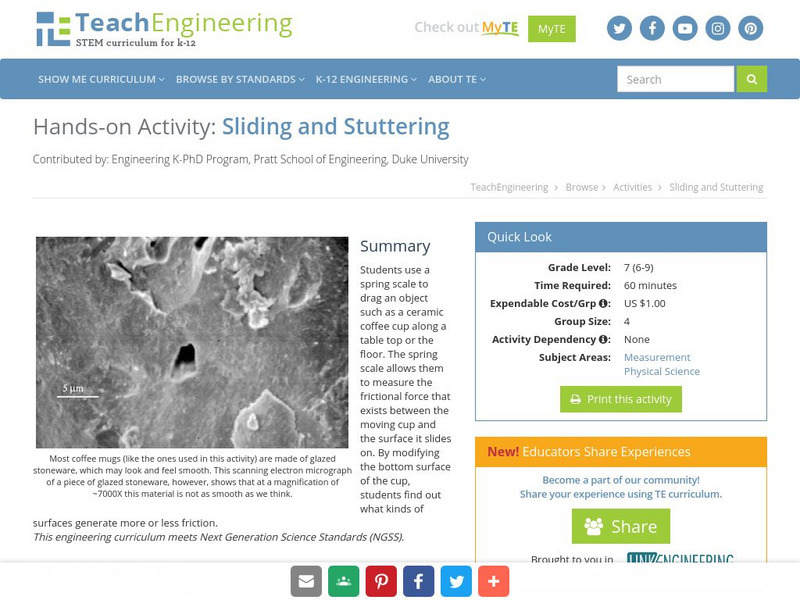
Teach Engineering: Sliding and Stuttering
Students use a spring scale to drag an object such as a ceramic coffee cup along a table top or the floor. The spring scale allows them to measure the frictional force that exists between the moving cup and the surface it slides on. By...
TeachEngineering
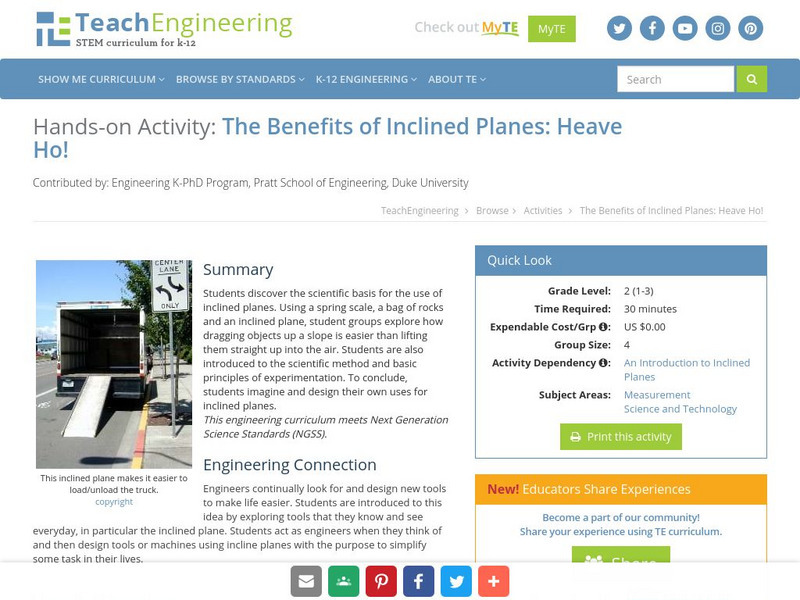
Teach Engineering: Heave Ho!
Students will discover the scientific basis for the use of inclined planes. They will explore, using a spring scale, a bag of rocks and an inclined plane, how dragging objects up a slope is easier than lifting them straight up into the...

TeachEngineering
Teach Engineering: Mechanics Mania
Through ten lessons and numerous activities, students explore the natural universal rules engineers and physicists use to understand how things move and stay still. Together, these rules are called "mechanics." The study of mechanics is...
TeachEngineering
Teach Engineering: Discovering Friction
With a simple demonstration activity, students are introduced to the concept of friction as a force that impedes motion when two surfaces are in contact. Then, in the Associated Activity (Sliding and Stuttering), they work in teams to...
Texas Instruments
Texas Instruments: Groucho's Sign Shop
Students' use force sensors to investigate forces and learn about force as a vector. Similar concept to the common "spring scale" force vector lab, but with a real-world twist.