Hi, what do you want to do?






Discovery Education
Discovery Education: Lesson Plans Library K 5
This resource presents a lesson plan library which holds hundreds of lesson plans organized by grade level and subject area. Often rooted with an Internet research piece, each lesson plan contains specific objectives, procedures,...

Cyberbee
Cyberbee: Who Dunnit?
If you are a crime scene investigation (CSI) fan, then you will love this site! You get to be the detective by examining the evidence, viewing the crime scene, dusting for fingerprints, interviewing the suspects, and solving the crime.

PBS
Pbs Learning Media: Laetoli Footprints
This Evolution video segment describes how the famous track fossils known as the Laetoli footprints might have been formed and what they can reveal about the creatures who left them.
PBS
Pbs Teachers:america's Stone Age Explorers
Discover how mitochondrial DNA (mtDNA) is inherited, and complete a pedigree chart by determining which individuals might share mtDNA with an unknown ancestor.
Federal Bureau of Investigation
Federal Bureau of Investigation: Practical Guide for Human Hairs
The FBI gives a detailed analysis of the human hair including how to use it as forensic evidence. Topics covered are hair structure, identification, and methods of hair recovery. Labeled diagrams and electron photomicrographs enhance the...
BiologyWise
Biology Wise: Why Is Dna Important
Explains what DNA is and how much information lies stored in its structure, and discusses the many applications of the science of DNA in agriculture, forensic science, human genetics, etc.

Khan Academy
Khan Academy: Meet Jared Roop
Meet Jared Roop, forensics/analytical chemist and Cardinals fan!

Open Curriculum
Open Curriculum: Biotechnology
This illustrated article describes various applications of biotechnology as related to medicine, agriculture, and forensic science.
PBS
Pbs: Nature: Crime Scene Creatures
Become a detective with this interactive crime scene! Use tools and animals at the crime scene to help you determine the time of death of the body. By collecting specimens at the scene, students try to determine how long the person has...

University of Arizona
The Biology Project: Human Biology: Blackett Family Dna Activity
Family studies are a good way to learn about DNA profiling and RFLP analysis because students can follow the inheritance of DNA markers from one generation to the next. Students have the opportunity to do this in this activity.
University of Arizona
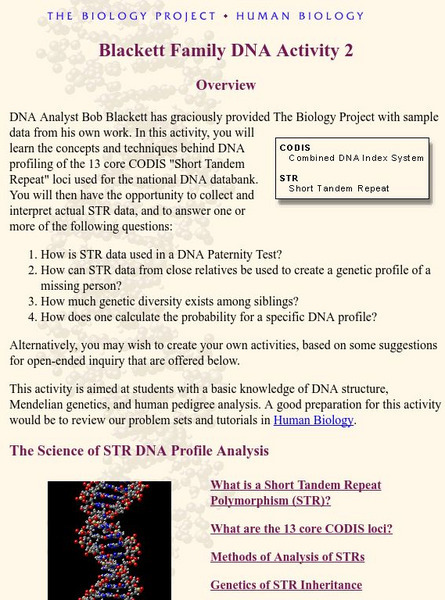
The Biology Project: Human Biology: Blackett Family Dna Activity 2
In this activity, students learn the concepts and techniques behind DNA profiling of the national DNA databank. Students will then have the opportunity to collect and interpret actual STR data, and to answer one or more questions.
BiologyWise
Biology Wise: History of Dna Fingerprinting
Discusses the scientists who made discoveries about DNA and those who invented and worked on DNA fingerprinting, and some of the criminal cases that were resolved or thrown out through the use of DNA evidence. (Warning: Some of these...
Smithsonian Institution
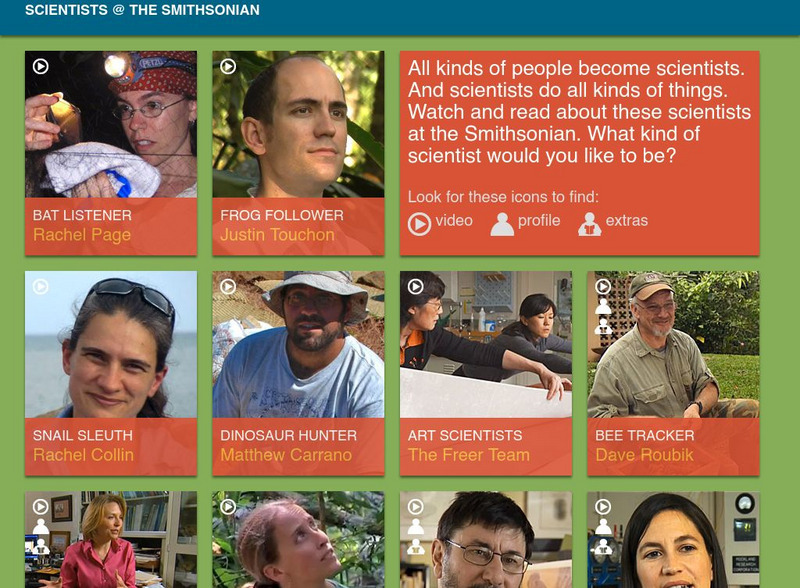
Smithsonian Institution: Scientists at the Smithsonian
This is a collection of video interviews with twenty Smithsonian scientists who work in a scientific areas as vastly different as measuring the moon and figuring out what kinds of birds collide with aircraft. An interesting way to...
National Institutes of Health
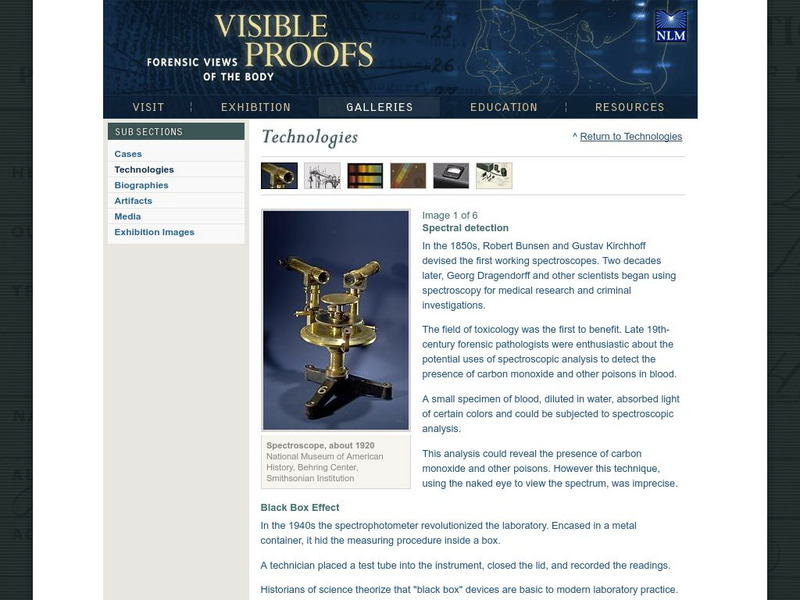
National Library of Medicine: Spectral Detection
This concise site provides a brief discussion of the invention of the first work spectroscopes and their impact on forensic science.
National Health Museum
Access Excellence Mysteries: The Mystery Spot
Here are a list of interesting interactive mysteries to go along with your science lessons. Students go through a short story and then try to solve the mystery. Topics include space, environmental issues, disease, and forensics. These...

Other
Early Fingerprinting Pioneers
This resource takes a look at some of the early fingerprinting pioneers such as Marcello Malpighi, William Herschel, Alphonse Bertillon and many more.
BiologyWise
Biology Wise: Uses of Dna Fingerprinting
Explains what DNA profiling is and describes some of the many ways it is used.
Michigan Reach Out
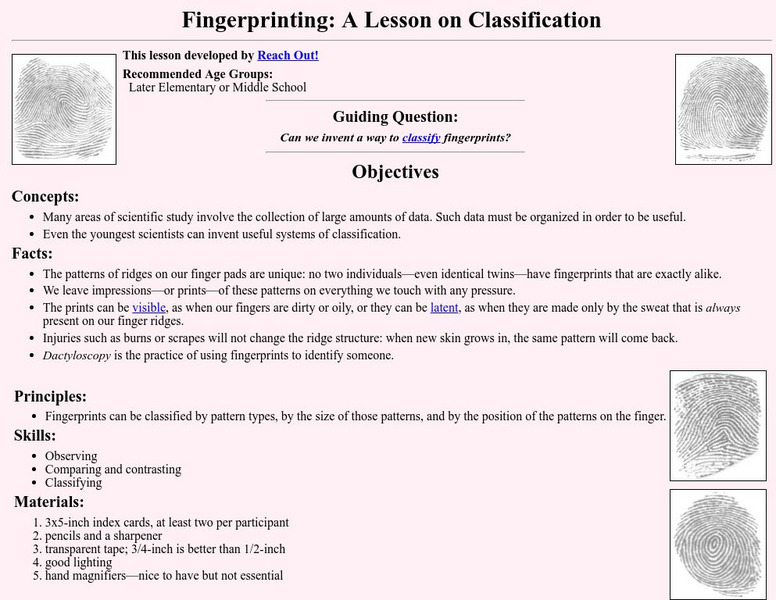
Fingerprinting: A Lesson on Classification
Who done it? Basic lesson plan to classify fingerprints. Students can classify their own and classmates fingerprints by taking prints and comparing them to the handout provided.

WebMD
Web Md: Autopsies: When Are They Done?
Why is an autopsy done? How is it done? What are the risks? Discover the answers to these questions and many more as you peruse this site.
Crown Copyright (UK)
Gov. Uk: The Northern Ireland Office
This resource provides information on law and order, criminal justice, prison service, and the forensic science agency of Northern Ireland.
PBS
Pbs Learning Media: Dna on the Witness Stand
Dr. Eric Lander of the Human Genome Project explains the use of DNA as forensic evidence. He describes the process and need for standards in testing laboratories and discusses the use of DNA evidence as a human rights tool.
Google
Louisiana Curriculum Hub: Ela Guidebooks: Grade 8: Written in Bone: Unit Files
A Google Drive folder with instructional presentations, discussion questions, student activities, and assessments for the text, Written in Bone.
Curated OER
Spectroscope, About 1920
This concise site provides a brief discussion of the invention of the first work spectroscopes and their impact on forensic science.
Curated OER
Spectroscopic Apparatus, Steel Engraving, 1869
This concise site provides a brief discussion of the invention of the first work spectroscopes and their impact on forensic science.