Hi, what do you want to do?






PBS
Pbs Learning Media: The Transforming Leap, From Four Legs to Two
John Noble Wilford, a "New York Times" science writer, outlines various hypotheses on the origin of bipedalism.
Science Buddies
Science Buddies: Use Dna Sequencing to Trace the Blue Whale's Evolutionary Tree
Around 50 million years ago, the mammalian ancestor of today's whales returned to the ocean. In this genomics science fair project, you will use mitochondrial protein sequencing to trace the evolution of whales and identify their closest...
TeachEngineering
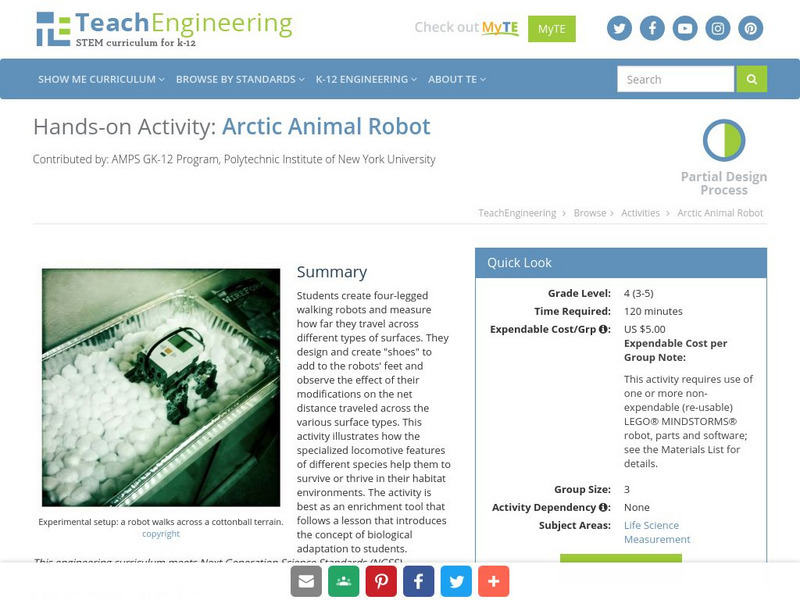
Teach Engineering: Arctic Animal Robot
Students create four-legged walking robots and measure how far they travel across different types of surfaces. They design and create "shoes" to add to the robots' feet and observe the effect of their modifications on the net distance...
Curated OER
Educational Technology Clearinghouse: Clip Art Etc: Mensa
The simplest kind of table was a round one with three legs. It is shown in the drinking scene painted on the wall of a wine shop at Pompeii, and is represented in the annexed woodcut. Tables, however, must usually have had four legs. For...
Curated OER
Unesco: Canada: Miguasha National Park
The palaeontological site of Miguasha National Park, in south-eastern Quebec on the southern coast of the Gaspe peninsula, is considered to be the world's most outstanding illustration of the Devonian Period known as the 'Age of Fishes'....
Curated OER
Science Kids: Science Images: Anchiceratops
This drawing shows the possible appearance of Anchiceratops, a dinosaur from the late Cretaceous Period (around 70 million years ago). Anchiceratops was a herbivore (plant eater) that walked on four legs and featured three horns on its...
CK-12 Foundation
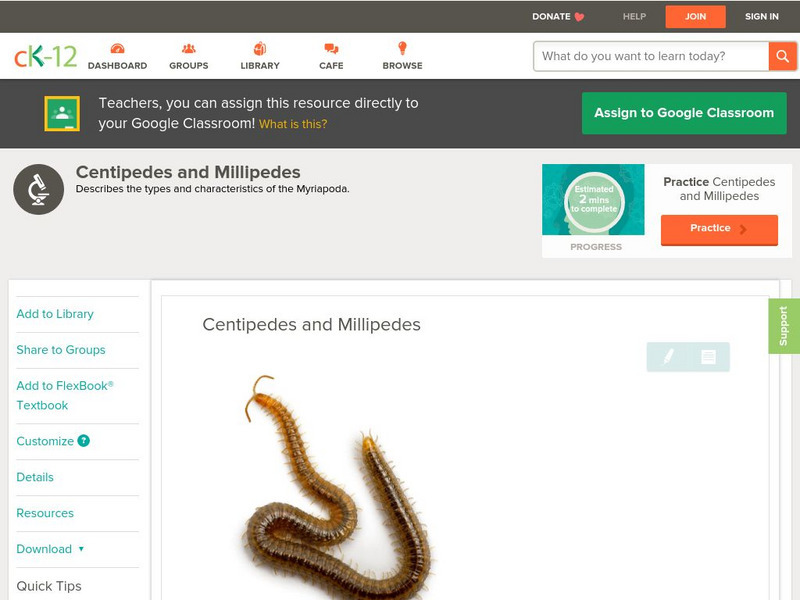
Ck 12: Life Science: Centipedes and Millipedes
[Free Registration/Login may be required to access all resource tools.] Centipedes and millipedes belong to the subphylum Myriapoda, which contains 13,000 species. They all live on land. They are divided among four classes: (1) Chilopoda...

TED Talks
Ted: Ted Ed: What Cameras See That Our Eyes Don't
Our eyes are practically magical, but they cannot see everything. For instance, the naked eye cannot see the moment where all four of a horse's legs are in the air or the gradual life cycle of plants- but cameras can capture these...
Wonderville Media
Wonderville: Aardvarks
The aardvark looks a bit like a pig. Its body is stout, with an arched back, and is sparsely covered with coarse hairs. Its legs are medium length. Its front feet have four toes, while the back feet have five toes. Each toe has a large,...
Australian Broadcasting Corporation
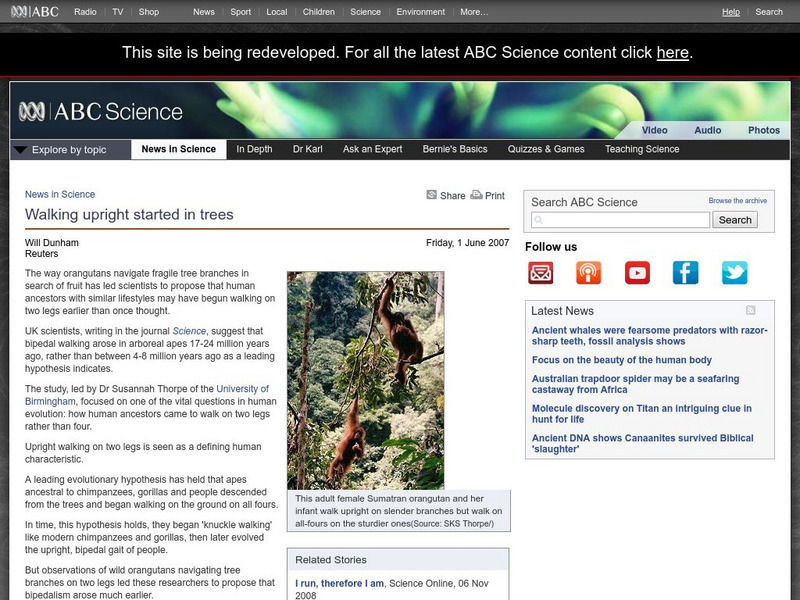
Australian Broadcasting Corporation: News in Science: Walking Upright Started in Trees
From ABC News in Science, Will Dunham's article on orangutans covers topics related to the evolutionary process of "bipedal walking," or walking on two legs instead of four.
Science Bob Pflugfelder
Science Bob: See Some Optical Illusions
A webpage on optical illusions, containing a grid of black squares, an elephant with four or five legs, and a picture with three faces in it.
Curated OER
Ar Kive: Emperor Scorpion (Pandinus Imperator)
The largest of scorpions, but not the longest, the emperor scorpion (Pandinus imperator) has a dark body ranging from dark blue/green through brown to black. The large pincers are blackish-red and have a granular texture. The front part...
Curated OER
Eternal Egypt: Bed of Queen Hetepheres
This marvelous bed, which belonged to Queen Hetepheres, rests on four gilded wooden supports in the form of lion's legs. Her son, King Khufu, transferred her funerary bed from Dahshur to Giza to provide more security.
Curated OER
Eternal Egypt: Latticed Stool of Sennedjem
The latticed stool, among the most commonly used of the time, belonged to the artisan Sennedjem. Thin struts of wood with angled braces supporting the seat and four rounded, animal-shaped legs support the chair.
Curated OER
Science Kids: Science Images: Cricket Bowling Grips Diagram
This diagram shows four different grips used by a seam bowler in the sport of cricket. The different deliveries include a fast ball, slower ball, off cutter and leg cutter, all achieved by holding the cricket ball with slightly different...