Hi, what do you want to do?





TeachEngineering
Teach Engineering: Puttin' It All Together
On the topic of energy related to motion, this summary lesson is intended to tie together the concepts of work, power, collisions, momentum and drag. A hands-on activity demonstrates this idea and reinforces students' math skills in...

Physics Aviary
Physics Aviary: Practice Problems: Acceleration on Incline Problem Medium
Students must calculate the acceleration of an object down an incline when there is friction present. Mass, angle and coefficient of friction will be generated randomly.
Other
Center for Education Partnerships: The Marble Roll
In this Science-athon, students try to make their marble roll the farthest across a flat surface, using their knowledge of forces, motion, and energy to guide them through their apparatus design. Teachers must enroll online.
Science Education Resource Center at Carleton College
Serc: Investigating Forces: Balloon Car Activity
In this activity, teams of young scholars build a car out of common materials which is then propelled by the release of air out of a balloon and must travel a minimum distance. The activity is then extended to a competition to build the...
Physics Classroom
The Physics Classroom: Newtons Laws: Rocket Sledder Interactive
Experience the effect of friction, air resistance, and applied force upon a sledder. The speed, acceleration, and force values are displayed as the sled moves. Learners can vary the mass of the sledder and the size of the parachute...
PBS
Pbs Learning Media: The Ruff Ruffman Show: Bottle Cap Hockey
Explore sports science and see how many points can you score with your bottle caps in Ruff's take on table hockey.
Science Education Resource Center at Carleton College
Serc: Newton's Second Law: Constant Force Applied to a Skateboarder
For this lab activity, young scholars will become familiar with Newton's 2nd Law of Motion. By investigating the motion of different skateboarders pulled with a variety of constant force values, they will discover that bodies acted on by...
Science Buddies
Science Buddies: Do Submarines Need Fins?
In this science project, you can investigate how submarines use stabilizing fins to move forward. Exploring friction and buoyant force you will get closer to understanding how these large ships function. Research resources are included...
University of Minnesota
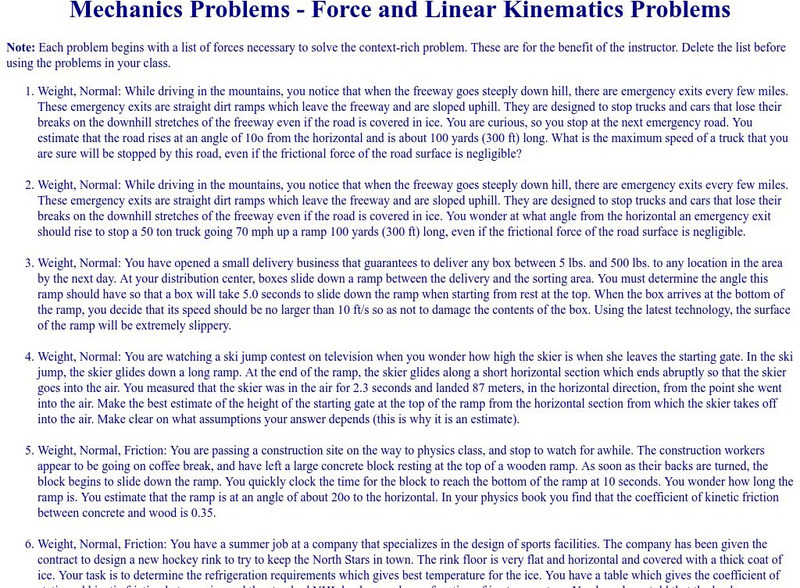
University of Minnesota: Mechanics Problems: Force and Linear Kinematics Problem
This University of Minnesota site provides a series of contextually rich problems pertaining to force, Newton's second law of motion, and linear kinematics.

CK-12 Foundation
Ck 12: Plix Series: Friction
[Free Registration/Login Required] Use given friction formulas and an interactive diagram for an inclined plane to solve a motion problem. After the activity, answer a challenge question to check for understanding.

Alabama Learning Exchange
Alex: Effects of Friction on a Moving Block
Students will move a 2 X 4 inch block with a hook attached across different surface areas. Students will discover how the friction created by these surface areas affect the movement of the block. Students will begin the activity by...
TeachEngineering
Teach Engineering: Sliding Textbooks
In this culminating activity of the unit which highlights how forces play a role in engineering design and material choices, students explore and apply their knowledge of forces, friction, acceleration, and gravity in a two-part experiment.
TeachEngineering
Teach Engineering: Mechanics Mania
Through ten lessons and numerous activities, students explore the natural universal rules engineers and physicists use to understand how things move and stay still. Together, these rules are called "mechanics." The study of mechanics is...
Georgia Department of Education
Ga Virtual Learning: Forces
Students learn about various forces and how they relate to everyday life in this interactive learning module.
University of Virginia
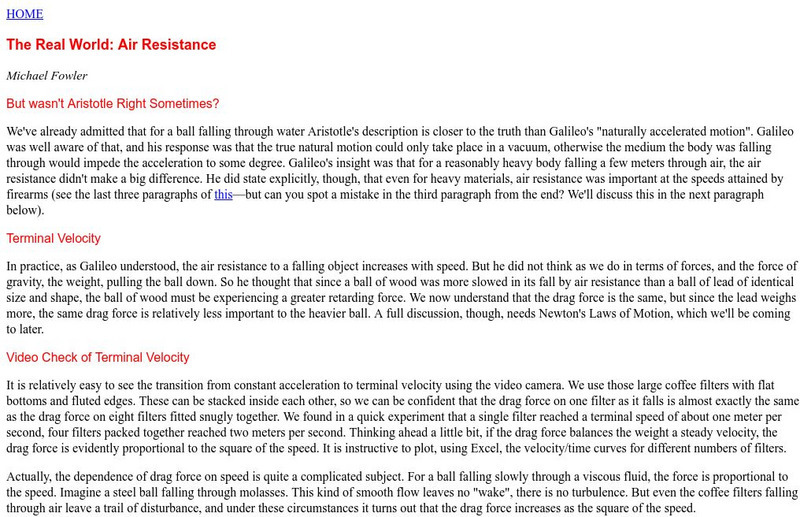
Uva: The Real World Air Resistance
A contrast of Galileo and Aristotle's view of inertia and motion. Describes air resistance force and how its reality seems to initially support Aristotle's view.
Concord Consortium
The Concord Consortium: Molecular Workbench: Mass Connected to 2 Springs
Observe how friction affects a mass connected to two springs that are on opposite sides of the mass. Create a graph while the friction is on or off.
TryEngineering
Try Engineering: Getting Your Bearings
Students learn about teamwork and problem solving in this lesson that focuses on friction and how ball bearings are used to reduce it.
TeachEngineering
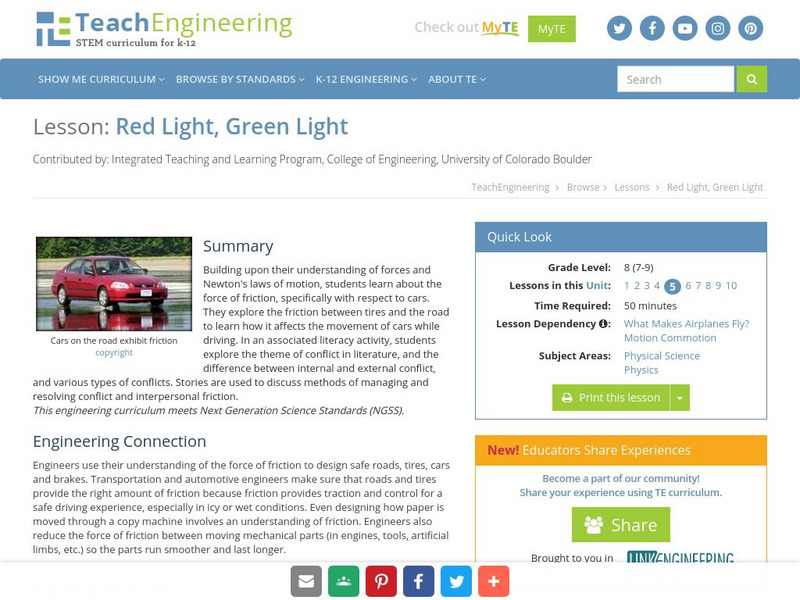
Teach Engineering: Red Light, Green Light
Building upon their understanding of forces and Newton's laws of motion, students learn about the force of friction, specifically with respect to cars. They explore the friction between tires and the road to learn how it affects the...
Other
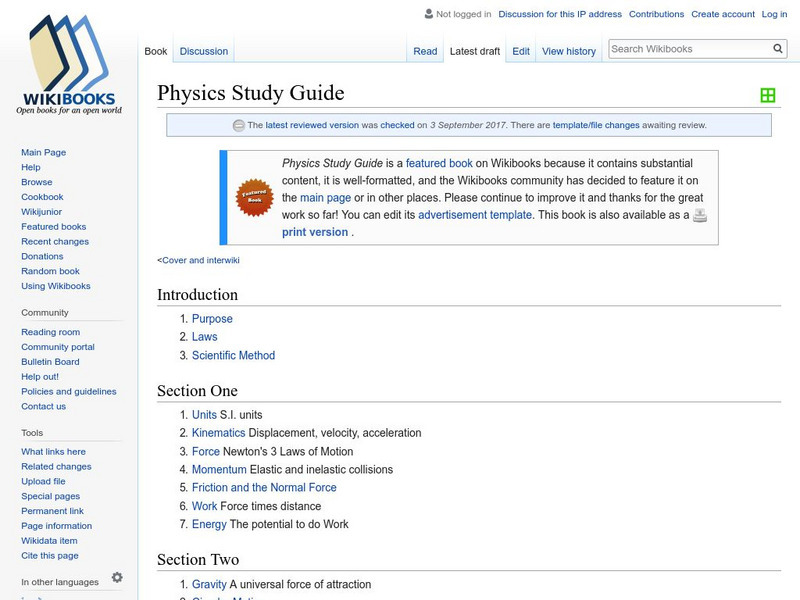
Wikibooks: Physics Study Guide
A handy resource that gives an overview of equations and definitions pertinent to an introductory, college-level physics course, with two of its three sections focusing on motion-related topics and principles.
Physics Classroom
The Physics Classroom: Finding Individual Forces
Explore the world of finding individual forces. "The process of determining the value of the individual forces acting upon an object involve [sic] an application of Newton's Second law and an application of the meaning of the net force."
University of Minnesota
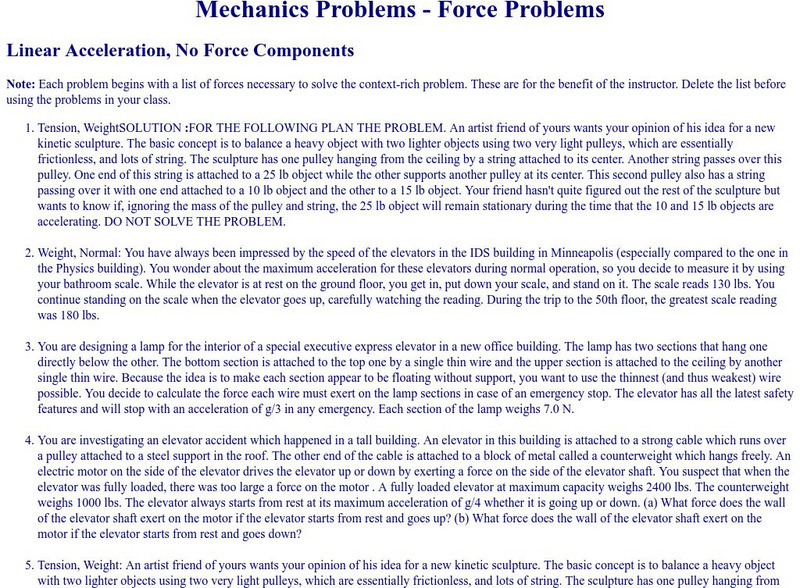
University of Minnesota: Mechanics Problems: Force Problems
This University of Minnesota site provides a series of contextually rich, real-world problems demonstrating force and Newton's second law of motion.
Physics Aviary
Physics Aviary: Practice Problems: Car Stopping Distance
Students must calculate the time it takes for a car to come to a rapid stop and the distance the car covers when stopping.
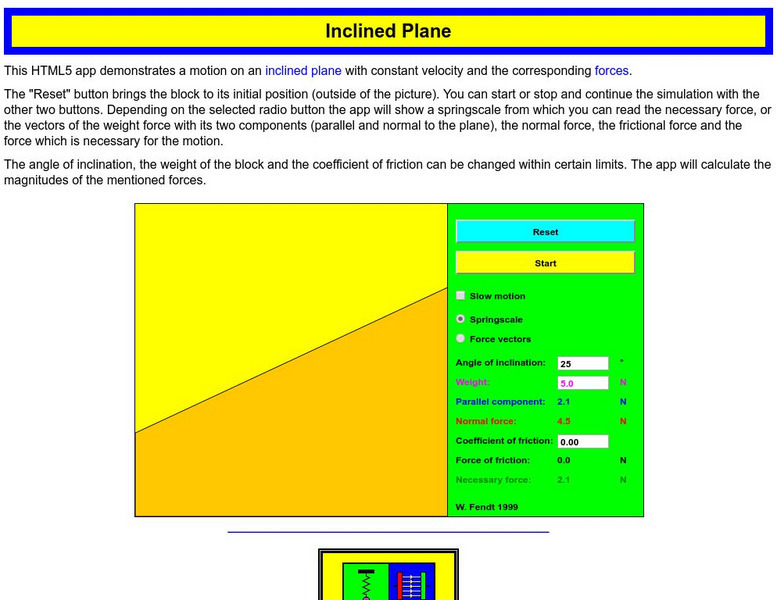
Walter Fendt
Walter Fendt: Inclined Plane
This site is an interactive app of an inclined plane showing the effect of the angle, the weight of the block, and the friction as a block is pulled up an incline.
Physics Aviary
Physics Aviary: Practice Problems: Car on a Turn Problem
Students must determine the force of friction on a car on a turn and the maximum speed the car could navigate a turn.