Hi, what do you want to do?






Khan Academy
Khan Academy: A Ramp in an Administrative Office
This passage will test your knowledge on forces on inclined planes.

Khan Academy
Khan Academy: Air and Fluid Resistance
This article on Khan Academy is about air and fluid resistance that is caused by friction.

Science Struck
Science Struck: A Comprehensive List of All the Physics Formulas
Provides a long list of physics formulas for easy reference.
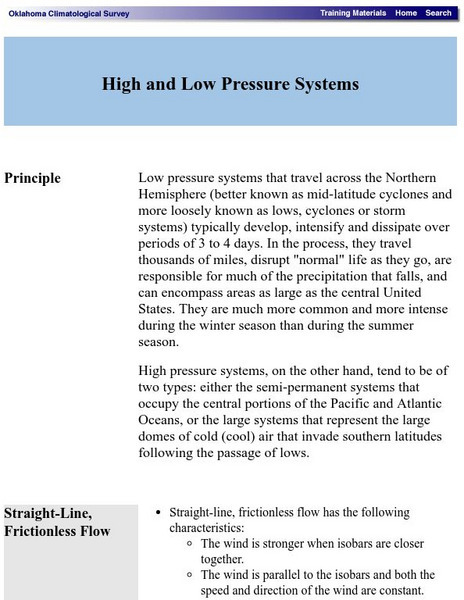
Oklahoma Mesonet
University of Oklahoma: High and Low Pressure
This University of Oklahoma meteorology tutorial explores both high and low pressure systems--how they form and the different forms they take.
Massachusetts Institute of Technology
Mit: Open Course Ware: Courses: Physics: Classical Mechanics
College-level online course highlighting the study of classical mechanics. This course focuses on Newtonian mechanics, fluid mechanics, and kinetic gas theory. Course features include a 35 video lecture series by Walter Lewin. Also link...
Texas Education Agency
Texas Gateway: Newton's First Law
Within this resource, you will learn more about Newton's first law and real-world applications of this law.
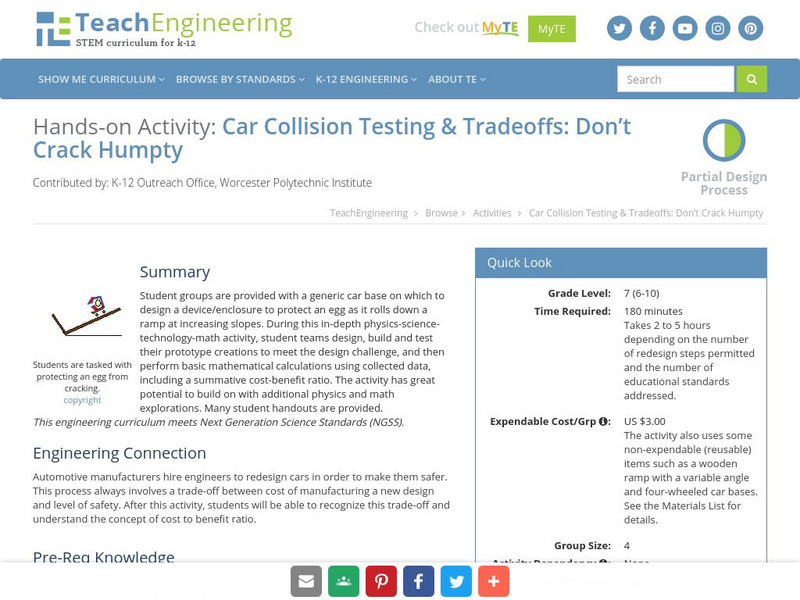
TeachEngineering
Teach Engineering: Car Collision Testing & Tradeoffs: Don't Crack Humpty
Student groups are provided with a generic car base on which to design a device/enclosure to protect an egg as it rolls down a ramp at increasing slopes. During this activity, student teams design, build and test their prototype...
BBC
Bbc: Gcse Bitesize: Static Electricity
This lesson focuses on static electricity, including how particles can be charged by friction, and electrical forces and why they repel or attract each other. Includes a link to a test.
Curated OER
Friction Is a Force That Moves in an Opposite Direction to Movement.
This resource provides a brief overview of friction. Its' affects on solids, liquids and gases is described with diagrams. An explanation of how friction is measured is included in the discussion. An online quiz can be used to check your...

Khan Academy
Khan Academy: What Is Newton's First Law?
Newton's First Law also called the law of inertia is the most important thing to realize about motion. This article offers more information on motion and explains solved problems involving Newton's First Law. Also included is a video...

Science Education Resource Center at Carleton College
Serc: Inertia: An Object in Motion Will Tend to Stay in Motion
This activity is a take off of Galileo's experiment with the inclined planes to show that an object in motion would stay in a straight line motion if no outside forces acted were acting on it. In this version, students will roll a ball...
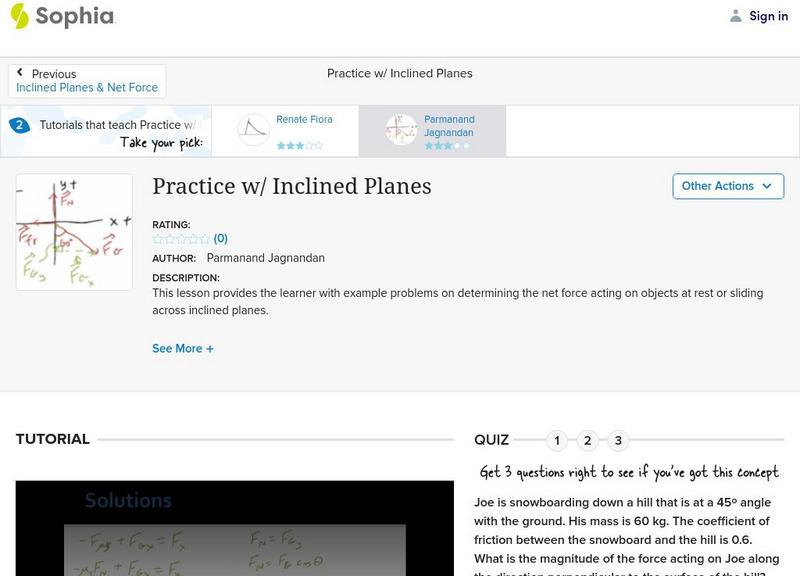
Sophia Learning
Sophia: Practice With Inclined Planes
A video presentation providing example problems on finding the net force acting on objects at rest or sliding across inclined planes. [13:08]
TeachEngineering
Teach Engineering: How Far?
To learn how friction affects motion, students explore how different textures provide varying amounts of friction to objects moving across them. They build a tool to measure the amount of friction between a note card and various surfaces...
TryEngineering
Try Engineering: Give Me a Brake
Activity investigates the concept of how bicycle brakes use force and friction to stop or slow mechanical motion. Students work in teams to devise a simple braking system while suggesting improvements to current bicycle brake design.
Physics Classroom
The Physics Classroom: Circular and Satellite Motion: Roller Coaster Model
An interactive playground for students to explore the physics of roller coasters. Learners investigate by changing the variables of force, velocity, friction, and vectors. Energy bar charts are displayed as the coaster car moves along...

American Association of Physics Teachers
Com Padre Digital Library: Open Source Physics: Sliding Down an Incline Plane
Here is a simulation demonstrating an object placed on an inclined plane. The user will vary the slope of the plane to see the relationship the slope has on the gravity of the object and the static friction.
Center of Science and Industry
Cosi Columbus: Hover Cup
Science experiment in which you make a hovercraft, a machine that uses compressed air to do work, from a paper cup. Includes full list of materials, procedures, and scientific explanation of how air flow can minimize friction and cause...
Science Education Resource Center at Carleton College
Serc: Newton's Second: Having a Ball With Motion
Students will create a gravity ball launcher to demonstrate their understanding of mass, force, momentum, and motion. The students will use critical thinking, measurement, and observation and analysis of data to make changes and improve...
Physics Classroom
The Physics Classroom: Work and Energy: Energy Transformation Downhill Skiing
The intricate relationship between work and mechanical energy is depicted in the animation for students to be able to visualize.
Famous Scientists
Famous Scientists: Charles Augustin De Coulomb
A short biography about Charles Coulomb, known for developing Coulomb's law, the definition of the electrostatic force of attraction and repulsion.
Physics Aviary
Physics Aviary: Practice Problems: Car Stopping Distance
Students must calculate the time it takes for a car to come to a rapid stop and the distance the car covers when stopping.
PBS
Pbs Learning Media: The Ruff Ruffman Show: Bottle Cap Hockey
Explore sports science and see how many points can you score with your bottle caps in Ruff's take on table hockey.
Science Education Resource Center at Carleton College
Serc: Investigating Motion: What Causes Objects to Move?
Students will have an opportunity to determine what makes everyday objects move. Students will be given objects and asked to make predictions on how far each object will move after they blow on it. Then they will measure the distance and...
Ohio State University
Ohio State Univ.: Simple Machines & Mechanical Advantage [Pdf]
This site details how simple machines create a mechanical advantage for humans. Levers, theoretical mechanical advantage, actual mechanical advantage, and pulley systems are discussed.