Hi, what do you want to do?






Science ABC
Why Do We Dance To Music?
Why do we dance? We dance to music because of neural connections in our brain. These connections link the part that perceives music, the auditory cortex to the regions that help us move, the motor regions. We might have started creating...
Science ABC
Why Do Power Lines Buzz?
The buzzing sound that power lines produce is caused by corona discharge. Corona discharge is an electrical discharge that occurs when a fluid (like air) surrounding an electrically-charged conductor becomes ionized. In simple terms, its...
Curated Video
CompTIA Security+ Certification SY0-601: The Total Course - About the Security+ (SY0-601) Exam
This episode goes over the domains of the CompTIA Security+ (SY0-601) exam objectives and the various topics that are covered.
This clip is from the chapter "Risk Management" of the series "CompTIA Security+ Certification...
This clip is from the chapter "Risk Management" of the series "CompTIA Security+ Certification...
Catalyst University
General Chemistry | Ideal Gas Law (PV=nRT) [Example #1]
In this video, we will do an example calculation using the ideal gas equation of state, PV=nRT. [Solving for volume, V]
Crash Course
Ideal Gas Problems: Crash Course Chemistry
We don't live in a perfect world, and neither do gases - it would be great if their particles always fulfilled the assumptions of the ideal gas law, and we could use PV=nRT to get the right answer every time. Unfortunately, the ideal gas...
Bozeman Science
Ideal Gas Law
In this video Paul Andersen explains how the pressure, volume, amount, and temperature of an ideal gas are related. Absolute zero of a gas can be determined by varying the temperature and measuring the corresponding volume of a gas...

Code.org
Unplugged - Abstraction with Mad Libs
Find the full course <a href='http://learn.code.org' target='_blank' rel='nofollow'>at</a> href='http://learn.code.org' target='_blank' rel='nofollow'>at
TED-Ed
TED-Ed: The ABC's of gas: Avogadro, Boyle, Charles - Brian Bennett
How can bottles and balloons help explain the different laws that govern gas? See how Boyle's Law, Charles' Law, and Avogadro's Law help us understand the laws that govern gas properties.
Curated Video
Visiting Wat Arun in Bangkok
Howcast - Learn about Wat Arun, the most famous of Thailand's many wats, or Buddhist temples, in this Howcast travel video.
Curated Video
The Connection Between Entropy, Time, and Information
The common interpretation of entropy is that it is a measure of disorder in the universe. The universe is on path to more and more disorder. And this is the reason time is thought to flow forward.Is entropy a...

JFR Science
Gas Laws: Why Do My Tires Deflate in Winter?
How many phenomena in the natural world can you explain through the relationship between temperature, pressure, and volume? Science scholars explore the gas laws with a video from JFR Science. Topics include manipulating gas laws...

Educreations
The Gas Laws
Temperature, pressure, and volume, oh my! Learn how one quality of gas affects the others with a video that includes worked out problems that use the Gas Laws with solutions.

Curated OER
The ABC's of Gas: Avogadro, Boyle, Charles
Using chalkboard animation, this video thoroughly explains the three empirical gas laws: Avogadro's, Boyle's, and Charles'. Use it as an introduction when teaching young chemists about the properties and behavior of gases.

Socratica
Chemistry: Charles's Law (Gas Laws)
Gay-Lussac first published the law relating the volume and temperature of gas, but he kindly credited Charles in what is now known as Charles's Law. Part of Socratica's chemistry playlist, the video explains Charles's Law. It also works...

Educreations
Ideal Gas Constant, R
The gas laws all solve for a constant, but none of them are truly constant in all situations. This video introduces the ideal gas constant, which is always the same. It explains how to solve for R and includes the numbers used on the...

Curated OER
STEMbite: Charles' Law
Charles' Law states that the temperature of a gas is directly proportional to the volume. Compressing a gas increases the heat, and giving it more space allows the molecules slow in speed and cool down. The narrator proves this concept...
Crash Course
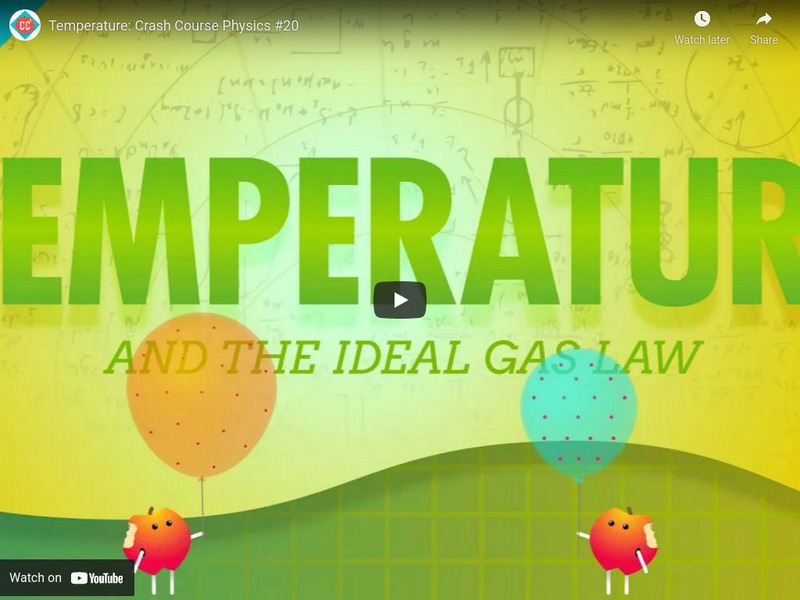
Crash Course Physics #20: Temperature and the Ideal Gas Law
Bridges don't deal well with temperature changes. In order to combat this, engineers have come up with some work arounds that allow bridges to flex as they expand or contract. In this video [9:01] episode of Crash Course Physics, Shini...

Khan Academy
Khan Academy: Chemistry: Ideal Gas Equation Example 2
A video lecture giving examples of how to solve for pressure, temperature, and volume using the ideal gas law. The video shows step-by-step how to solve the problems. [13:01]
Bozeman Science
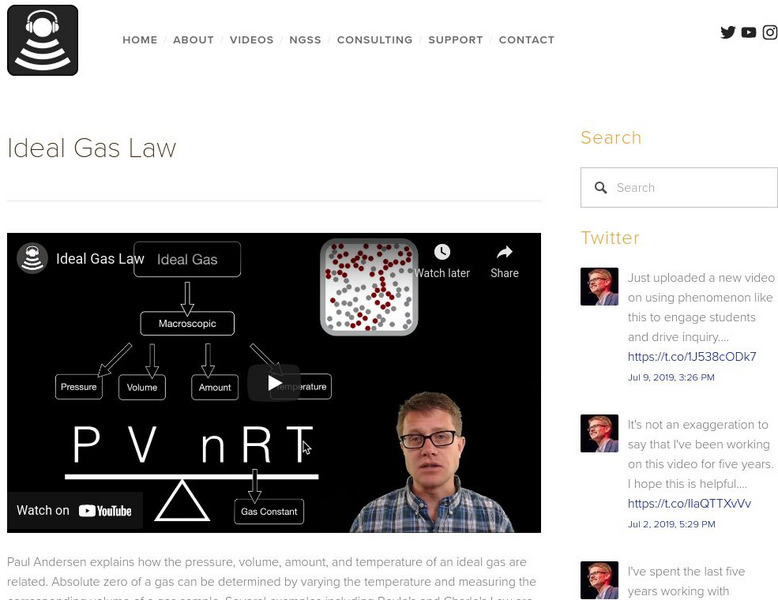
Bozeman Science: Ideal Gas Law
In the following video Paul Andersen explains how the pressure, volume, amount, and temperature of an ideal gas are related. Absolute zero of a gas can be determined by varying the temperature and measuring the corresponding volume of a...
Sophia Learning
Sophia: Charles' Law: Lesson 2
This lesson will demonstrate the relationship between volume and temperature of a gas at constant pressure. It is 2 of 2 in the series titled "Charles' Law."
![Educaplus: Ley De Los Gases Ideales [In Spanish] Instructional Video](https://content.lessonplanet.com/knovation/original/120234-df1188f5ad6ee9ceb4cf227e31e3e095.jpg?1661810918 "Educaplus: Ley De Los Gases Ideales [In Spanish] Instructional Video")
Educaplus (Jesús Peñas Cano)
Educaplus: Ley De Los Gases Ideales [In Spanish]
Watch this short video to learn how the ideal gas law is deducted and how to calculate the value of the constant R.
Sophia Learning
Sophia: Charles' Law: Lesson 1
This lesson will demonstrate the relationship between volume and temperature of a gas at constant pressure. It is 1 of 2 in the series titled "Charles' Law."