Hi, what do you want to do?






Museum of Science
Create Gas
Let's have a gas. Individuals mix baking soda and vinegar in a bottle. Learners view the interaction between the solid and the liquid and notice that a gas is formed. Scholars notice the gas inflates a balloon stretched across the mouth...

Perkins School for the Blind
The Three Basic States (Phases) of Matter
There are three basic states of matter: Solid, liquid, and gas. Help your learners with visual impairments to understand the chemical nature of each state of matter with tactile elements. Marbles are used to model the particles in each...

Exploratorium
Bubble Suspension
Create a cushion of carbon dioxide gas to float some soap bubbles on. Many concepts can be demonstrated through this activity:
Carbon dioxide gas is more dense than air
Bubbles are semipermeable, allowing only carbon dioxide to diffuse...

Center for Learning in Action
Gases
Explore the properties of gases through one activity and two investigations in which super scientists observe the changes gas makes when encountering different conditions.

Resources for Educators
Math & Science Connection
Whether you're using a collection of Dr. Seuss books to teach basic math skills like counting, adding, and subtracting, or exploring the different states of matter by melting a crayon with a hairdryer, a series...

NorthEast Ohio Geoscience Education Outreach
Introduction to Density
Seventh grade scientists weigh in on the concept of density. In a nutshell, they participate in the following activities:
Measurement of the mass and volume of fruit in order to compare densities
Measurement of the mass of oil and water...

K-State Research and Extensions
The Crusty Earth
Geology rocks — literally! A geology chapter offers eleven activities at four different levels. Scholars enjoy completing hands-on experiments before applying critical thinking skills following a share, process, generalize, apply,...

Curated OER
Element Research Project
Students research elements on interactive Internet periodic tables, take notes using Inspiration software, and write descriptive paragraphs with graphics. They create presentations.
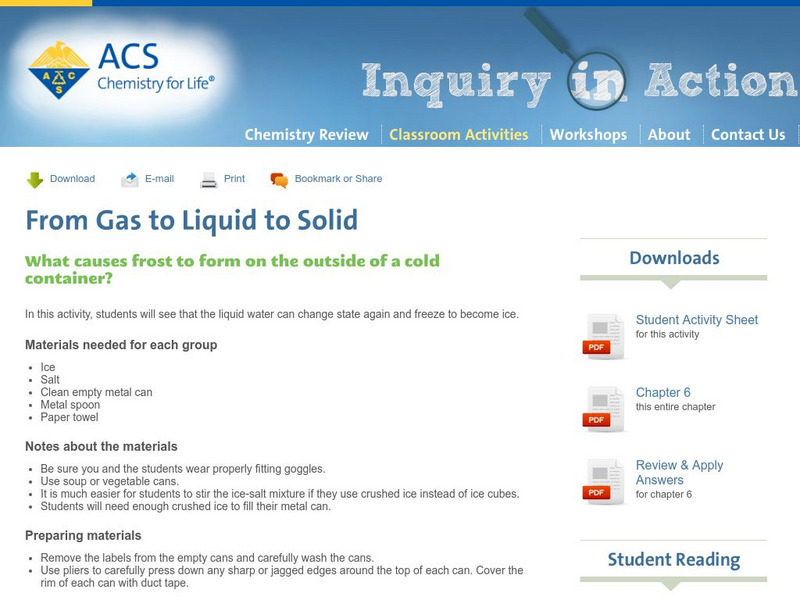
American Chemical Society
Inquiry in Action: From Liquid to Gas to Solid
What causes frost to form on the outside of a cold container? In this activity, students will see that the liquid water can change state again and freeze to become ice.

Concord Consortium
Concord Consortium: Molecular Workbench Showcase: Chemistry, States of Matter
See how gas, liquid, and solid molecules react to external pressure in this simulation. Also see a model of intermolecular motion through elliptical particles.
Ministerio de Educación (Spain)
Ministerio De Educacion: La Materia
In this site you can learn and experiment with matter properties and change in behavior. Every theoretical explanation is accompanied by an animation. You will be able to aply the theory to real experiments.
Center of Science and Industry
Cosi Columbus: Can You Stand the Pressure
Science experiment that demonstrates the four states or phases of matter: solid, liquid, gas, and plasma. Includes full list of materials, procedures, and scientific explanation of how you change water from a liquid state to a gaseous...
Read Works
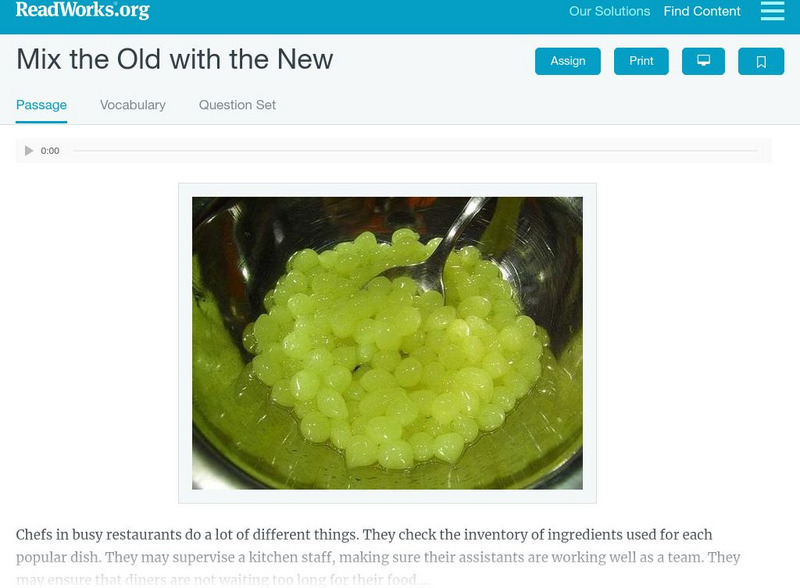
Read Works: Mix the Old With the New
[Free Registration/Login Required] An informational text about how cooking causes changes in matter. A question sheet is available to help students build skills in reading comprehension.
Museum of Science
The Atom's Family: Phases of Matter
Help the Phantom choose a material and observe the changes at different temperatures in the molecule chamber. What happens to the elements or molecules as the temperature changes?
Museum of Science
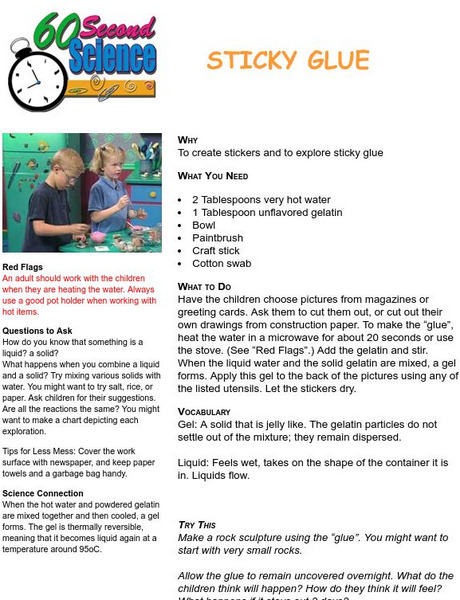
The Atom's Family: Mighty Molecules
In this activity, students construct models of molecules using marshmallows and gum drops.