Hi, what do you want to do?






Center for Learning in Action
Water – Changing States (Part 2)
Here is part two of a two-part lesson in which scholars investigate the changing states of water—liquid, solid, and gas—and how energy from heat changes its molecules. With grand conversation, two demonstrations, and one hands-on...

Center for Learning in Action
Water—Changing States (Part 1)
Here is part one of a two-part lesson in which scholars investigate the changing states of water—liquid, solid, and gas. With grand conversation and up to three demonstrations, learners make predictions about what they think will happen...

National Institute of Open Schooling
Adsorption and Catalysis
Adsorption, not absorption, is when atoms stick to the surface of an object, like water sticking to a grain of sand. An informative lesson delves into adsorption, teaching physical and chemisorption and the factors that affect them....

National Institute of Open Schooling
The Liquid State
Due to surface tension, dew — a liquid, is spherical in shape. Learners explore the properties of liquids in activity seven in this series of 36. Beginning with its basic properties such as boiling point and moving through to surface...

Center for Learning in Action
Introduction to the States of Matter
Liquids, gases, and solids are the states of matter in which scholars investigate in a lesson plan that offers in-depth information and engaging activities that look into the three states and the changes their properties make when mixed...

National Institute of Open Schooling
Solid State
Crystal comes from a Greek word meaning ice. Activity eight in a series of 36 has class members analyzing amorphous and crystalline solids and further classifying them based on their forces. They then explore solids, learning about unit...

Curated OER
First Land Plants Found on Earth
In this first land plants worksheet, students read about the major events that allowed plants to evolve on Earth. Students read about the primary and secondary atmospheres, the formation of the ozone layer to protect from UV light and...
Simon Fraser University
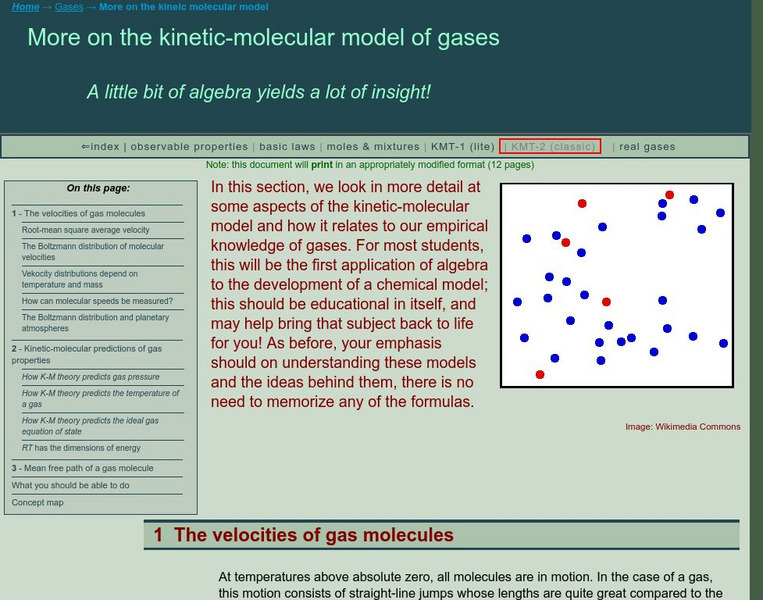
Chem1 Virtual Textbook: Velocities of Gas Molecules and Boltzmann Distribution
The General Chemistry Virtual Textbook, or Chem 1, is broken into several sections covering various aspects of topics related to chemistry. This section deals with both Boltzmann Distribution and the velocity of gas molecules.
University Corporation for Atmospheric Research
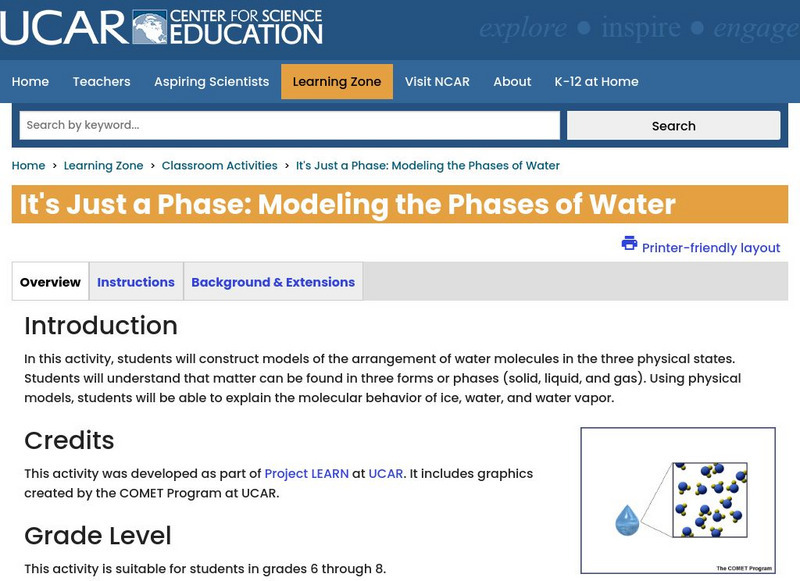
Ucar: Just a Phase: Water as a Solid, Liquid, and Gas
This site helps students construct a model of the arrangement of water molecules when present as solid, liquid or gas. Includes background information, lesson plans, links to standards and assessment ideas.
Simon Fraser University
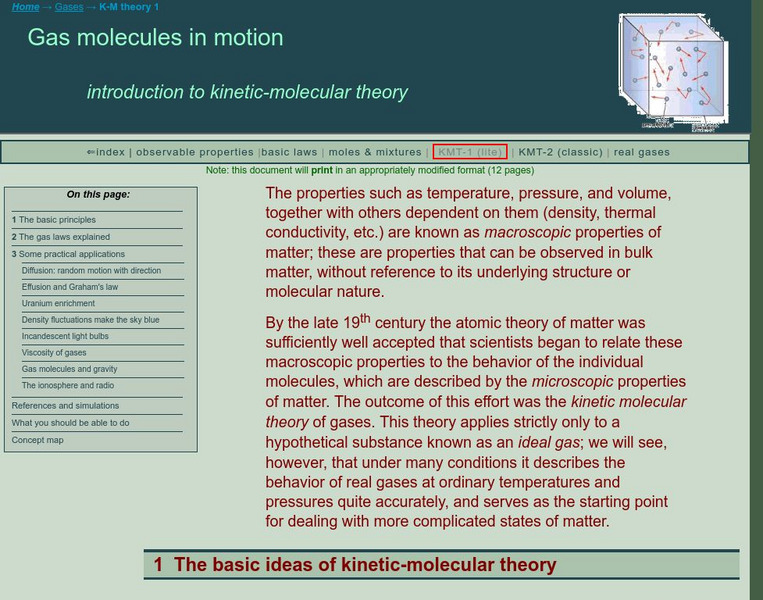
Chem1 Virtual Textbook: Molecules in Motion
As part of the General Chemistry Virtual Textbook, this site continues a study conducted on various topics related to gases. As a specific topic, the site covers an introduction to kinetic molecular theory.

University of Florida
Chem. 2041 Lecture Notes: The Forces Between Molecules
A discussion of the variety of forces which hold molecules together. The relative strengths of these forces for the various states of matter is discussed. The effect of such forces on the boiling points and other phase change...
Simon Fraser University
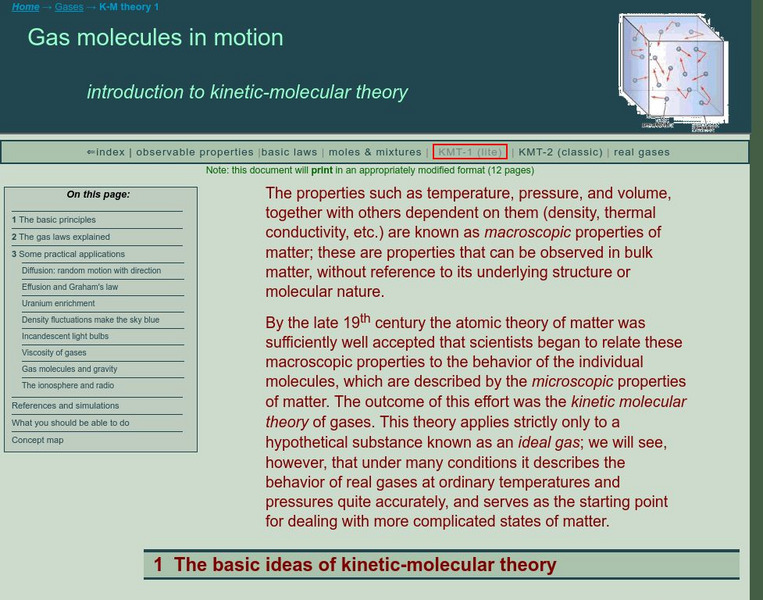
Chem1 Virtual Textbook: Kinetic Molecular Model
The General Chemistry Virtual Textbook, or Chem 1, is broken into several sections covering various aspects of topics related to chemistry. This section deals with the basic components of the Kinetic-Molecular Theory in addition to...
Simon Fraser University
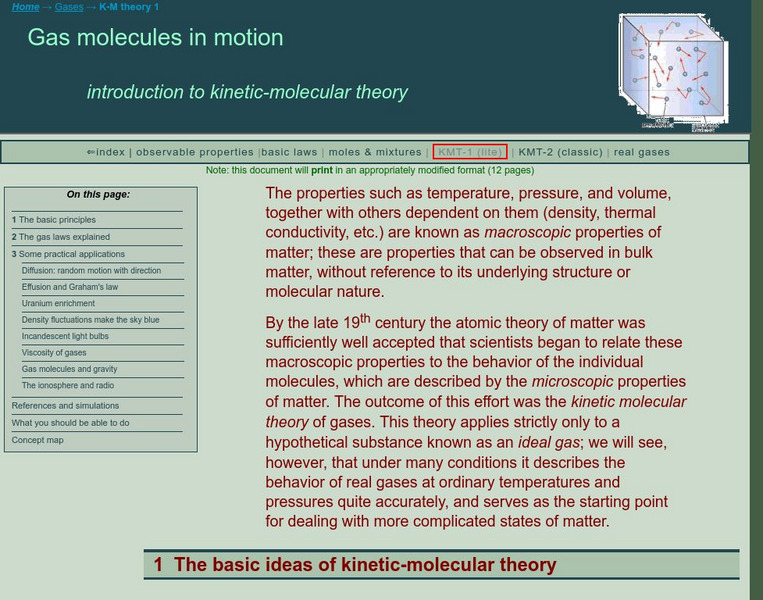
Chem1 Virtual Textbook: Diffusion: Random Motion With Direction
The General Chemistry Virtual Textbook, or Chem 1, is broken into several sections covering various aspects of topics related to chemistry. This section deals with diffusion along with topics such as concentration gradient and random...
Purdue University
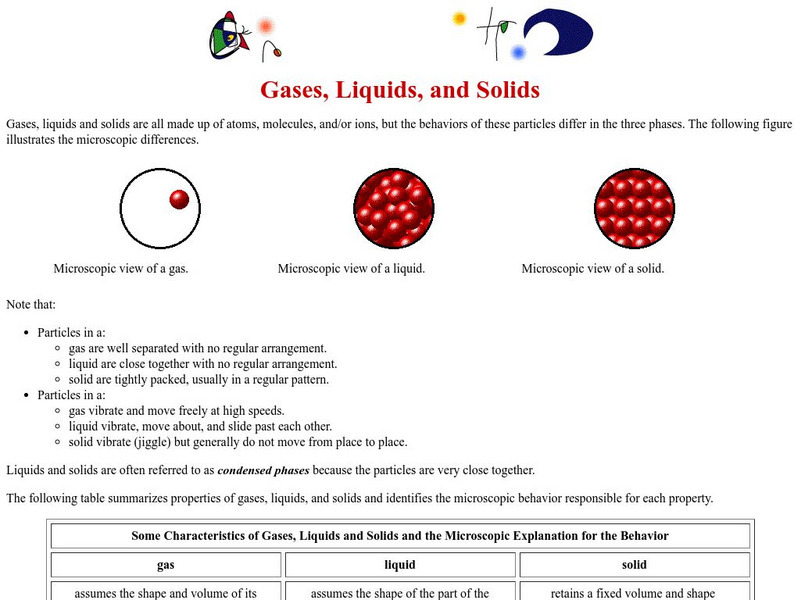
Purdue Univ: Gases, Liquids, and Solids
This site has a brief description of the differences in particles in a gas, liquid, and solid. Animated microscopic pictures demonstrate the molecular movement in each state. Information is then summarized in an easy-to-read chart.
Frostburg State University
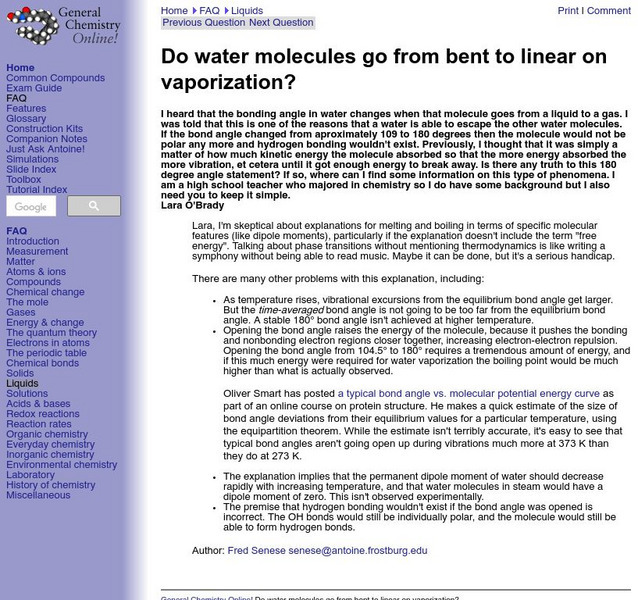
Frostburg State Chemistry Online: Water Bond Angles & Phase Changes
Describes the bond angle of the water molecule during the transition from liquid to gas state. Also provides several examples and explanations for responses and answers given.
New York University
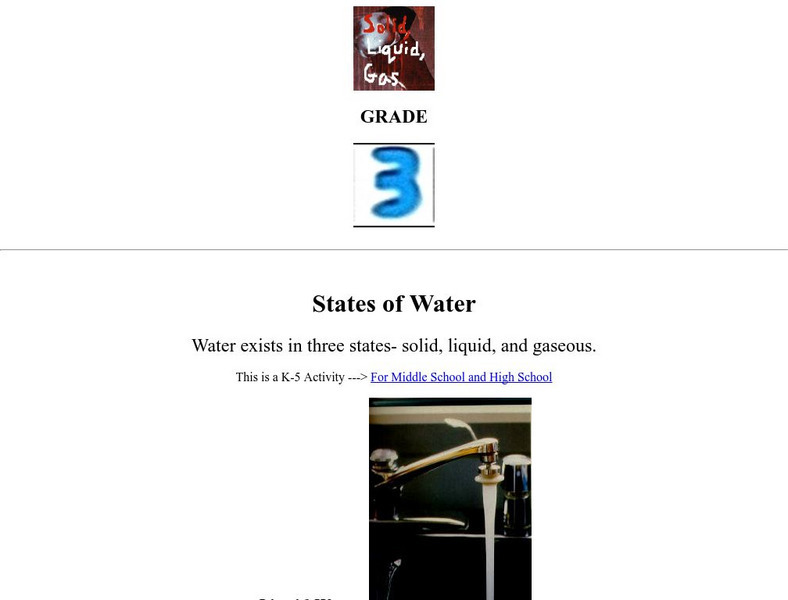
New York University: States of Water
Use this resource to learn about the three different phases of water; solid, liquid, and gas. What happens to water as it changes into a solid or gas? Includes short and easy to do activity.

National Earth Science Teachers Association
Windows to the Universe: Ammonia Nh3
Read about the chemical compound ammonia and learn how it is part of the Nitrogen Cycle.

Vision Learning
Vision Learning: Three States of Matter
Concept animation compares molecular movement of solids, liquids, and gases.
Encyclopedia of Earth
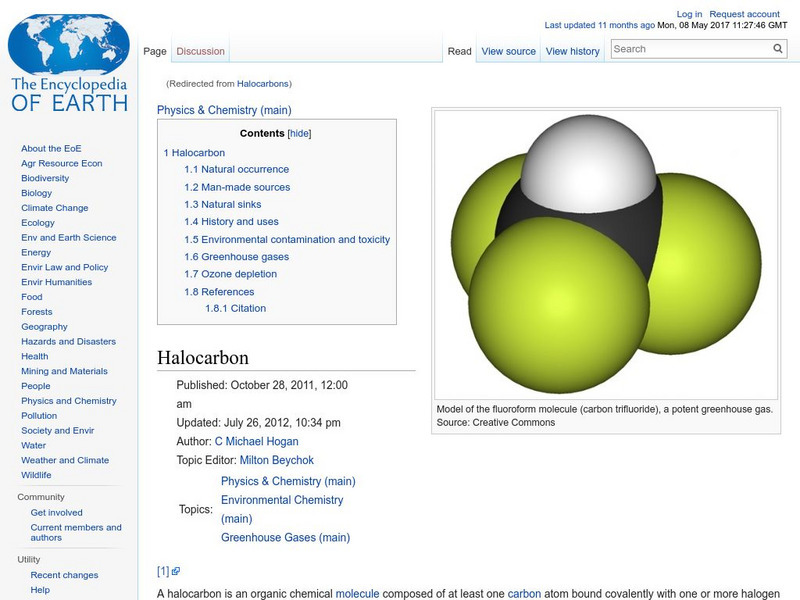
Encyclopedia of Earth: Physics & Chemistry: Halocarbon
Article explaining what halocarbons are, where they occur in nature as well as man-made sources, how they are used, and their negative environmental impact. (Published: October 28, 2011)
Simon Fraser University
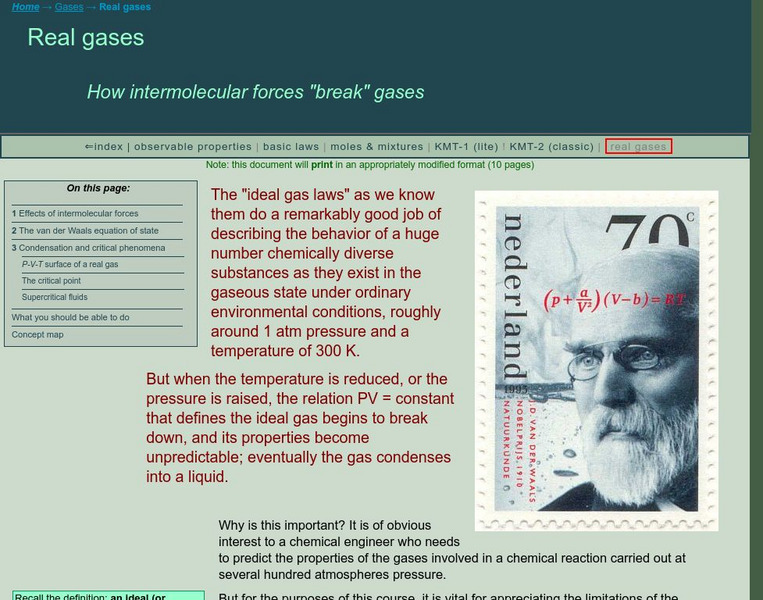
Chem1 Virtual Textbook: Effects of of Intermolecular Forces
The General Chemistry Virtual Textbook, or Chem 1, is broken into several sections covering various aspects of topics related to chemistry. This section deals with intermolecular forces and topics including repulsive forces and...