Hi, what do you want to do?





US Geological Survey
Usgs: Tsunamis in the Pacific Northwest
This page from the U.S. Geological Survey is devoted to Tsunamis in the Pacific Northwest. View some animations of tsunamis.
Burke Museum
Burke Museum: The Big One
This is the introduction to the Burke Museum's online exhibit on earthquakes and natural disasters. This is part of the Burke Museum's collection of geology. Topics that are covered include an introduction to quakes, quake science, quake...
Science Buddies
Science Buddies: Measuring the Earth's Core With Seismic Waves
When an earthquake occurs, seismic shock waves travel out through the earth from the source of the event. The shock waves travel through the earth (body waves), or along the Earth's surface (surface waves), and can be recorded at remote...
Burke Museum
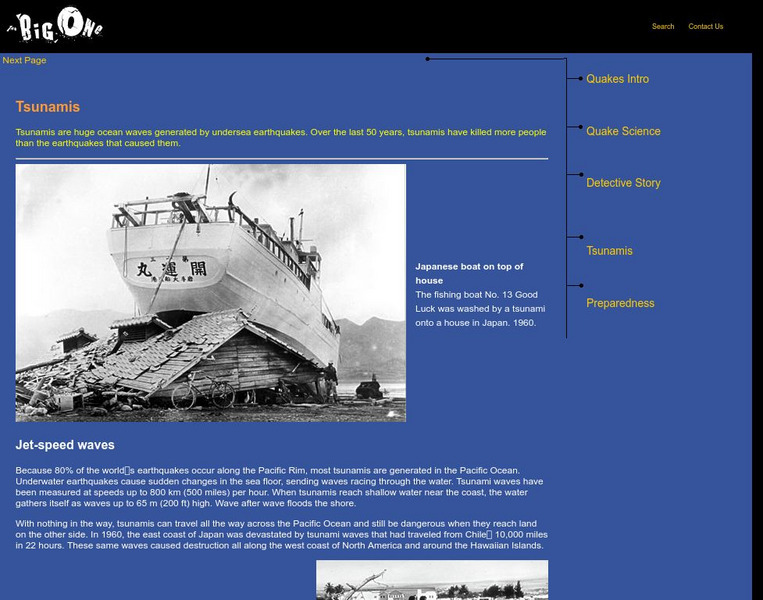
Burke Museum: Tsunamis
The information on tsunamis provided at this site is part of the Burke Museum's online exhibition on earthquakes and geology. Prevention is discussed, along with famous tsunamis in history.

US Geological Survey
U.s. Geological Survey: A Child's View of Earthquake Facts and Feelings
This is an excellent resource for children, parents, and teachers who need to talk about earthquakes. It includes guides for teachers and parents and an ABC Children's Book about earthquakes.
US Geological Survey
Usgs: Determining the Depth of an Earthquake
Provides insight on how scientists determine the depth of an earthquake. Offers links to locating earthquakes as well as earthquake facts and lists.
US Geological Survey
U.s. Geological Survey: Search Earthquake Catalog
Use this interactive map to find out about earthquakes which have happened around the world since about 1970.

Science Struck
Science Struck: Earthquakes and Volcanic Eruptions
Explains what earthquakes and volcanic eruptions are and how they are related.

US Geological Survey
U.s. Geological Survey: Learning About Earthquakes Coloring Pages
Coloring pictures of seismic waves, earthquake safety and hazard maps. [PDF] Links to other handy tools, including trivia, stories, games and fun projects.
Purdue University
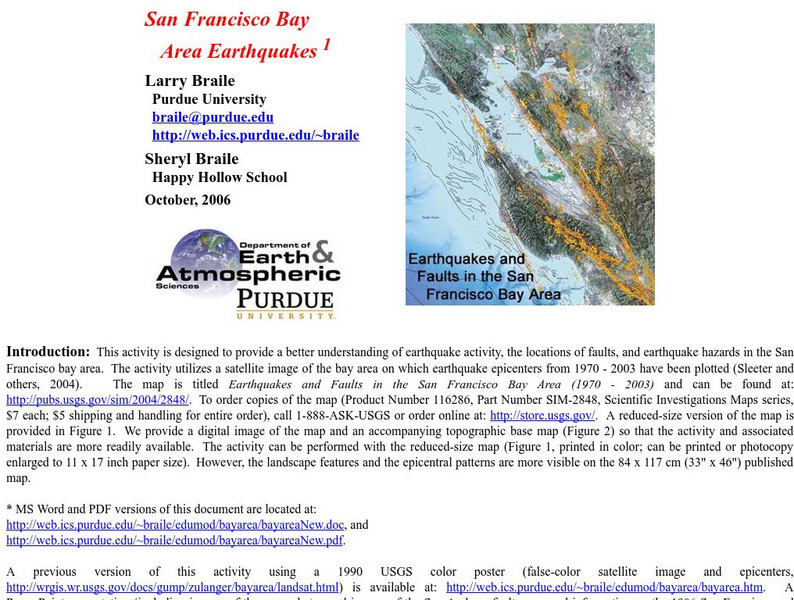
Purdue University: San Francisco Bay Area Earthquakes
Students use geologic fault maps of the San Francisco Bay Area to find relationships between tectonic plate fault lines and landscape features, topographic features, and epicenters of past earthquakes.
US Geological Survey
U.s. Geological Survey: Earthquakes: Liquefaction
Maps and images that show liquefaction, the process by which water-filled sediment loses strength and acts like a fluid.
US Geological Survey
Usgs: 2004 Deadliest in Nearly 500 Years for Earthquakes
The USGS provides the facts and figures on 2004's earthquakes, which is the second most fatal in recorded history.
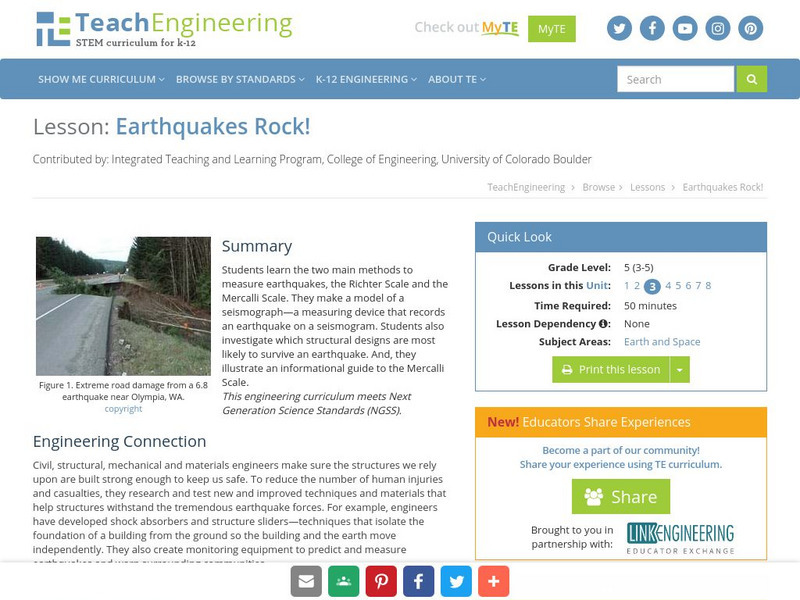
TeachEngineering
Teach Engineering: Earthquakes Rock!
Students learn the two main methods to measure earthquakes, the Richter Scale and the Mercalli Scale. They make a model of a seismograph - a measuring device that records an earthquake on a seismogram. Students also investigate which...
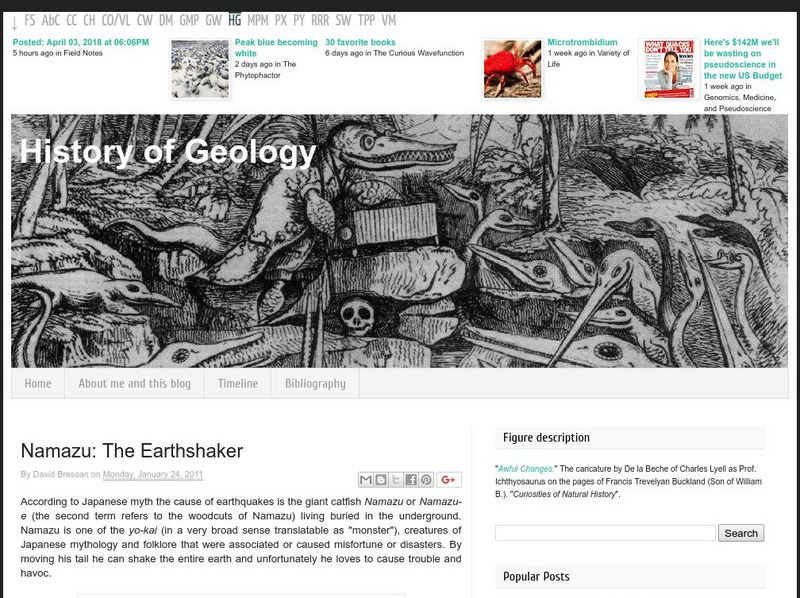
Other
History of Geology: Namazu: The Earthshaker
Article on the Japanese mythological explanations of the history of geologic events in Japan.
US Geological Survey
U.s. Geological Survey: San Andreas Fault at Wallace Creek
See interactive, 360 degree panoramic photos of the San Andreas Fault. Aerial photos of the fault were taken using a technique called Kite Aerial Photography.
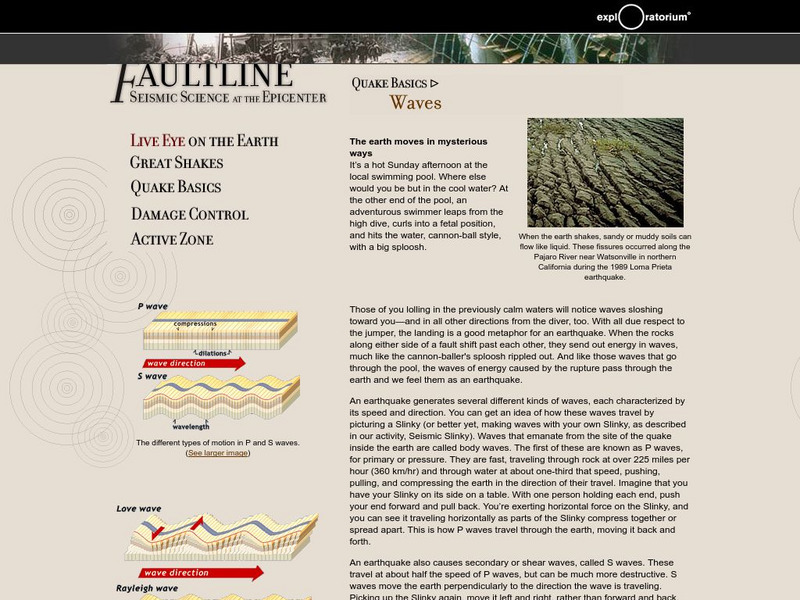
Exploratorium
Exploratorium: Faultline: P and S Waves
The different types of earthquake waves are discussed and illustrated. Features geologist video clip.
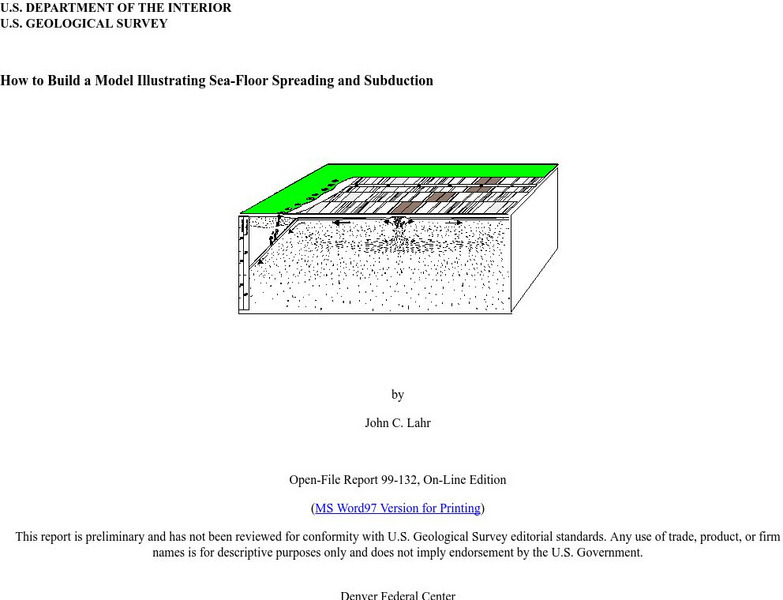
US Geological Survey
Usgs: How to Build a Model Illustrating Sea Floor Spreading
This is a comprehensive website featuring how to build a model that illustrates sea-floor spreading and subduction. It has diagrams and pictures reviewing major geological concepts.
Columbia University
Scientific Background on the Indian Ocean Earthquake and Tsunami
This site features information and related links that can be used by students and scientists to understand the events that led to the December 2004 Indian Ocean tsunami.
Science and Mathematics Initiative for Learning Enhancement (SMILE)
Smile: Earthquake Waves and Their Destructions
Looking for the epicenter of an earthquake and measuring the magnitude of waves are goals for students in this lesson plan for intermediate to middle school students. Students get to analyze the P and S waves.
Science Buddies
Science Buddies: Pop Goes the Geyser!
Our home, Earth, is a living planet. Earthquakes and volcanic eruptions are proof that the geological forces that shaped our planet and created the land masses are ongoing. An amazing example of geologic activity that is less damaging is...
Science Buddies
Science Buddies: What's All That Shaking? Make Your Own Seismograph!
If you live in an area where earthquakes happen, you might be especially interested in this science project. You'll learn how to build your own seismograph and how to use it to detect ground motion.
Utah State Office of Education
Utah Science: Rocks & Minerals
A unit on rocks and minerals presented with interactive and classroom activities. Gain understanding of rocks, weather, erosion, earthquakes, and relative dating with this resource.
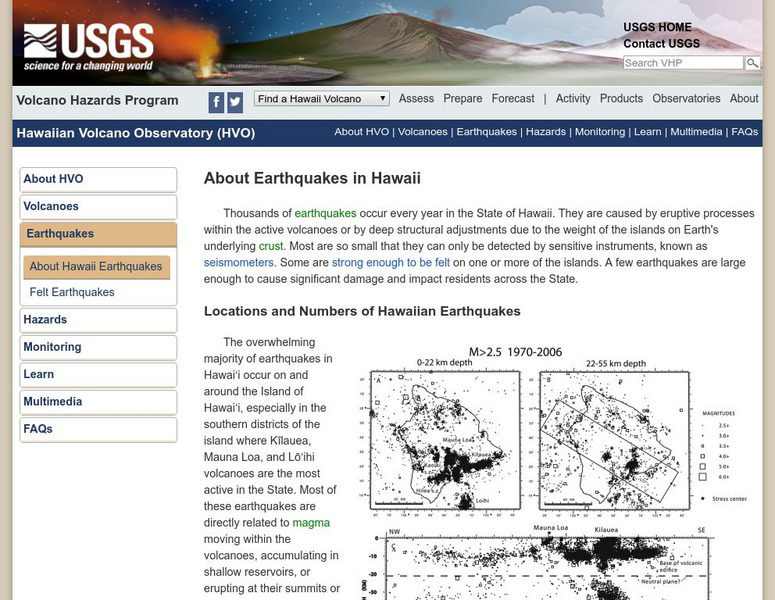
US Geological Survey
Usgs: November 29, 1975 Kalapana
Describes details of the earthquake of November 29, 1975 Kalapana in Hawaii, the tsunami, and the eruption of the volcano Kilauea as a result of the earthquake.
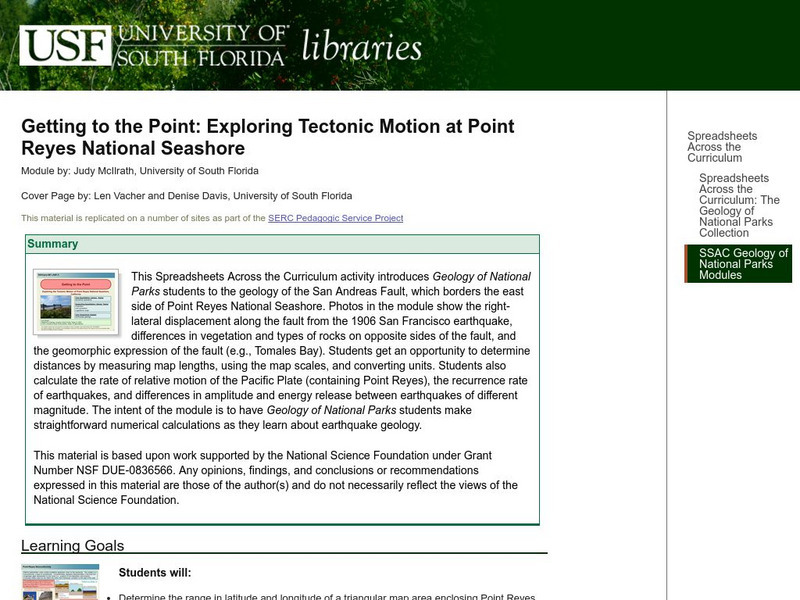
Science Education Resource Center at Carleton College
Serc: Getting to the Point: Exploring Tectonic Motion Point Reyes Seashore
The intent of this module is for students to make straightforward numerical calculations as they learn about earthquake geology at a National Park.