Hi, what do you want to do?






Illustrative Mathematics
3-D Shape Sort
From the apple on your desk and the coffee cup in your hand, to the cabinets along the classroom wall, basic three-dimensional shapes are found everywhere in the world around us. Introduce young mathematicians to the these common figures...

EngageNY
How Do 3D Printers Work?
If we stack up all the cross sections of a figure, does it create the figure? Pupils make the connection between the complete set of cross sections and the solid. They then view videos in order to see how 3D printers use Cavalerie's...

Inside Mathematics
Quadratic (2009)
Functions require an input in order to get an output, which explains why the answer always has at least two parts. After only three multi-part questions, the teacher can analyze pupils' strengths and weaknesses when it comes to...

Inside Mathematics
Quadratic (2006)
Most problems can be solved using more than one method. A worksheet includes just nine questions but many more ways to solve each. Scholars must graph, solve, and justify quadratic problems.

Inside Mathematics
Hexagons
Scholars find a pattern from a geometric sequence and write the formula for extending it. The learning exercise includes a table to complete plus four analysis questions. It concludes with instructional implications for the teacher.

Noyce Foundation
Snail Pace
Slow and steady wins the race? In the assessment task, scholars calculate the rates at which different snails travel in order to find the fastest snail. Hopefully, your class will move much more quickly in finishing the task!
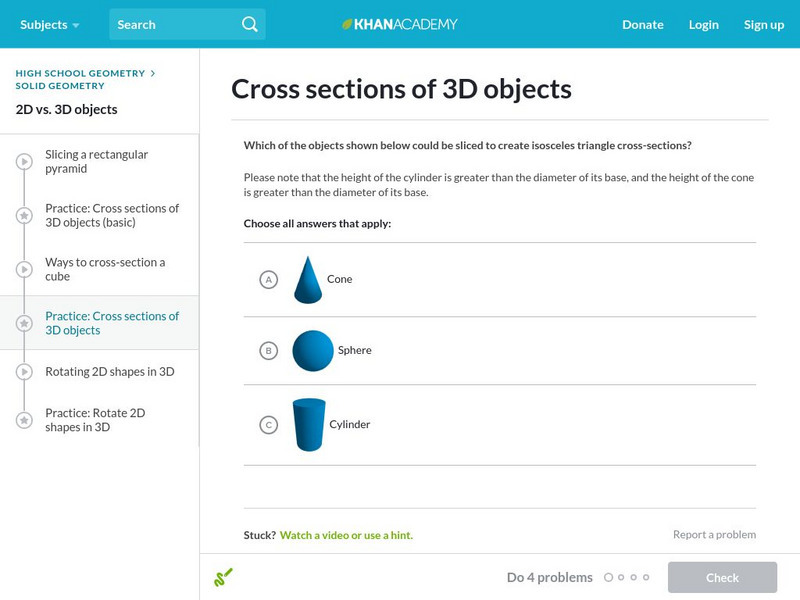
Khan Academy
Khan Academy: Cross Sections of 3 D Objects
Practice your knowledge of all possible cross-sections of common 3D objects. Students receive immediate feedback and have the opportunity to try questions repeatedly, watch a video or receive hints.

Khan Academy
Khan Academy: Cross Sections of 3 D Objects (Basic)
Basic practice problems involving cross sections of 3D objects.
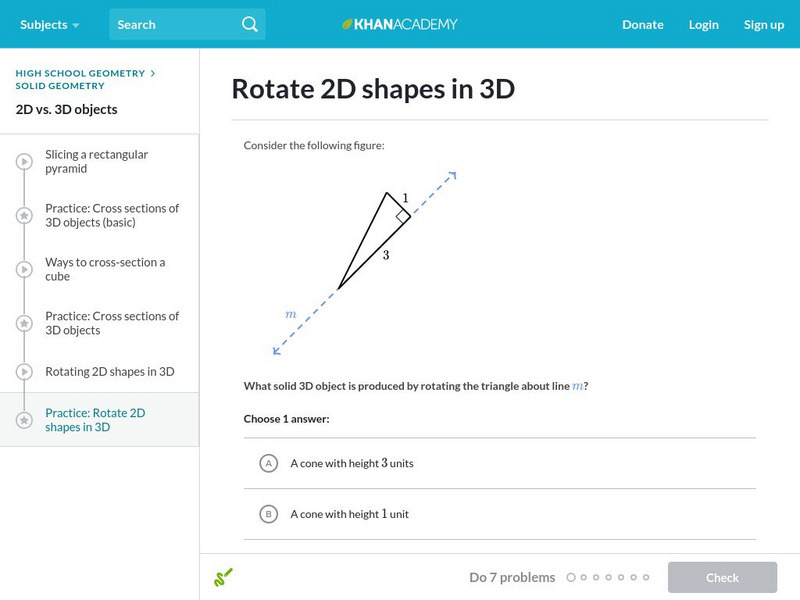
Khan Academy
Khan Academy: Rotate 2 D Shapes in 3 D
Practice your 3D visualization skills by rotating 2D shapes. Students receive immediate feedback and have the opportunity to try questions repeatedly, watch a video or receive hints.