Hi, what do you want to do?






Curated OER
More Prisms/Nets
Students calculate the volume and surface are of three-dimensional shapes. In this geometry lesson plan, students use the nets to prove their calculations of shapes. They identify the different parts of a solid using the nets.

Curated OER
Sketching Prisms
Students sketch and create nets of different polygons.In this geometry lesson, students differentiate prisms from other three-dimensional shapes. They define the properties of prisms.

Curated OER
Measurement
Seventh graders measure surface area. In this geometry lesson plan, 7th graders find the surface area of various geometrical shapes. Using a computer program, students compute the area of 2-D and 3-D shapes. Students...

Curated OER
Box Folding: Predict, Analyze and Measure
Students predict the shape of a geometric figure in 3D. In this geometry lesson plan, students construct 3D shapes to perfect their knowledge of measuring and predicting. This assignment is also available as an online interactive lesson...

Curated OER
Poly-Mania
This hands-on lesson takes young geometers on a tour of 2D polygons and 3D polyhedrons. After exploring different web resources and discussing geometric shapes, small groups construct models of polyhedrons using bendable straws. Note:...

Shodor Education Foundation
Surface Area of Rectangular Prism
With this interactive lesson, learners compute the surface area of rectangular prisms. They visit an online investigation applet and record data on the provided handout. Pair this lesson with the volume lesson by the same publisher as an...

Shodor Education Foundation
Volume of Prisms
Explore the concept of volume of prisms using an applet to perform the calculations. The link to the interactive applet is embedded into the lesson plan as well as a link to associated data sheets. Get your math class to the computer lab...

Curated OER
Volume of Rectangular Prisms
Introduce the procedure needed to find the volume of a rectangular prism. Learners rank various prisms such as cereal boxes and tissue boxes from smallest to largest volume. They use an applet to find the volume and surface area of each...

Curated OER
Volume and Surface Area
Students explore volume and surface area. In this math lesson, students fill boxes with cubes to identify the volume of the boxes. Students discuss area.

Curated OER
Surface Area of Prisms
Students compute surface area and volume of prisms. In this surface area lesson, students find the surface area and volume of rectangular and triangular prisms. Independently, students use their computers to determine the volume,...

Curated OER
Analyzing 3-D Shapes and 2-D Representations
Students can analyze 3-D objects better with actual physical models and by also drawing 2-D representations of them.

Curated OER
Marshmallow Figures
Students enjoy making 3-D figures while learning about rectangular prisms, pyramids, vertices, edges, and faces. After a lecture/demo, students use marshmallows, toothpicks and a worksheet imbedded in this activity to create 3...

Illustrative Mathematics
Overlapping Squares
The objective of this activity is to find the percent of the area of a two squares overlapping. Mathematicians find the ratio of area for the part that overlaps to the rectangle formed. The final answer is a percent as a rate per 100....

Curated OER
Sizing Up Shapes
First graders explore geometric shapes. In this math instructional activity, 1st graders sort shapes into groups and discuss the characteristics of the shapes. Students build geometric shapes using toothpicks and marshmallows.

Curated OER
Volume and Surface Area of Polyhedrea
For this volume and surface area worksheet, students use given formulas to determine the volume and area of polyhedrea. This four-page worksheet contains examples, explanations and 32 problems. Answers are provided on the fourth page.

Curated OER
Volume and Surface Area: Which Is More?
Students explore the volume and surface area of three dimensional figures. Through the use of video, students discover three dimensional shapes, their uses in real-life applications, and methods used to calculate their volume and surface...

Curated OER
Classifying Pyramids
Students study pyramids. In this prisms instructional activity, students explore the attributes of pyramids. Students will explore the lateral surface area of pyramids and be able to distinguish pyramids from other space shapes.

Curated OER
Three-Dimensional Objects
Fourth graders view and identify three-dimensional figures. They analyze and discuss various figures, build three-dimensional figures, and complete various worksheets and worksheet discussion questions.

Curated OER
Pyramids with Basic Bases
Pupils explore pyramids. In this math lesson, students discuss where they have seen examples of pyramids. Pupils classify pyramids as three-dimensional figures and identify their attributes.

Curated OER
Geometric Solids
Students identify and create simple geometric shapes and describe simple spatial relationships. Through discussion, hands-on activities and show and tell, they identify geometric solids in real life and create graphs of commonly found...

Curated OER
Shapes are Everywhere
Second graders gain an understanding of geometric shapes and spatial reasoning. They learn the attributes of solid shapes in everyday activities. Students compare geometric shapes to everday objects, finding things that serve a purpose...
Shmoop University
Shmoop: Basic Geometry: 3 D Objects (Prisms, Cylinders, Cones, Spheres)
The geometry resource investigates three-dimensional objects. Objects include prisms, cylinders, cones, and spheres. Detailed examples and practice exercises are included.
Khan Academy
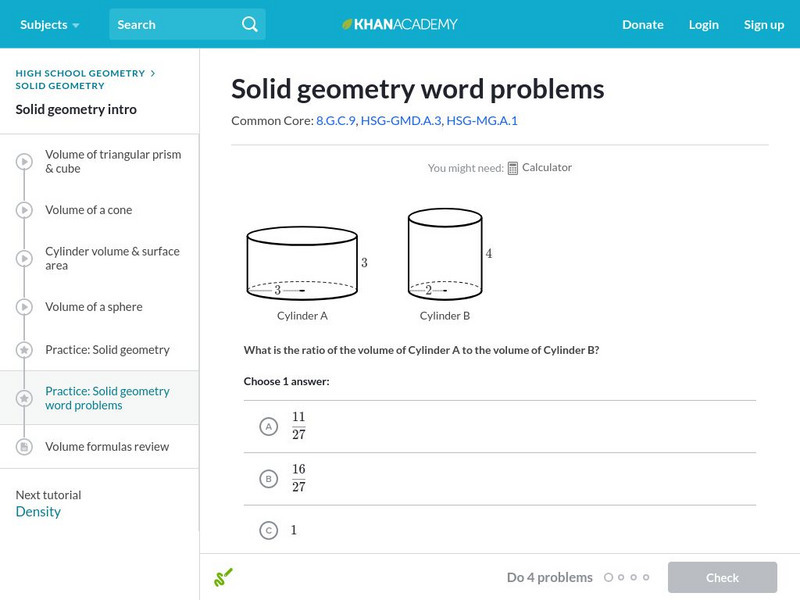
Khan Academy: Solid Geometry Word Problems
Solve problems concerning real-world situations with the volumes of cones, cylinders, and spheres. Students receive immediate feedback and have the opportunity to try questions repeatedly, watch a video or receive hints.
Khan Academy
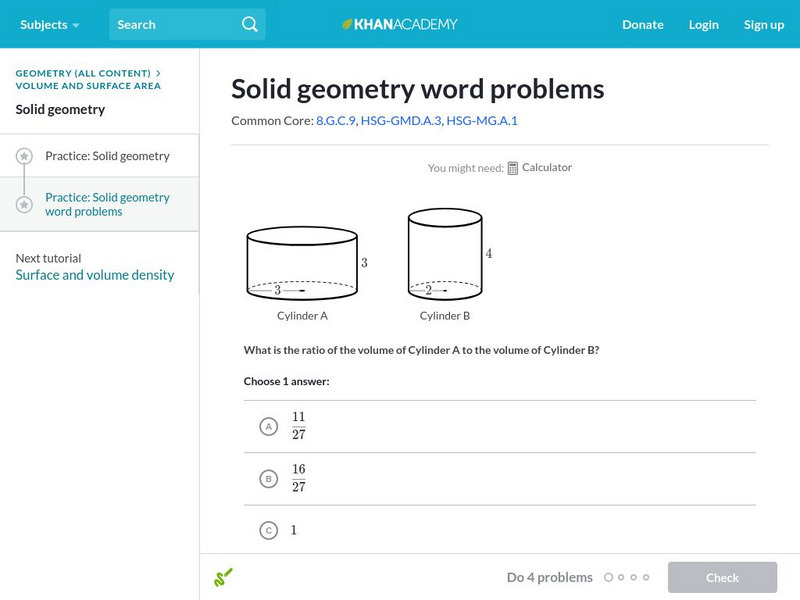
Khan Academy: Solid Geometry Word Problems
In this exercise, students practice volume word problems with cones, cylinders, and spheres. Students receive immediate feedback and have the opportunity to watch a video, get hints, or try questions repeatedly.