Hi, what do you want to do?






Curated OER
Examining Geometric Solids
Students explore geometry by completing a math worksheet in class. In this shape identification lesson, students identify the characteristics associated with 15 solid geometric shapes. Students identify patterns between vertices, edges...

Curated OER
Investigating Nets and Polyhedra
Fifth graders create a net for a given polyhedron. They determine the corresponding polyhedron for a given net. Students investigate several polyhedra (cube, tetrahedron, and one of their choosing) and their corresponding nets. They...

Curated OER
Folding to Make Shapes
Second graders identify different polygons and their attributes. In this geometry instructional activity, 2nd graders get to know polygons by studying the vocabulary and finding polygons in their classroom. They create these shapes and...

Pennsylvania Department of Education
Rotational Symmetry of Polygons and Other Figures
Students explore geometry by participating in a shape rotation experiment. In this symmetry lesson, students identify the term symmetry and a list of other geometry vocabulary. Students analyze shapes as they are turned 90 degrees and...

Curated OER
Faces, Vertices, Edges
Learners identify the parts of three dimensional objects. In this geometry lesson, students find the number of faces, edges and vertices. They differentiate between prisms and polyhedra.

Curated OER
Countdown Challenge: Platonic Solids - Part I
Use a Platonic solids worksheet to record the number of faces, edges, and vertices of five polyhedra whose faces, edges, and vertices are all identical. For each figure, learners write a proof of Euler's formula (F+V=E+2). They create a...

Curated OER
Classifying Three-Dimensional Shapes
Compare geometric solids based on their properties. Your emergent geometers use spaghetti and marshmallows to build models so they can examine the number of faces, edges, and vertices on polyhedra of their own creation. Resource includes...

Curated OER
Ratios for Area and Volume
In this ratios for area and volume worksheet, students solve problems where they find the ratios for problems of shapes dealing with area and volume. Students complete 4 problems.

Oleh Yudin
iCrosss
Did you know that a soccer ball is very similar to a truncated icosahedron? Both have 32 faces, but while a truncated icosahedron is made up solely of flat hexagons, a traditional soccer ball has 12 pentagons and 20 hexagons, each curved...

Curated OER
Solids...Volume and Surface Area
In this volume and surface area worksheet, students find the volume and surface area of different solid figures. Students complete 8 problems.

Curated OER
Volume and Surface Area of Polyhedrea
For this volume and surface area worksheet, learners use given formulas to determine the volume and area of polyhedrea. This four-page worksheet contains examples, explanations and 32 problems. Answers are provided on the fourth page.

Curated OER
Integrating Art Into Other Content Areas
Here are some ideas to help add an art lesson to every math, science, social studies, or language arts unit.

Curated OER
Pape's Theorems
For this math worksheet, students find the length of the side of a regular hexagon whose area is numerically equal to its perimeter.

Curated OER
Pass It On
Fifth graders participate in a class activity that helps them learn some geometric terms along with their definitions. They describe relationships between two and three-dimensional shapes and analyze attributes and properties of...
CK-12 Foundation
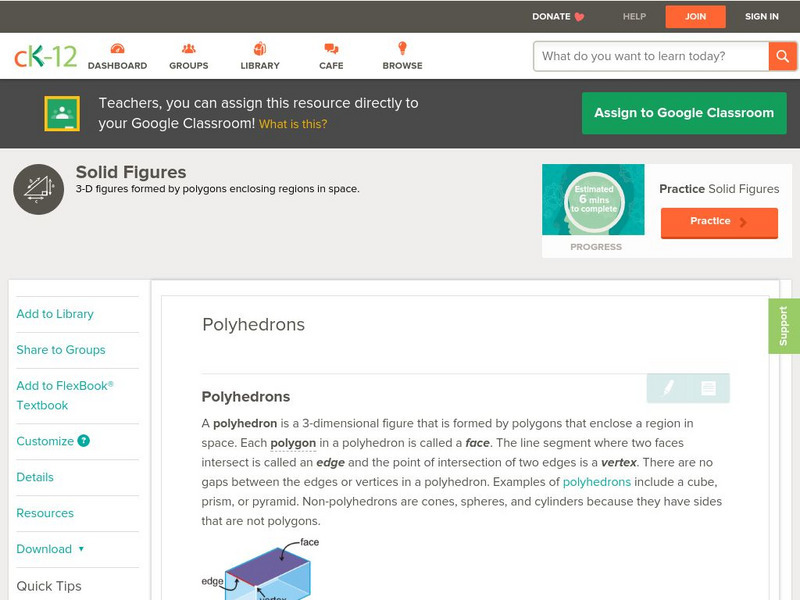
Ck 12: Geometry: Polyhedrons
[Free Registration/Login may be required to access all resource tools.] This concept teaches students about polyhedrons, Euler's Theorem, and regular polyhedrons.
CK-12 Foundation
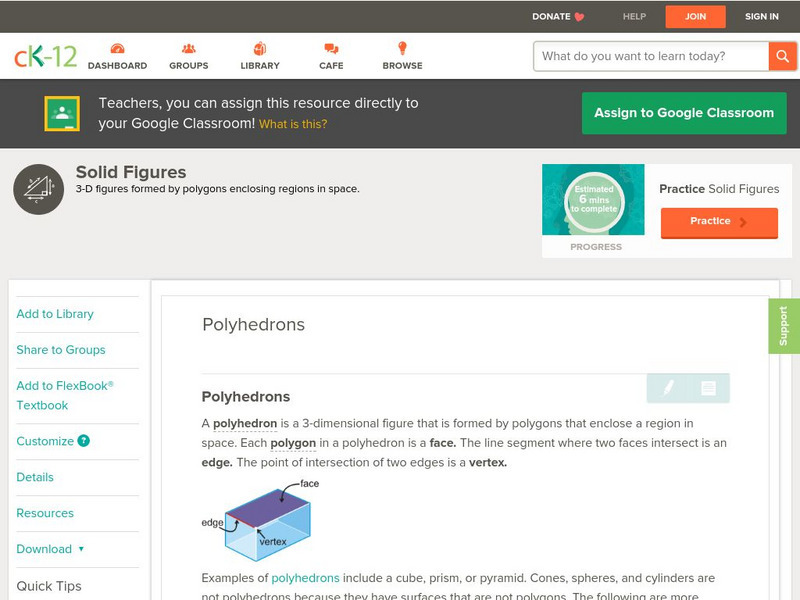
Ck 12: Geometry: Polyhedrons
[Free Registration/Login may be required to access all resource tools.] Apply Euler's Theorem.

Cuemath
Cuemath: Polyhedron
Introduces the concept of polyhedrons by learning the definition, types, and where they are found. Check-out the solved examples for better understanding and try your hand at solving a few interactive questions at the end of the page.
Wolfram Research
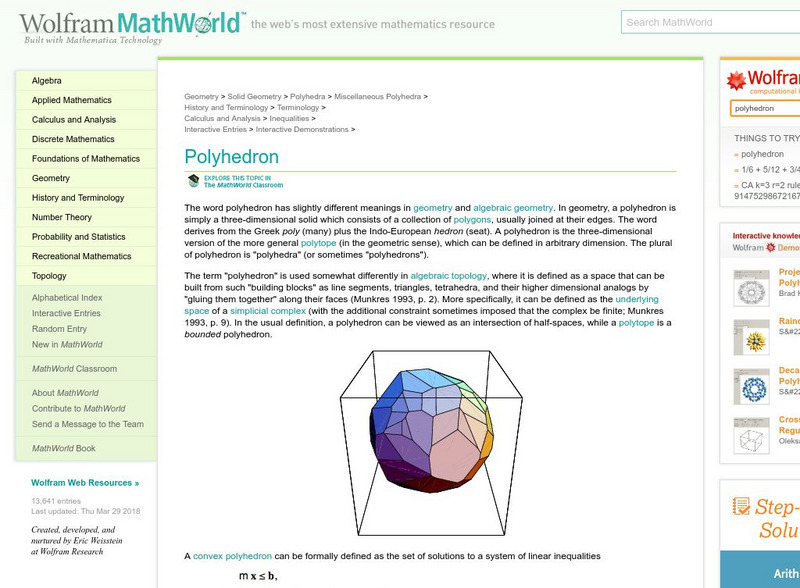
Wolfram Math World: Polyhedron
This is a detailed site with numerous links related to polyhedrons, the site explains the term polyhedron in terms of geometry and algebraic topology it briefly discusses special polyhedrons which link to other Math World sites which...
University of Saskatchewan (Canada)
University of Saskatchewan: Geometry
The University of Saskatchewan's Department of Mathematics and Statistics provides high school students with online tutorials and exercises on what they deem some of the most important topics in geometry: Triangles, and Circles and Other...

Annenberg Foundation
Annenberg Learner: Geometry 3 D Shapes: Polyhedra, Prisms, and Pyramids
An introduction to a type of three-dimensional shape called a polyhedron. See examples and play with an interactive animation, showing the faces, vertices, and edges of pyramids, which are a type of polyhedron.
Mathigon
Mathigon: Geometry: Polygons and Polyhedra: Polyhedra
This lesson focuses on polyhedra; a polyhedron (the plural is polyhedra) is a 3-dimensional solid object that is made up of polygons. Euler's Polyhedron Formula: In every polyhedron, the number of faces (F) plus the number of vertices...
Mathigon
Mathigon: Geometry: Polygons and Polyhedra: More on Polyhedra
This lesson focuses on polyhedra other than the platonic solids; these include an Archimedean solid, a polyhedron made up of different kinds of regular polygons, that looks the same from every direction. There are 13 different...
Mathigon
Mathigon: Geometry: Polygons and Polyhedra: Platonic Solids
A Platonic solid is a polyhedron made up of only one kind of regular polygon, that looks the same from every direction. (In other words, the same number of faces meet at every vertex.) There are only five different Platonic solids:...
Math Is Fun
Math Is Fun: Polyhedron
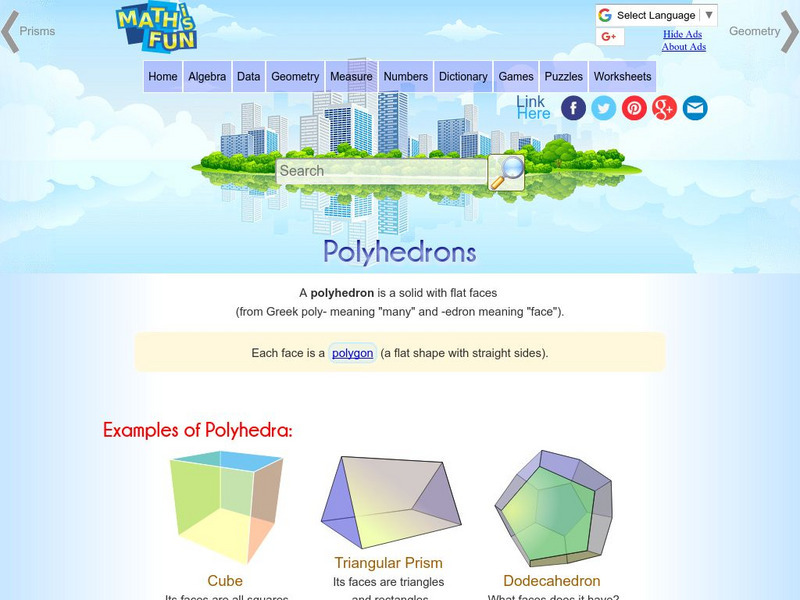
Students learn about the terminology and formulas associated with polyhedrons. The learning resource consists of definitions, images, and examples.