Hi, what do you want to do?






Mathematics Vision Project
Module 6: Congruence, Construction, and Proof
Trace the links between a variety of math concepts in this far-reaching unit. Ideas that seem very different on the outset (like the distance formula and rigid transformations) come together in very natural and logical ways. This...

Curated OER
Marshmallow Figures
Students enjoy making 3-D figures while learning about rectangular prisms, pyramids, vertices, edges, and faces. After a lecture/demo, students use marshmallows, toothpicks and a worksheet imbedded in this instructional activity to...

Curated OER
Exploring Quadratic Data with Transformation Graphing
Using a data collection device to collect data regarding a bouncing ball, students use various features on graphing calculators to experiment with the parameters of the vertex form of the parabola and their effect on the shape of the...

Curated OER
Angles Activities
A series of geometry worksheets have mathematicians constructing, dissecting, overlapping, and measuring as they analyze angles in various contexts. Learners use symmetry and reflections in a compass rose to write instructions on...

Curated OER
Transformations in the Coordinate Plane
Your learners connect the new concepts of transformations in the coordinate plane to their previous knowledge using the solid vocabulary development in this unit. Like a foreign language, mathematics has its own set of vocabulary terms...

Curated OER
Congruent Segments
The task, should your class decide to take it, is to list a series of reflections that transfer a line segment from one position to another.

Curated OER
Tantalizing Tangrams: What Are Transformations?
Students use the Internet to learn about transformations and tessellations. In this geometry lesson, students use the Internet to define the meaning of reflections, translations, rotations, glide reflection and symmetry. ...

Curated OER
Coordinate Plane
Tenth graders plot points on a coordinate plane. In this geometry lesson, 10th graders identify the different quadrants, plots points on a number line and coordinate plane and solve for the midpoint of line segments.

Curated OER
The Castle
Students build a castle to Ravi's design using the cubes. Students then make an original model of a solid object from diagrams which show views from the top, front, side and back. Students describe the reflection of rotational symmetry...

Curated OER
Reflections
Tenth graders perform reflections on different geometric shapes. In this geometry worksheet,students define the concept of geometric reflections and find the coordinates of the reflection on a coordinate grid.

Curated OER
The Overlooked Regular Pentagon
Tenth graders discuss the history of geometry as it relates to pentagons. In this geometry lesson, 10th graders solve problems of a pentagon inscribed inside of a circle using ratio. They review other properties for shapes of polygons...

Curated OER
Scenario Challenge
Young scholars create a quilt, using different patterns. In this geometry lesson, students apply prior knowledge as they use different patterns to help them create a quilt using transformations and geometric shapes.

Curated OER
Butterfly Adventure
Learners in second grade are paired with fifth grade computer research buddies. They observe the characteristics of caterpillars, and identify the four stages of the caterpillar to butterfly life cycle. They graph the number of...

Curated OER
Gotcha Covered, Pardner!
Young geometers use the interactive website Cyberchase to practice calculating both area and perimeter. Real world problems encourage learners to discover that we use math each and every day.

Dick Blick Art Materials
Start with a Circle...
The Golden Ratio. The Divine Proportion. Yup. It's math and art blended into one colorful activity. Young artists combine colored tissue paper circles and parts of circles to create geometric patterns. As a bonus, kids get to figure out...

Curated OER
Geometric Collages
Fourth graders investigate the concept of geometric patterning. They create their own patterns with a few basic requirements. The patterns must illustrate the concepts of flipping, 90 and 180 degree rotations. The collages also consist...

Curated OER
Drawing to Scale
Learners examine the process of drawing a picture to scale. They analyze and discuss real-life blueprints for a house, and create a scale drawing of an original invention using calculators and rulers.

Curated OER
What do two-dimensional tessellations look like? Where in art can they be found?
Students explore the world of art and culture, including the works of M.C. Escher. They identify and create original tessellations. Students use a wealth of interactive multimedia applications. They explore the artistic representations...

Curated OER
Introduction to Fractals: Infinity, Self-Similarity and Recursion.
This lesson introduces students to the ideas involved in understanding fractals. They develop a sense of infinity, self-similarity and recursion and

Curated OER
Introduction to Fractals: Geometric Fractals
Students study and observe the patterns made by the areas of the Sierpinski Triangle. Students use the computer to draw two or three iterations to discover the number patterns. Students complete worksheets based on Geometric Fractals.

Curated OER
Scaled Rubber Band Drawings
Students demonstrate the process of creating a scaled rubber band enlargement of a simple drawing. They observe and discuss a teacher-led demonstration, and create a scaled rubber band enlargement of simple drawings and their invention...

Curated OER
Surveying our First President
Students act as surveyors. In this George Washington lesson, students read transcriptions from Washington's surveying journal and then try surveying skills on their own.
CK-12 Foundation
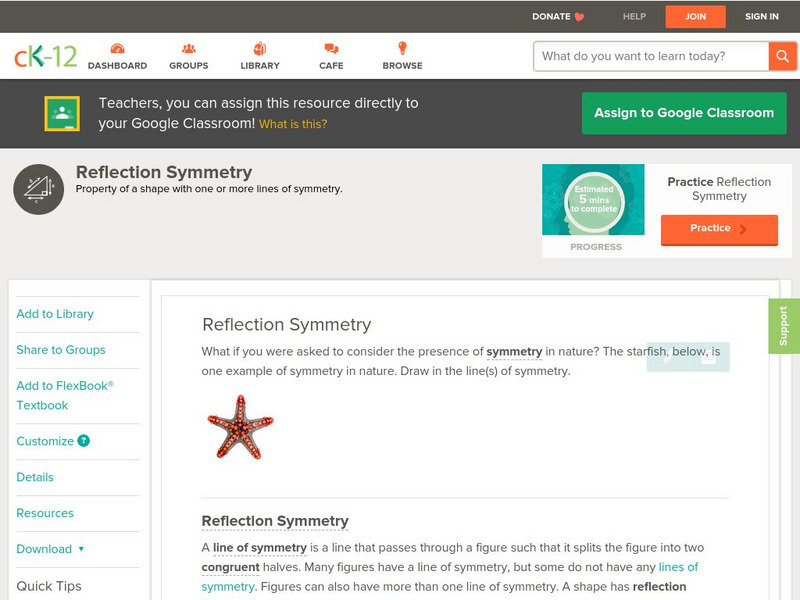
Ck 12: Geometry: Reflection Symmetry
[Free Registration/Login may be required to access all resource tools.] This concept teaches students how to determine whether or not a shape has reflection symmetry and how to draw lines of symmetry.
CK-12 Foundation
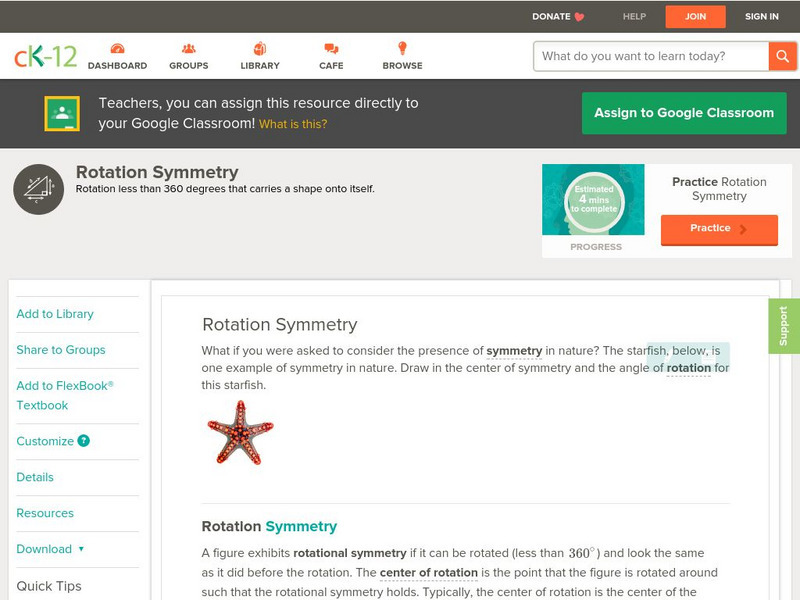
Ck 12: Geometry: Rotation Symmetry
[Free Registration/Login may be required to access all resource tools.] This concept teaches students how to determine whether or not a shape has rotation symmetry.