Hi, what do you want to do?






Consortium for Ocean Science Exploration and Engagement (COSEE)
One Ocean: It Matters!
Here is the first of four poignant lessons on how humans and oceans interact, even if people live far from the coast. This particular instructional activity also examines studies that are taking place in Antarctica of how climate change...

Consortium for Ocean Science Exploration and Engagement (COSEE)
Plankton to Penguins: Antarctic Food Web
A well-written lesson plan, second in a series of four, gets high schoolers exploring how the Antarctic food web is impacted by climate change and the associated melting of polar ice sheets. It begins with a PowerPoint presentation about...

Curated OER
The Global Precipitation Measurement Mission (GPM) Lesson
Introduce your class to one of the ways that technology is benefiting humanity. The Global Precipitation Measurement Mission involves the data collected by nine satellites from different countries with a united focus on studying world...

World Wildlife Fund
Arctic Food Chain
Explore the food chains that support Arctic ecosystems. A class discussion on interdependence and the different roles plants and animals play in ecosystems provides students with the knowledge to complete a worksheet asking them to...

Curated OER
United States -- Soviet Cooperation
Students examine the competition between the United States and Russia to put the first man in space. In groups, they use the internet to identify areas in which the two countries cooperated with one another to promote space exploration....

Curated OER
Exploring the Temperate Forest: Biodiversity and Interdependence
Young scholars examine the consequences of cutting down large amounts of forests throughout the world. In groups, they use the internet to complete a module taking them on a tour through different temperate forests. To end the lesson,...

Wild BC
Is Climate Change Good for Us?
Is it really that big of a deal if the global climate undergoes a little change? Young environmentalists consider this very question as they discuss in small groups the impact of different climate change scenarios on their lives,...

Curated OER
Ecosystems and Remote Sensing
Students obtain remote sensing data to compare and contrast global biomass data with global temperature data.

Curated OER
2.0 "Water Is Life" Global Water Awareness Mini-Unit (Grades3-5)
Learners study the amount of potable water on the Earth. In this water lesson, students examine the amount of potable water as compared to all the water on the Earth. They discuss why many parts of the world do not have access to good...

Curated OER
"Water is Life" Global Water Awareness
Students examine and calculate the percentage of potable water remaining on the earth. For this ecology and geography lesson, students brainstorm the main factors affecting water distribution. Students use mathematical problem solving to...

Curated OER
Greenhouse Gases: The Chemistry Behind the Culprits
Ninth graders investigate the effect of different gases in the atmosphere. In this chemistry instructional activity, 9th graders explain how these gases contribute to global warming. They suggest possible solutions to this growing problem.

Chicago Botanic Garden
Faces of Climate Change
How does climate change affect you? First in a three-part series, the activity focuses on how individuals living around the world are affected by climate change. Individuals take on the role of a given character and share their...

American Chemical Society
Development of Baking Powder
Did you know baking powder can be used to treat acne, whiten teeth, and make sugar cookies? The lesson plan on the development of baking powder is ready-to-go with no preparation required. Through readings, pupils answer questions,...

Curated OER
The Fish Trade
High schoolers read and discuss a document regarding how the global fish trade is important to humans all over the world. Students conduct Internet research and write a scenario about what would happen if other countries did not help...

Curated OER
The Impacts of Human Activities on Biodiversity in New Haven County
Students discover how plants and animal ecosystems are affected by the growth of a city. In this ecology lesson, students study and observe a plant over a period of time. They develop a creative presentation of their data and share them...

Curated OER
The Many, Varied, and Unusual Places and Things on Earth
Students discover how energy flows through communities because of the relationship between producers, consumers and decomposers. Examining various ecosystems, they identify the materials that cycle continuously through them. They label...

Curated OER
The Risk-Benefit Factor Challenging Our Environment
Seventh graders examine the factors that are contributing to the degrading of the Earth's environment. In groups, they analyze the types of hazards when dealing with pests and give an example of each. For each situation given, they...

Curated OER
Theobroma - Food of the Gods
Students discuss the history of cacao and its use in the production of chocolate. They analyze actual cacao pods and record their observations. Finally they create a five minute contour drawing of the cacao pod and seeds.

Curated OER
Introduction to Waste Management
Young scholars research the difference between hazardous waste and municipal solid waste. Different companies in their community are researched to determine which are contributing waste in their region, what type of waste is generated,...

Curated OER
Science of War
Tenth graders, from an environmental perspective, study the pros and cons of war. Distinctions between characteristics of biological, chemical and nuclear threats and the impact of economic development are considered.

Curated OER
The Tree Of Life
Fourth graders investigate the concept of forestry and how trees are used for different purposes. The problem of deforestation is presented in this historical lesson. The comparison of our society to others that depend on forests are...
Population Connection
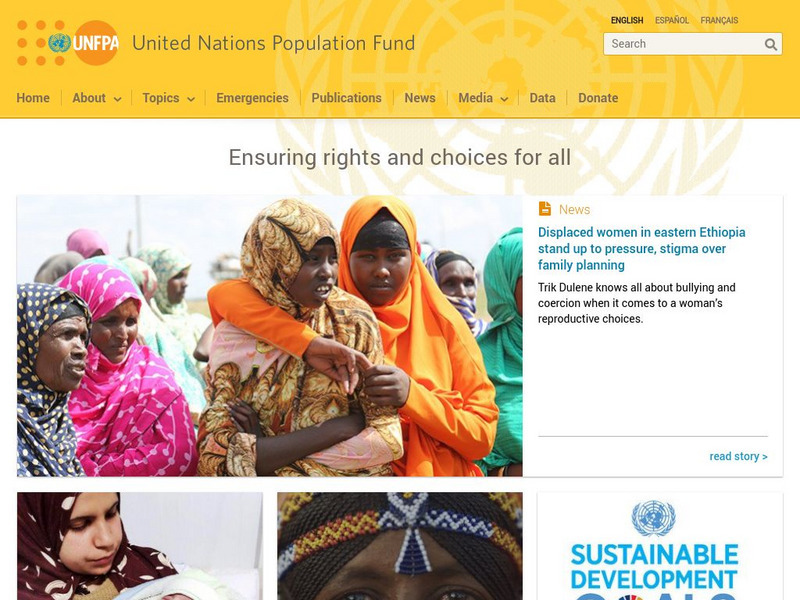
United Nations Population Fund
This resource attempts to assist developing countries manage their population problems.