Hi, what do you want to do?






Curated OER
Is Grandpa Right, Were Winters Colder When He Was a Boy?
Learners compare current weather data to historic data to see if there is a temperature change. In this weather lesson students complete a lab activity and determine average changes in temperature, precipitation and cloud cover.

New York State Education Department
Regents High School Examination Physical Setting: Physics 2006
In this physics worksheet, students complete a series of multiple-choice and short-answer questions on force, magnitude, and energy. They complete calculations to solve word problems.

Curated OER
Ordered pairs and total number of items
In this ordered pairs and total number of items worksheet, students answer multiple choice questions about ordered pairs and number totals. Students complete 10 multiple choice questions.

Curated OER
Understanding Cloud Formation
Students view a demonstration that simulates cloud formation. They read a poem about clouds, participate in a class demonstration using warm water and ice and write a paragraph summarizing their observations.

Curated OER
Trends of Snow Cover and Temperature in Alaska
Students compare NASA satellite data observations with student surface measurements of snow cover and temperature. They practice data collection, data correlations, and making scientific predictions.

New York State Education Department
Regents High School Examination, Physical Setting, Earth Science 2010
For this earth science instructional activity, students answer 85 multiple-choice and short-answer questions on various earth science concepts.

New York State Education Department
Regents High School Examination, Physical Setting, Physics 2008
For this physics worksheet, high schoolers answer 49 multiple-choice questions on general physics knowledge. They solve and write short answers to 27 more questions.

New York State Education Department
Regents High School Examination, Physical Setting, Physics 2007
In this physics assessment, learners complete a series of multiple-choice and short-answer questions on altitude, velocity, and energy.

New York State Education Department
Regents High School Examination, Physical Setting, Physics 2006
For this physics worksheet, students complete 72 multiple-choice, problem-solving, and short-answer questions on various physics concepts.

New York State Education Department
Regents High School Examination, Physical Setting, Physics 2005
In this physics worksheet, learners complete 74 multiple-choice, problem-solving, and short-answer questions on various physics concepts.

Curated OER
TV Viewing
Pupils test a hypothesis to see if there is a direct correlation between number of hours of TV viewing and academic grade. They collect and compile data to enter on a spreadsheet and create a word processing document supporting their...

Curated OER
Career Exploration
Students complete a unit about career choices. They conduct research on a selected career that interests them, conduct an interview, explore various websites, create a five-page HyperStudio stack, and write ten checks that relate to...

Curated OER
Frequency Tables
Seventh graders construct frequency tables and box-and-whisker plots. After constructing tables and plots, they take a quiz on mean, median, mode, range, scientific notation, and number properties.

Curated OER
Irish Eyes: Taking a Look at Local Landscape
Students create landscape flyers of local landscapes using digital photography, educational software, and examples of Irish landscapes. This creative-project instructional activity lasts two weeks, including class time spent collecting...

Curated OER
A Bird's Eye View of our 50 States
Third graders focus on state birds as they learned absolute location (latitude/longitude) of each state, as well as their relative location (bordering states).

Curated OER
Cinderbank
Fourth graders identify major components of a "Cinderella" story in order to create a database.
Google
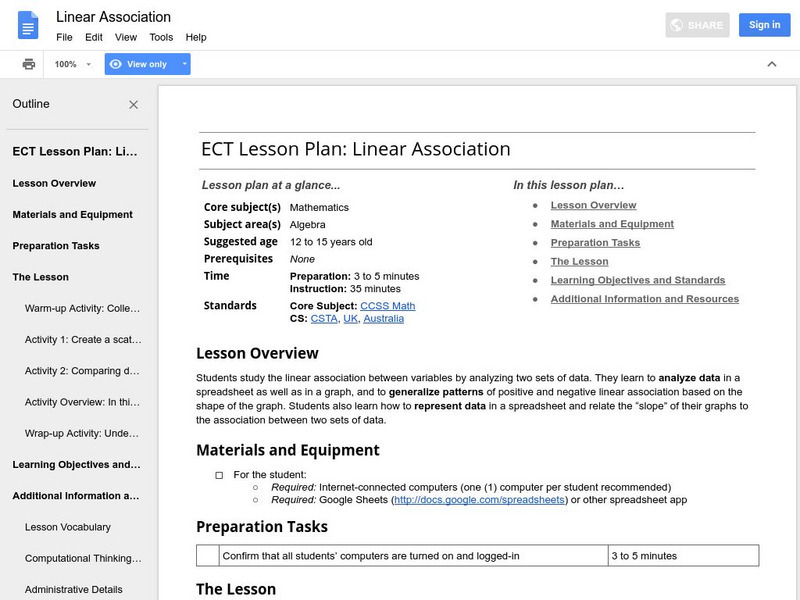
Google for Education: Linear Association
This student activity allows for practice in graphing data in a spreadsheet and relate the "slope" of their graphs to the association between two sets of data.
TeachEngineering
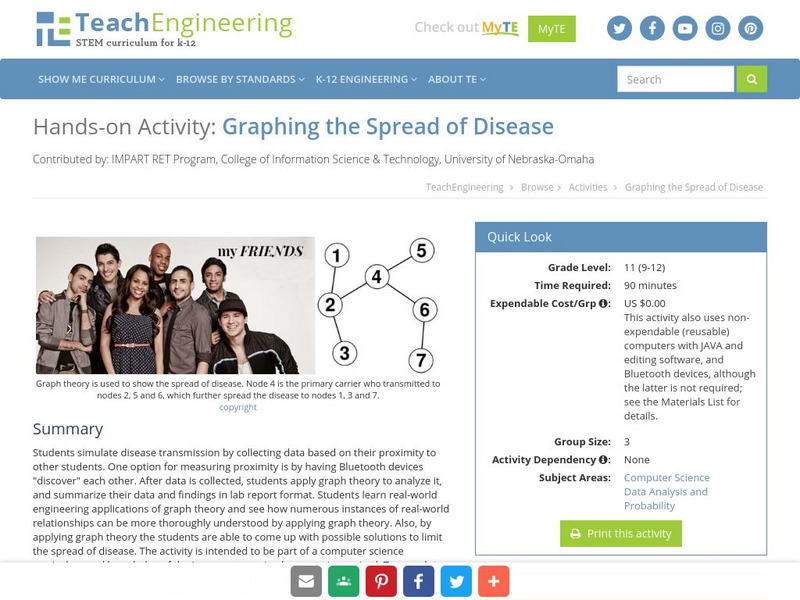
Teach Engineering: Graphing the Spread of Disease
Students simulate disease transmission by collecting data based on their proximity to other students. One option for measuring proximity is by having Bluetooth devices "discover" each other. After data is collected, students apply graph...
Google
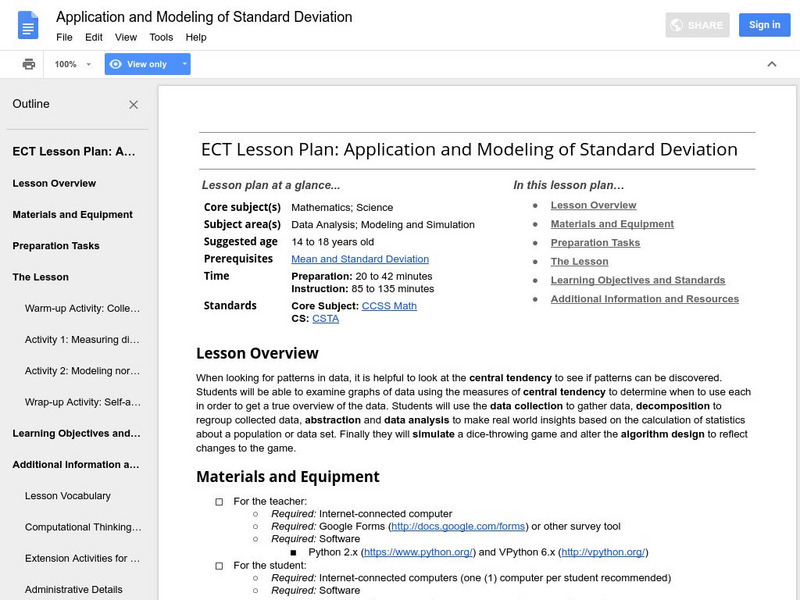
Google for Education: Application and Modeling of Standard Deviation
Students examine graphs of data using each of the measures of central tendency to determine when to use each in order to get a true overview of the data.