Hi, what do you want to do?





University of Colorado
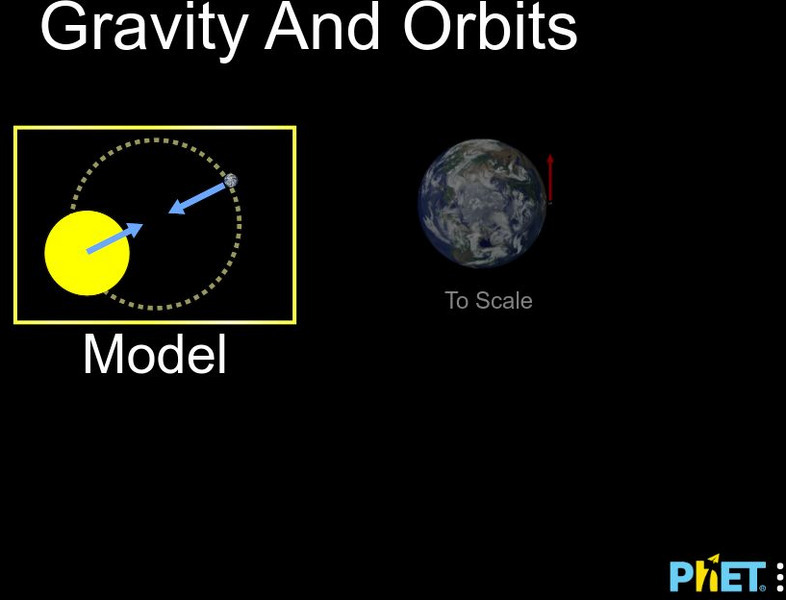
University of Colorado: Ph Et Interactive Simulations: Gravity and Orbits
Move the sun, earth, moon, and space station to see how it affects their gravitational forces and orbital paths. Visualize the sizes and distances between different heavenly bodies, and turn off gravity to see what would happen without it.

Physics Classroom
The Physics Classroom: Circular and Satellite Motion: Satellite Motion Math
In this interactive physics tutorial, students explore the variety of mathematical equations that describe the motion of satellites.
Physics Classroom
The Physics Classroom: Circular and Satellite Motion: Weightlessness in Orbit
Through illustrated examples and practice problems, this interactive physics tutorial helps students clear up their possible misconceptions about weightlessness.
Physics Classroom
The Physics Classroom: Circular and Satellite Motion: The Inverse Square Law
Through illustrated examples and interactive practice, students explore Newton's ability to relate the cause for heavenly motion (the orbit of the moon about the earth) to the cause for Earthly motion (the falling of an apple to the...
Physics Classroom
The Physics Classroom: Circular and Satellite Motion: Energy in Satellites
Through interactive practice problems and illustrated examples, students explore energy relationships for satellites.

Cornell University
Cornell University: Astronomy: Orbital Motion and Kepler's Laws
At this site from the Astronomy Department of Cornell University, Kepler's three laws of planetary motion are stated. There are brief explanations of each, along with links to additional information on related subjects.
Georgia State University
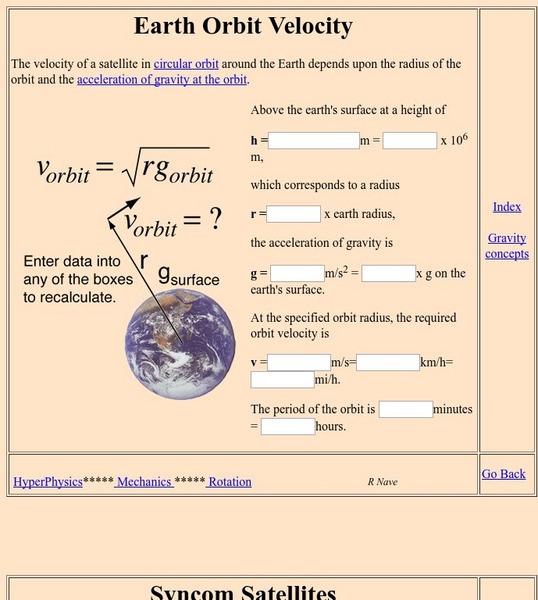
Georgia State University: Hyper Physics: Earth Orbit Velocity
A discussion and statement of an equation for orbital speed. An interactive JavaScript form allows the user to investigate the relationship between orbital height and orbital speed. A very good opportunity to practice and receive...

NASA
Nasa: Kepler and His Laws
This site from NASA provides biographical details about the lives of Tycho Brahe and Johannes Kepler. Discusses Kepler's successes at developing laws of planeatry motion. States the three laws and discusses each one individually....
Physics Classroom
The Physics Classroom: Momentum and Collisions: The Astronaut Catch
Students imagine that they are hovering next to the space shuttle in earth-orbit, and bump into another astronaut of equal mass. If the two astronauts holds onto each other, then how fast do they move after the collision?
Physics Classroom
The Physics Classroom: The Apple, the Moon, and the Inverse Square Law
Describes the logic behind the development of Newton's law of universal gravitation. Beginning with Johannes Kepler and his three laws of planetary motion, content walks the reader through Newton's thought process and development of this...
Massachusetts Institute of Technology
Mit: Open Course Ware: Courses: Physics: Classical Mechanics
College-level online course highlighting the study of classical mechanics. This course focuses on Newtonian mechanics, fluid mechanics, and kinetic gas theory. Course features include a 35 video lecture series by Walter Lewin. Also link...
NASA
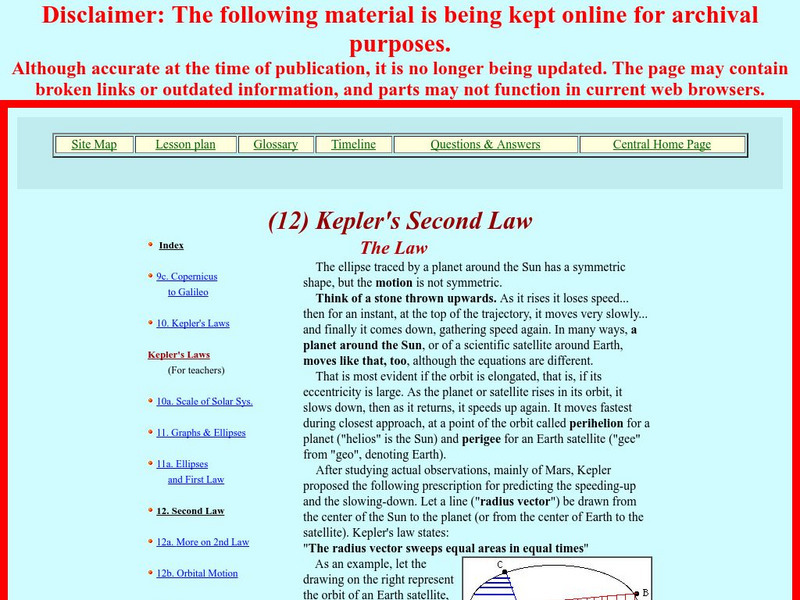
Nasa: Kepler's Second Law
This site from NASA states Kepler's second law of planetary motion and depicts its meaning with an informative diagram. Relates the law to conservation of energy principles and discusses the eccentricity of a satellite's (or a planet's)...
Utah Education Network
Uen: My Solar System
Students will use a simulation to build their own solar system discovering the relationship between gravity and motion that keeps a planet in orbit.
TeachEngineering
Teach Engineering: Solar System!
An introduction to our solar system: the planets, our Sun and our Moon. Students begin by learning the history and engineering of space travel. They make simple rockets to acquire a basic understanding Newton's third law of motion. They...
Georgia Department of Education
Ga Virtual Learning: A Brief History of Astronomy
In this interactive module students will explore what different ancient cultures believe was an explanation of the stars and planets. They will look at how the work of Nicolas Copernicus revolutionize the world of astronomy and learn how...
Physics Classroom
The Physics Classroom: Kepler's Second Law
Kepler's second law of planetary motion is stated and explained. An animation of the orbit of a planet and an accompanying graphic assists in explaining the meaning of the law of equal areas.
Science and Mathematics Initiative for Learning Enhancement (SMILE)
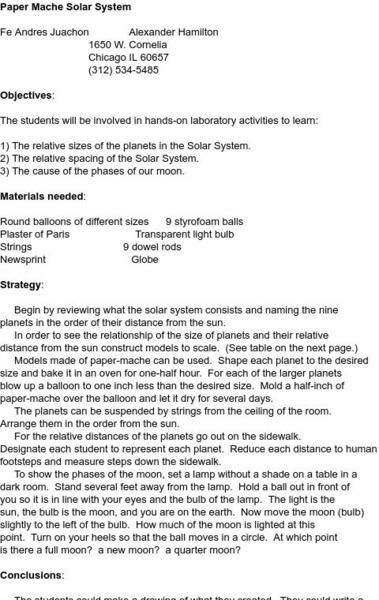
Smile: Paper Mache Solar System
This site from the Illinois Institute of Technology provides a set of directions for the creation of a solar system model out of paper mache. Includes orbital distances and planet diameters for the nine planets. Great idea for a student...