Hi, what do you want to do?





Science Buddies
Science Buddies: Mixing Light to Make Colors
You know how to make new colors by mixing paint or crayons. For example, you get green by mixing yellow and blue, or orange by mixing red and yellow. With paint, blue, yellow, and red are primary colors, which you can use to make other...
Museum of Science
Museum of Science and Industry: Online Science: Three Colors of Light
An experiment where students combine solutions from red, green, and blue glow sticks to make different colors and to make white light.
University of Colorado
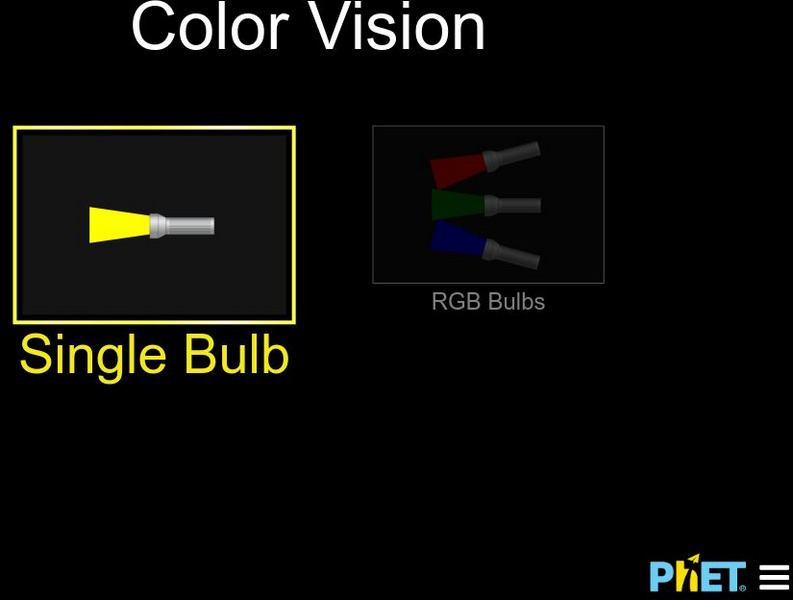
University of Colorado: Ph Et Interactive Simulations: Color Vision
Make a whole rainbow by mixing red, green, and blue light. Change the wavelength of a monochromatic beam or filter white light. View the light as a solid beam, or see the individual photons.

TeachEngineering
Teach Engineering: Laser Types and Uses
Through two classroom demos, students are introduced to the basic properties of lasers through various mediums. In the Making an Electric Pickle demonstration, students see how cellular tissue is able to conduct electricity, and how this...
TeachEngineering
Teach Engineering: Red Light, Green Light
Building upon their understanding of forces and Newton's laws of motion, students learn about the force of friction, specifically with respect to cars. They explore the friction between tires and the road to learn how it affects the...

University of Colorado
University of Colorado: Physics 2000: Temperature and Absolute Zero
A thorough, multipage discussion of color and color television sets that explains how an image is formed on the television using red, green, and blue light. Understandable discussion, excellent graphics, and many interactive Java applets.
Project Britain
Primary Homework Help: Color Investigation Puzzle
Try making words on the screen disappear by changing the background color of this page. Add or subtract red, green, or blue, and see how light is made up of many different colors.
TED Talks
Ted: Ted Ed: How We See Color
There are three types of color receptors in your eye: red, green and blue. But how do we see the amazing kaleidoscope of other colors that make up our world? The following learning module explains how humans can see everything from...
Physics Aviary
Physics Aviary: Color Mixing Activity
This program gives students a chance to get a feel for the different colors that can be made by mixing red, green and blue light in different proportions. This activity is meant to be a lead in to students using the color mixing game...
Physics Aviary
Physics Aviary: Color Matching Game
This game has been built to show students that they can make any color they want by mixing different amounts of red, blue and green.
Frontiers Media
Frontiers: How Do We See Color
The heroine of the movie is leaning over a ticking bomb. Under the bright white lights of the mayor's office, the timer is racing down to zero and she has only one chance to defuse it. As she opens the cover from the control panel, a...
Curated OER
Ar Kive: Emperor Scorpion (Pandinus Imperator)
The largest of scorpions, but not the longest, the emperor scorpion (Pandinus imperator) has a dark body ranging from dark blue/green through brown to black. The large pincers are blackish-red and have a granular texture. The front part...
Curated OER
Educational Technology Clearinghouse: Maps Etc: New Zealand, 1904
A geo-political map of New Zealand current to 1904, showing major cities, railroad lines, and navigable rivers. Physical features include mountain ranges with elevation measured in feet, major rivers and watersheds, and the 100-fathom...