Hi, what do you want to do?





Better Lesson
Better Lesson: The Fox and the Grapes Moral
Students will get exposure to a folktale and work to understand the moral. This lesson uses two fables "The Fox and the Grapes" and "The Fox and the Hen". The lesson involves guided practice where the students write notes on the left...
National Endowment for the Arts
National Endowment for the Arts: The Big Read: Bless Me, Ultima
Guide to Rudolfo Anaya's Bless Me, Ultima, including historical information, author biography, discussion questions, and a ten-lesson unit of study with activities, homework assignments, project ideas, and essay topics. A radio show,...
National Endowment for the Arts
National Endowment for the Arts: The Big Read: The Call for the Wild
Guide to Jack London's, The Call of the Wild, with historical information, author biography, discussion questions, and a ten-lesson unit of study including activities, homework assignments, project ideas, and essay topics. A radio show...
Better Lesson
Better Lesson: Say What?
This is a practice instructional activity designed to excite sports fans in a unit about determining who is speaking in a story. The students practice this specific skill as the teacher models it in the hook. They get guided practice...
Better Lesson
Better Lesson: Arctic vs. Antarctic
Students will be able to identify similarities and differences between two texts about the polar habitats by using a Venn diagram. Included in this lesson are guided questions to use while reading, a printable Venn Diagram, and pictures...
Better Lesson
Better Lesson: Accountable Talk Introduction
Learning to engage in collaborative conversations allows children to learn about their world, to become familiar with words, and to build a solid foundation for the development of reading and writing skills. This lesson introduces rules...
Better Lesson
Better Lesson: Ew, Gross!
In this lesson, students will be able to gather information from provided resources to answer a question. Using the book "Owls", the teacher will read the book while asking guiding questions. After the book, the students will have to...
Better Lesson
Better Lesson: Who Said That?
It is important for students to learn how to identify who is telling the story. This lesson not only asks students to identify the speaker but also asks the students to start identifying the point of view in the guided practice and...

Better Lesson
Better Lesson: Work Out Together
Students will read an article and determine the author's point and identify the reasons the author gives to support his or her point. This lesson requires analysis by the students and a great deal of higher-order thinking as they...
PBS
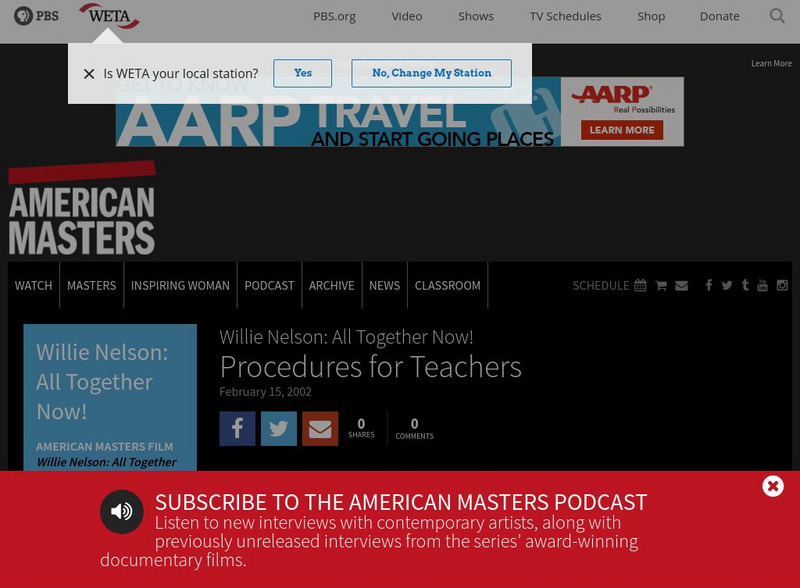
Pbs American Masters: Willie Nelson: All Together Now!
This lesson plan is based on Willie Nelson lyrics, and the PBS feature on him. It focuses on brainstorming and choral reading skills. In addition to the lesson plan, there is information on how to do guided reading and choral reading.

Khan Academy
Khan Academy: Inferences About Information Quick Guide
Some questions in the Reading Comprehension section will ask you to make an inference about information in the passage. The answer may not be explicitly stated in the passage, but it will be supported by the content of the passage. In...
Khan Academy
Khan Academy: Main Point Quick Guide
The first question in most Reading Comprehension sets will ask you to identify the statement that best expresses the central idea or the main point that the passage as a whole is designed to convey.
National Endowment for the Arts
National Endowment for the Arts: The Big Read: Mahfouz: The Thief and the Dogs
Guide to Naguib Mahfouz's The Thief and the Dogs, including historical background, author biography, discussion questions, and a ten-lesson unit with project ideas and essay topics. A radio show, with transcripts, features excerpts from...
National Endowment for the Arts
National Endowment for the Arts: The Big Read: James: Washington Square
Guide to Henry James's novel Washington Square provides historical context, author biography, questions, and a collection of resources for teachers, including a ten-lesson unit, projects, and essay topics.
Khan Academy
Khan Academy: Primary Purpose Quick Guide
Primary purpose questions ask us to identify why the author may have written the passage. As you read through the passage the first time, it's a good idea to always be asking yourself: "So what?" "What's the point?"
Read Works
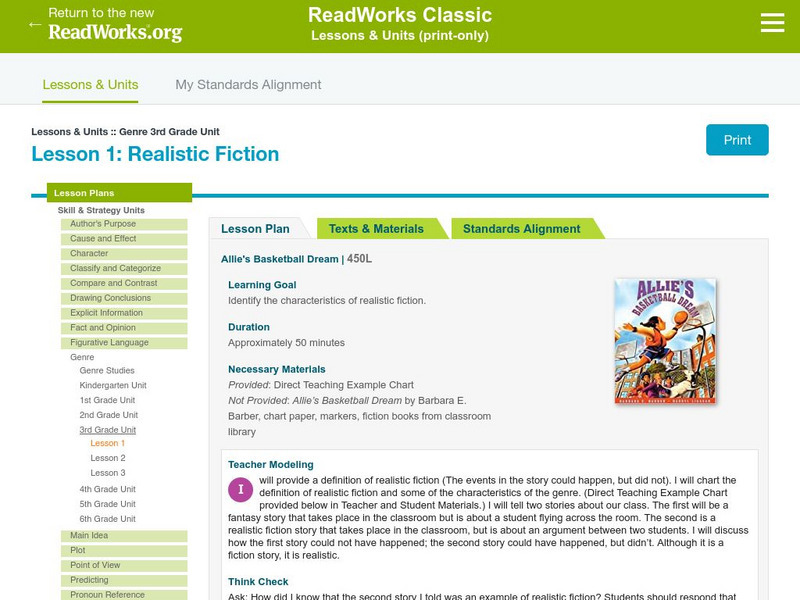
Read Works: 3rd Grade Lesson: Realistic Fiction
[Free Registration/Login Required] A lesson in which learners use the book Allie's Basketball Dream by Barbara E. Barber to learn about the characteristics that define realistic fiction. Lesson includes direct teaching, guided practice,...

Read Works
Read Works: 4th Grade Lesson: Similes and Metaphors
[Free Registration/Login Required] A lesson in which students use the book Poetry for Young People: Langston Hughes edited by David Roessel and Arnold Rampersad to learn to identify and understand the use of simile and metaphor in...
Read Works
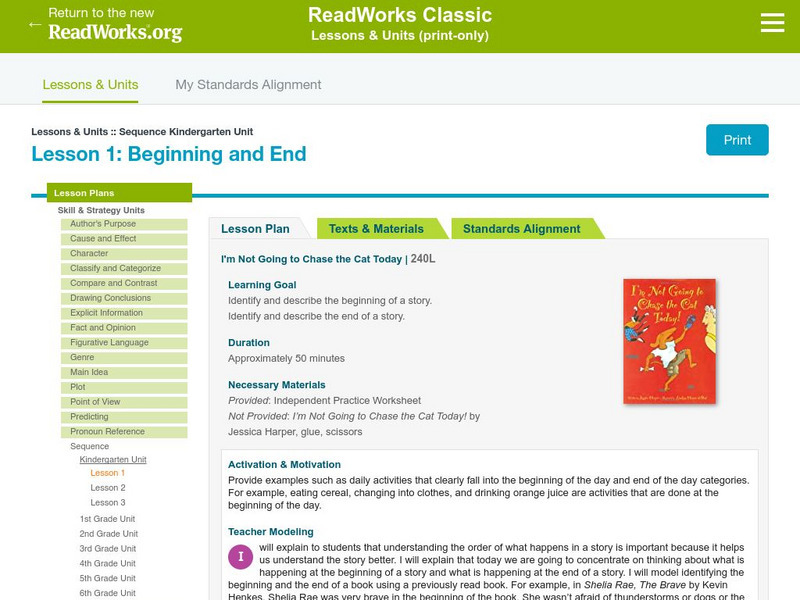
Read Works: Sequence Kindergarten Unit: Beginning and End
[Free Registration/Login Required] This webiste provides a lesson in which students identify and describe the beginning and end of a fiction story. Lesson includes ideas for direct teaching, guided practice, and independent practice and...
National Endowment for the Arts
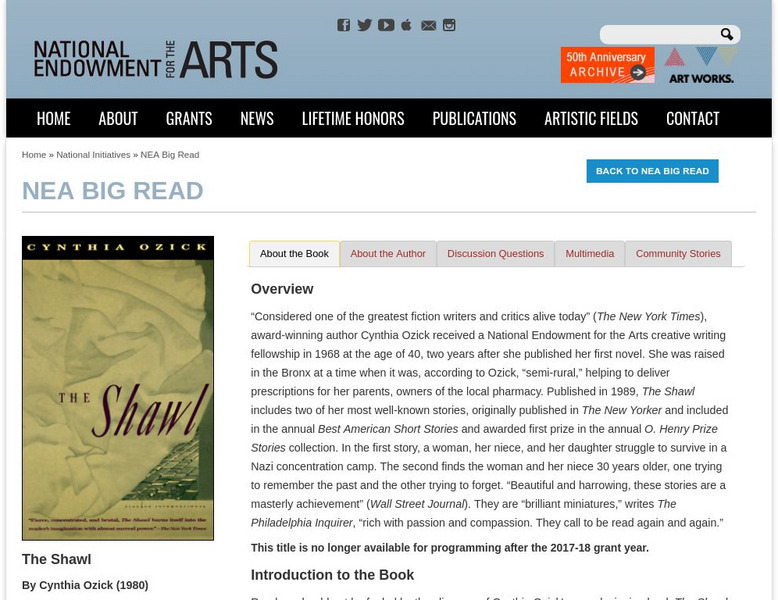
National Endowment for the Arts: The Big Read: Ozick: The Shawl
Readers guide to Cynthia Ozick's The Shawl, including historical context, author biography and discussion questions. Included teachers guide contains a ten-lesson unit with discussion activities, homework assignments, essay topics, and...

National Endowment for the Arts
National Endowment for the Arts: The Big Read: Jeffers: Poetry
Guide to the poetry of Robinson Jeffers, including historical information, biographies, discussion questions, and lesson plans. Each one of ten lesson plans has discussion activities, writing exercises, vocabulary, and homework...
CPALMS
Cpalms: Five Little Monkeys: Comparing and Contrasting
[Free Registration/Login Required] Five little monkeys sitting on a bed or sitting in a tree? In this close reading instructional activity, students will compare and contrast the actions of the characters in two of Eileen Christelow's...

National Endowment for the Arts
National Endowment for the Arts: The Big Read: Twain: Adventures of Tom Sawyer
Guide to Mark Twain's The Adventures of Tom Sawyer, including historical information, author biography, discussion questions, and a ten-lesson unit of study with handouts, project ideas, and essay topics. A radio show, with transcripts,...
National Endowment for the Arts
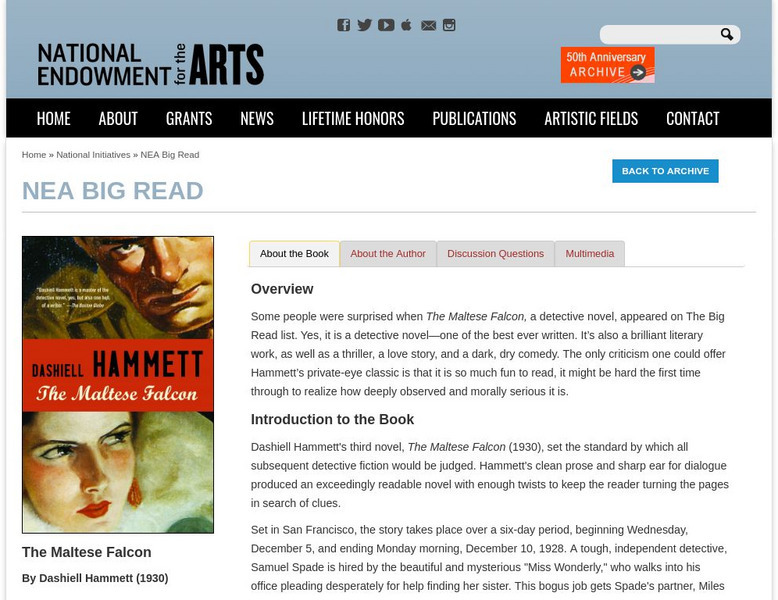
National Endowment for the Arts: The Big Read: The Maltese Falcon
Guide to Dashiell Hammett's The Maltese Falcon, with historical information, author biography, discussion questions, and a ten-lesson unit of study including activities, homework assignments, project ideas, and essay topics. A radio...
Shmoop University
Shmoop: The Piano Lesson
This Pulitizer Prize winning play explores looking at the past of many African Americans. Read about the characters and their motivations.
Other popular searches
- Guided Reading Lessons Plans
- Guided Reading Lessons 4 6
- Guided Reading Lessons K 2
- Free Guided Reading Lessons
- Guided Reading Lessons Frogs
- Guided Reading Lessons 3 6
- Ell Guided Reading Lessons