
Curated OER
The Joy Luck Club by Amy Tan
In this literature worksheet, students respond to 20 short answer and essay questions about Amy Tan's The Joy Luck Club. Students may also link to an online interactive quiz on the novel at the bottom of the page.

Curated OER
Magnetism: Knowledge Quiz
In this magnetism quiz worksheet, students complete a set of 10 multiple choice questions covering a variety of concepts about magnetism.

Curated OER
Inner Planets
Students research characteristics of the planets and record their findings on Planet Web worksheet. They create fold paper to create a foldable booklet to display the information they discover about the planets.

Curated OER
Feeling Pressured
Young scholars explore pressure in our atmosphere. They examine the relationship between pressure and depth. Students construct an experimental apparatus and take measurements. Young scholars evaluate the impact of pressure on the lungs.

Curated OER
Orbit, rotation, revolution of Earth
Eighth graders define orbit, rotation and revolution. They demonstrate the orbit, rotation and revolution of the Earth. Students identify the types of measurements and the instruments that used for orbit, rotation and revolution. They...

Curated OER
The Wolf's Tale: Louise Cooper: Extension 2
For this wolves worksheet, students complete 3 pages of extension activities pertaining to wolves, their endangered status, and fear of wolves in history and literature. This is intended to be an extension after reading The Wolf's Tale...

Curated OER
You Don't Say!!
Fourth graders write and respond to sayings throughout the school year. They define the idioms, illustrate them and compare their meanings with other groups in the class.

Curated OER
Earth to Saturn, Earth to Saturn!
Learners compare and contrast the characteristics of Earth and Saturn. They practice writing analogies using those characteristics. They complete a worksheet to end the lesson plan.

Curated OER
Large Numbers Reasoning Questions
In this large number reasoning activity, students answer 5 questions that require them to use large numbers such as 1,000,000. They answer multiple choice questions and explain their reasoning.

Curated OER
Let the North Star Tell You Where You Are
Students create an astrolabe and locate the North Star in the night sky. They determine the latitude of the North Star, and calculate an average latitude based on class results.

Curated OER
Let the North Star Tell You Where You Are
Pupils participate in activities in which they find the Big Dipper and locate the North Star in the night sky, examine the relationship between the angle to Polaris and latitude, and determine latitude by using an astrolabe.

Curated OER
A Journey Through Our Solar System
Students investigate the concept of the solar system in our universe by constructing a model that is made to a measurable scale. Once the model is constructed it should be placed in a wide open space for observation and demonstration...

Curated OER
Day to Combat Desertification and Drought
In this day to combat desertification and drought activity, students read or listen to a passage, then match phrases, fill in the blanks, choose the correct words, unscramble words and sentences, write discussion questions and conduct a...

Curated OER
Circles, Cylinders, Cones and Spheres
In this comparing geometric figures worksheet, students continue patterns and observe circles. In this problem solving worksheet, students answer seven questions.

Curated OER
Annabel Lee
In this poems worksheet, students read a poem about Annabel Lee and complete multiple choice questions and a word search. Students complete 2 activities.

Curated OER
Teens Buckle Each Other Up
Students explore teen driving habits. In this health journalism lesson, students read the USA Today article titled "Teens Buckle Each Other Up", respond to discussion questions regarding the article, and complete an activity based on the...

Curated OER
The Planet Mars
In this worksheet on the planet Mars, students look at a picture of the planet and read accompanying facts, along with a brief paragraph.

Curated OER
Precession
High schoolers explain how Hipparchus, around 130 BC, used a shift in the predicted location of a lunar eclipse to detect a slight shift in the path of the Sun around the sky. They examine the elliptical orbit in which the Earth travels...

Curated OER
The Planet Saturn
In this worksheet on the planet Saturn, students look at a picture of the planet and read accompanying facts, along with a brief paragraph.

Curated OER
May The Earth Be Revolving Around The Sun?
Students trace the beginning of the heliocentric theory of the solar system--the idea that the solar system revolves around the Sun--to an observation by the Greek astronomer Aristarchus, which convinced him that the Sun was much bigger...

Library of Congress
Loc: Poetry 180: The Moon
This one-stanza poem describes a half-moon in an original way.
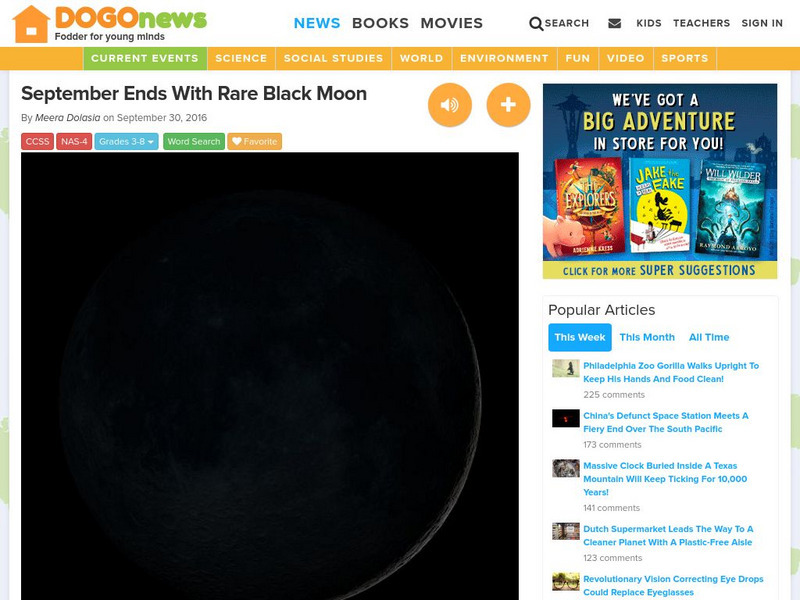
DOGO Media
Dogo News: September Ends With Rare Black Moon
We've seen a full moon, a half moon, a blue moon, but how often do we get to see a black moon? Find out what a black moon is, why it is so rare, and what it looks like.

PBS
Pbs Learning Media: Phases of the Moon
When we look up at the night sky, why do we see the Moon's appearance changing over time from a full sphere to a crescent to nothing at all? Find the answers in this interactive resource adapted from the National Air and Space Museum.
Other
The Happy Scientist: Why Is a Full Moon So Bright?
Activity helps students find out why a full moon is so bright.