Hi, what do you want to do?






Curated OER
Muppet Treasure Island
Students watch the movie "Muppet Treasure Island" and then taking on roles of characters in the movie answer navigational questions to try discover the location of a treasure hidden by the teacher.

Curated OER
Travel to Mesoamerica
Students research books, watch movies, and look on the internet to find information on ancient America, Mexico, and Central America. In this Mesoamerica lesson plan, students participate in a social studies unit on North America of the...

Curated OER
Introduction to Africa
Students are introduced to Africa. The purpose of this lesson is to find out what students all ready know about the continent of Africa, and what students are interested in learning more about. They focus on the physical features of Africa.

Curated OER
Walking on Maps
Students are introduced to the various types of maps and their functions. As a class, they play a game similar to twister to review map concepts. They answer questions about the map and use the internet to view larger maps of the world.

Curated OER
Sailin' Through Time...Rhode Island, The Ocean State
Fourth graders explore the history of Rhode Island. They research famous people who brought change to the state. They explore the state song, natural resources, and colonies of the state. In groups, 4th graders create a travel brochure...

Curated OER
Lights On ! Lights Off! Exploring Human Settlement Patterns
Third graders write informational paragraphs based on the settlement patterns of the United States. In this settlement lesson plan, 3rd graders read about population and how it affects where people settle next.

Curated OER
What's Holding Up the Water?
Students read about the history and locate dams in Arizona. In this Arizona dams lesson plan, students write a summary about what they read focusing on word choice, ideas, conventions, and geography content.

Curated OER
The Tilting Earth
Fourth graders use a styrofoam ball on a stick to represent earth and a light bulb in the center of the room to represent the sun. They walk around the light, holding their sticks at an angle to show the tilt of the earth's axis. They...

Curated OER
Is Shep Sherman Innocent or Guilty?
Middle schoolers participate in a whole group discussion about what Shep Sherman is being charged with? They discuss if they think he is innocent or guilty? They observe while the teacher writes their thoughts on the board and then...

Curated OER
Landforms All Around
Students create a "Landform Dictionary". They develop an overlay map and participate in hands-on activities to identify the key characteristics of landforms. They discuss the plant and animal life of these areas. Handouts for the lessons...

Curated OER
Meteorology Word Search Puzzle
In this science worksheet, middle schoolers look for the words that are related to the theme of the worksheet. They also work on the skills of spelling and word recognition.

Curated OER
Seasons in 3D: Student Exploration
For this seasons exploration worksheet, students review vocabulary and answer prior knowledge questions, then use the Seasons in 3D Gizmo to complete exploration activities.

Curated OER
The Reason for the Seasons; Science, Geography
Students think about what causes the seasons to change, reflect on what they know about seasons and how their lives affected by seasonal changes.

Curated OER
Is it Really Winter in Australia? It is June!
The purpose of this activity is to determine how the location of a place on the Earth (hemisphere) determines what season that place is experiencing relative to the Sun's rays. Day one the students will be introduced to the terms...

Curated OER
Using Magnetotactic Bacteria to Study Natural Selection
Students demonstrate that living organisms may possess incredible adaptations which enable them to survive. They observe bacteria that are able to orient themselves using the Earth's magnetic field and formulate a hypothesis as to how...

Curated OER
Seasons of the Year
High schoolers examine how the link between the tilt of the Earth's axis to the ecliptic and seasons of the year--length of day, effectiveness of sunlight, polar day and night, and seasons south and north of the equator, as well as near it.

Curated OER
CYCLONES EXPLAINED
Students examine how tropical cyclones form and behave. They answer a variety of questions after examining specific pictures and figures regarding cyclones.

Curated OER
Tooling Around Arizona: Reading Arizona Maps
Students study geography. In this Arizona maps lesson, students develop their map reading skills. They have class discussions and work independently with various copies of Arizona maps to practice those skills. This lesson mentions...

Curated OER
Baseball Challenge - Basic Geography Skills
A fabulous presentation/activity based on geography. The author has designed a "baseball game" where batters advance to the next base if they correctly answer a multiple choice question about geography. Geographic terms are used, along...

Curated OER
Ocean Currents Quiz
In this ocean worksheet, middle schoolers complete a 13 question multiple choice on-line interactive quiz about ocean currents. Prior knowledge is assumed.

Curated OER
Is Shep Sherman Innocent or Guilty?
Learners engage in this activity to use knowledge acquired in this unit to predict the outcome of the trial in Science Court. The students will then publish their predictions on Microsoft Word.

Curated OER
Geography Overview
Second graders look at the United States often over the next few months. Help them to see how the United States has changed as territories have become states. They may be surprised to know the areas of our country that were territories...
PBS
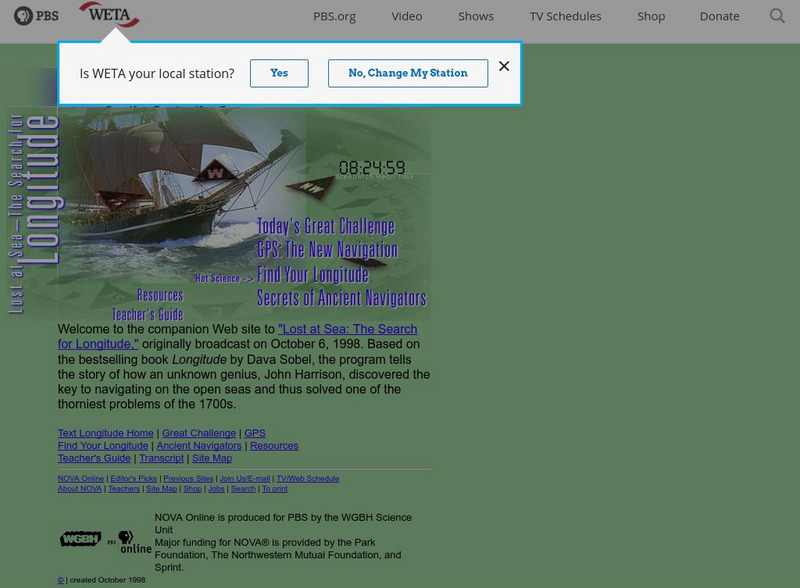
Pbs Nova Online: Lost at Sea the Search for Longitude
"The quest for a reliable method to find your way at sea was one of the thorniest problems of the 1700s." Find out about the search for longitude at this NOVA site. Includes interactive Shockwave game, learning activities and more.

ClassFlow
Class Flow: Global Knowledge Where in the World Am I?
[Free Registration/Login Required] This flipchart explains the division of the hemispheres, northern and southern, and eastern and western. The Equator and Prime Meridian are defined, as well as latitude and longitude. Students are given...