Hi, what do you want to do?






Curated OER
Happy Face Spider Propagation
Students research genetic adaptations. In this chromosome lesson, students investigate dominant and recessive genes using spiders indigenous to Hawaii. Students create Punnett squares to determine the probability of passing specific...

Curated OER
How Unique Are You?
Students explore how genetic information is passed down from parent to offspring. Because of this, they examine how this causes the variation in each species.

Curated OER
Karyotypes and Inheritance of Chromosomes
Students explore the mode of inheritance of chromosomes. Given a scenario, students use the Human Genome sheet to determine inherited chromosomes. They illustrate the difference between genotype and phenotype. Students develop a model...

Curated OER
Dragon Genetics Lab-Principles of Mendelian Genetics
Students study genetic traits using popsicle sticks as chromosomes. In this biology instructional activity, students explain how traits are inherited from parents. They differentiate dominant and recessive genes.

Curated OER
Genetically Inherited Traits
Pupils explore heredity by examining how traits are passed from parent to offspring. Genetic terminology is examined and examples of inherited traits discussed. calculating genetic probability is also investigated in this instructional...

Curated OER
Modeling a Gene Pool
In this genetic worksheet, students examine how gene frequency changes in a population of organisms. After completing 5 pre-lab questions, they work in pairs to collect data and answer 5 additional post-lab questions.

Curated OER
Dare to be Punnett Square
Eighth graders become familiar with Punnett squares, specifically purpose, application and interpretation. Key terms from previous lessons (included below) are reviewed/reinforced before data is applied to a Punnett square and interpreted.

Curated OER
Modeling Allele Distribution Through Meiosis and Fertilization
The main objective of this activity is to illustrate the variation that results from crossing-over during prophase I of meiosis. Other sources of variation from generation to generation are: (1) independent assortment (223 possible...

Curated OER
Heredity (Mendelian Genetics)
Students observe and record observations of whether a person is a taster or nontaster. They test selected individuals from their families and peer groups and chart all findings to determine which trait (e.g. taster or non-taster) is...

Curated OER
Genetics Mendelian
High schoolers explore genetic terms, the Law of Dominance and the contributions of Gregor Mendel. After discussing Mendel's lab and his pea plants students observe examples of a phenotype chart. Afterward, they conduct their own lab to...

Curated OER
Super Hero Genetics
Learners explore the concepts of phenotypes and genotypes. In this genetics lesson plan students work together to pick a superhero and determine the traits of the offspring.

Curated OER
Using Blood Tests to Identify Babies and Criminals
Learners solve a crime by matching a suspect's blood type to physical evidence collected at the crime scene. In this forensic science lesson, students identify the different blood types. They explain how blood tests work.

Curated OER
Punnett Squares
Students revie the Law of Independent Assortment and Law of Dominance. They practice Punnet squares and predicting genetic outcomes and identify factors that influence heredity.

Curated OER
Cell Reproduction and Inheritance
Students determine their inherited characteristics from their parents. In this biology lesson, students study the life of Mendel using an interactive website. They differentiate dominant and recessive characteristics.
Khan Academy
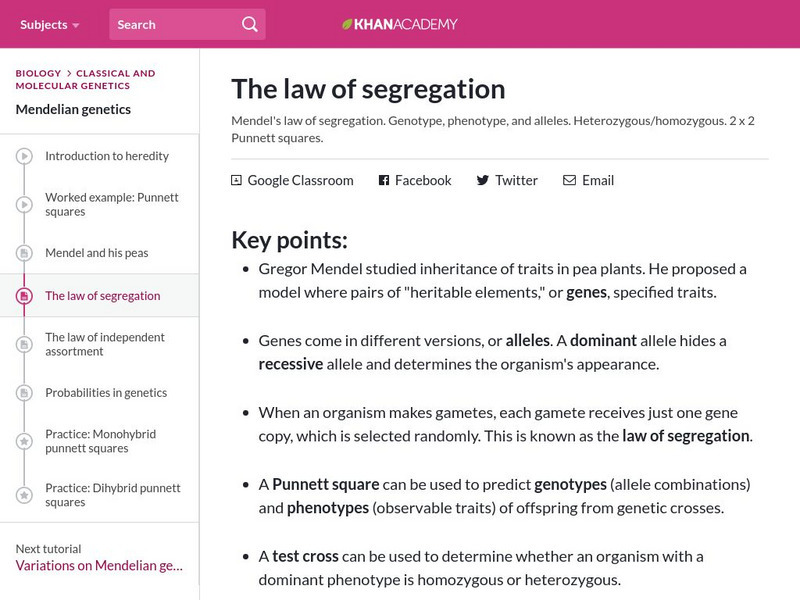
Khan Academy: The Law of Segregation
Resource provides a discussion of Mendel's law of segregation with a focus on genotype, phenotype, alleles, heterozygous/homozygous, and 2 x 2 Punnett squares.

BiologyWise
Biology Wise: Homozygous vs. Heterozygous
Genetic traits are described as homozygous or heterozygous based on allele similarity. Homozygosity and heterozygosity are explained in this resource. Includes a chart highlighting their differences and some examples that occur in humans.

Sophia Learning
Sophia: Types of Traits: Lesson 2
This lesson will explain that genotypes can be either homozygous or heterozygous. It is 2 of 4 in the series titled "Types of Traits."

Sophia Learning
Sophia: Types of Traits: Lesson 3
This lesson will explain that genotypes can be either homozygous or heterozygous. It is 3 of 4 in the series titled "Types of Traits."
Sophia Learning
Sophia: Types of Traits: Lesson 4
This lesson will explain that genotypes can be either homozygous or heterozygous. It is 4 of 4 in the series titled "Types of Traits."

ClassFlow
Class Flow: Using a Punnett Square
[Free Registration/Login Required] This flipchart show students how to use a Punnett Square to introduce how homozygous and heterozygous genotypes are inherited and how they determine phenotypes.

Biology Pages
Kimball's Biology Pages: Phenylketonuria (Pku)
Read about phenylketonuria and the tests used to diagnose it in those who might have inherited this recessive trait.
Palomar Community College District
Palomar College: Mendels' Genetics
This site from Palomar College provides a good background on exactly what Mendel did. Vocabulary links throughout make this a very good introduction article for genetics.
University of Arizona
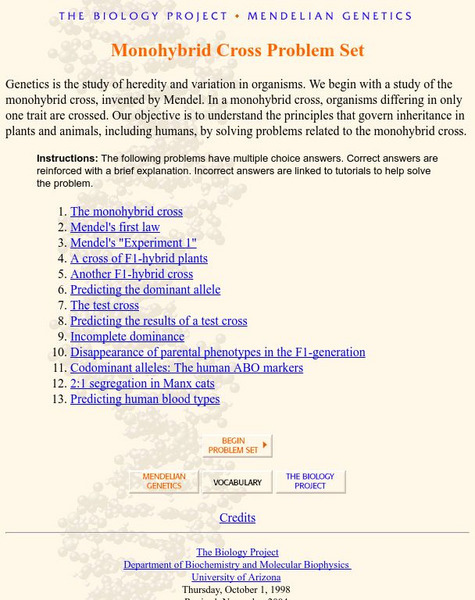
University of Arizona: Monohybrid Problem Set
This site, which is provided for by the University of Arizona, gives problems online that correspond to basic Mendelian genetics. Test your knowledge once you've read about Mendel and accessed the links to the various subjects covered in...
University of Arizona
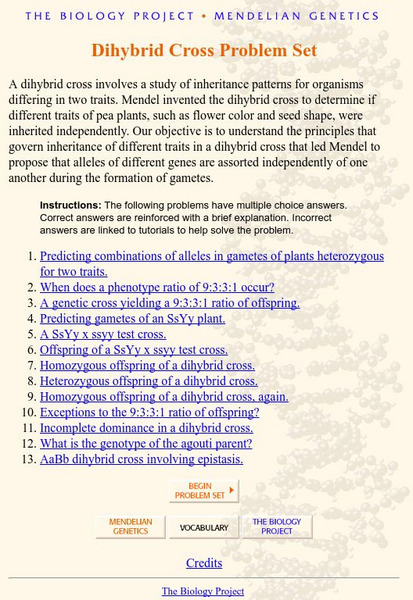
University of Arizona: Dihybrid Problem Set
This site is provided by the University of Arizona and it gives great information on the subject. Good collection of dihybrid crosses which exemplify the issue of independent assortment. Work these once you think you've mastered th concept.