Hi, what do you want to do?





Wikimedia
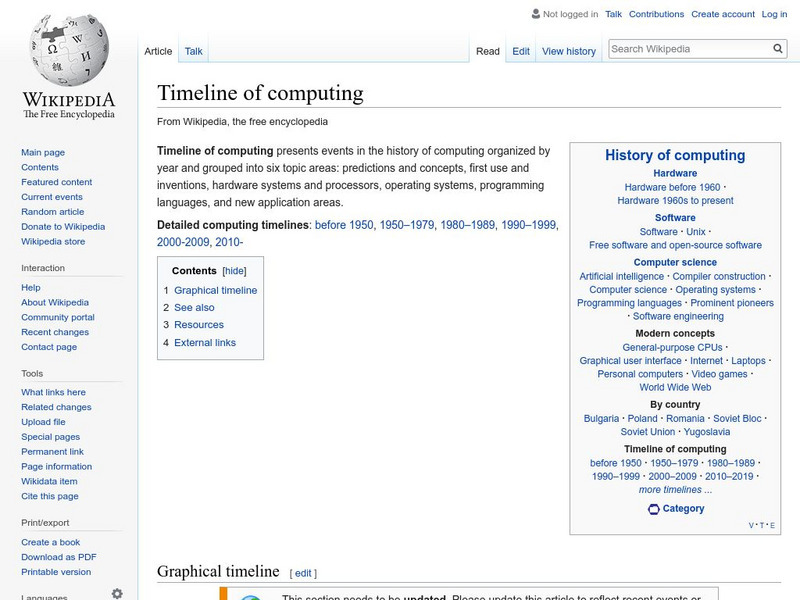
Wikipedia: Timeline of Computing
This article from the encyclopedia Wikipedia presents a detailed timeline of events in the history of computing from 500 BC to the beginning of the 21st century. Links are also provided for additional information on related subjects.

Great Idea Finder
Computing History
This site contains a listing of computing inventions and inventors throughout history with links for more detailed information.
History of Computing Science
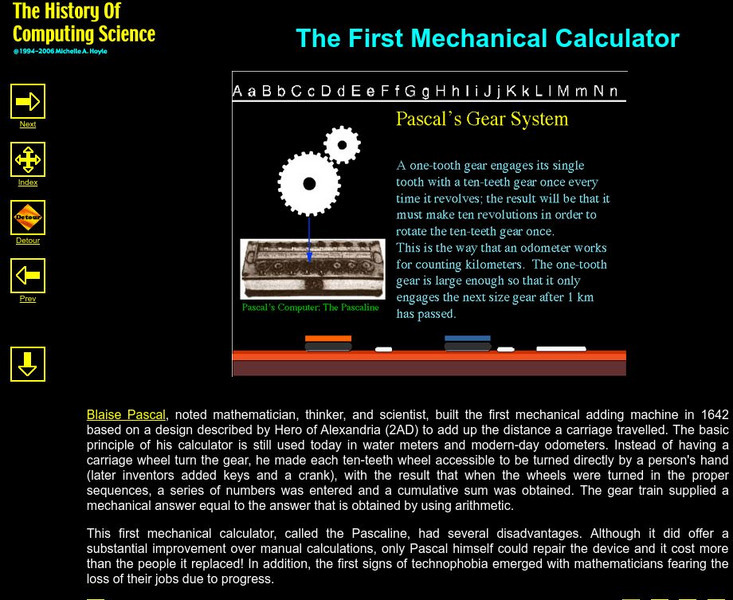
History of Computing Science: First Mechanical Calculator
Blaise Pascal, the seventeenth-century French mathematician, thinker, and scientist, built the first mechanical adding machine in 1642 based on a design described by Hero of Alexandria (2 CE) to add up the distance a carriage traveled.
Massachusetts Institute of Technology
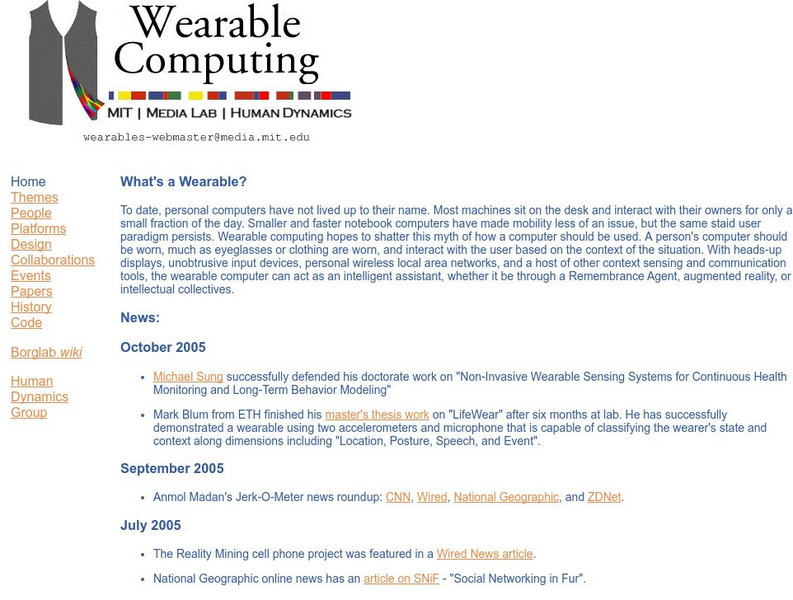
Mit: Wearable Computing
Take an academic look at wearable computing with this site from MIT. Check out the research currently going on at the institution, including "fashion shows" of various devices. Also contains "A Brief History of Wearable Computing Timeline".
History of Computing Science
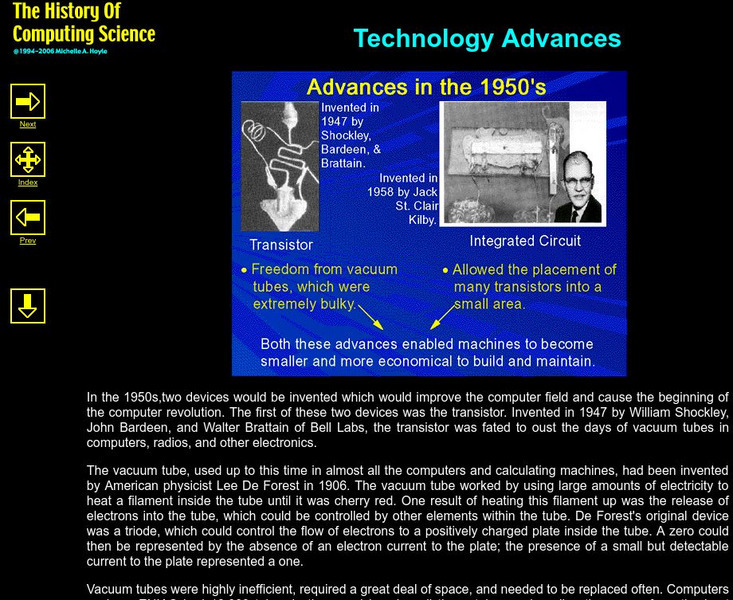
History of Computing Science: Technology Advances
The transistor and the integrated circuit were two inventions that fueled the technology explosion. This lecture presents a brief discussion of these two inventions.
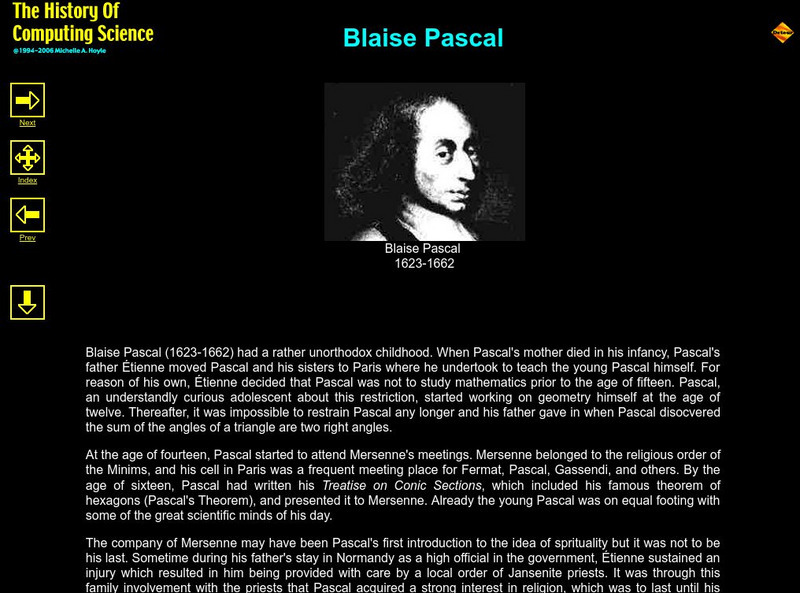
History of Computing Science
History of Computing Science: Blaise Pascal
Blaise Pascal was a French mathematician, physicist, and religious philosopher. He built the first mechanical calculator. This lecture presents a short treatment of his life and his accomplishments.

History of Computing Science
History of Computing Science: Harvard Mark I
The Harvard Mark I computer was the first large-scale automatic digital computer in the USA. This lecture provides a brief description of the Harvard Mark I computer.

History of Computing Science
History of Computing Science: The Difference Engine
The difference engine was never built, but its design was an important step in the history of computing devices. This lecture series presents a brief description of this early mechanical computing device.

History of Computing Science
History of Computing Science: The Web
This History of Computing lecture series presents a simple and clear description of the World Wide Web.

Khan Academy
Khan Academy: History Break: How Did John Build J Query?
John Resig developed the jQuery library. This article explores the history of jQuery and includes an interview with Resig.
Google
Google for Education: Finding Patterns in Spelling Errors and History
In this lesson plan, students analyze spelling errors and large sets of data to find patterns, develop abstractions, and discover how large amounts of data can tell us much about our society.
University of Houston
University of Houston: Engines of Our Ingenuity: No. 401: Ibm and the 1890 Census
Learn about the history of the Ferris wheel in this transcript of a radio broadcast. In this transcript of a radio broadcast, we learn about Herman Hollerith, who invented a method of quickly tabulating information from the 1890 census...
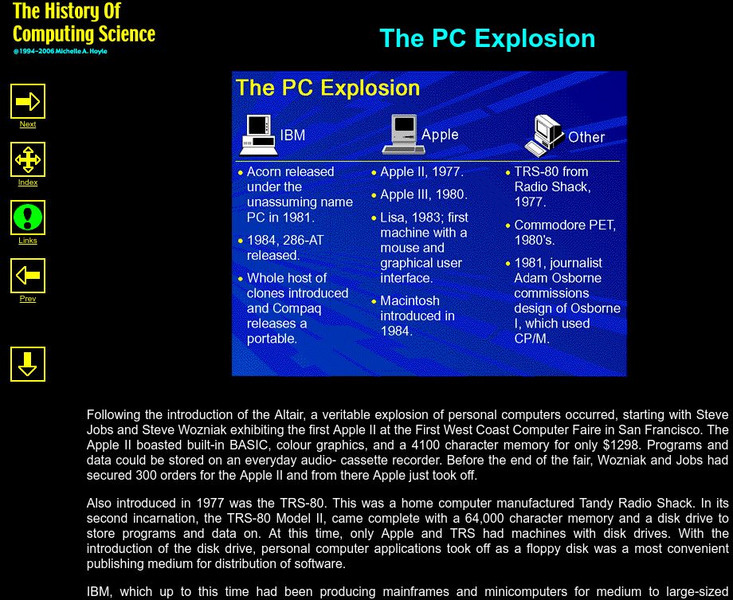
History of Computing Science
History of Computing Science: P Cs Today
The personal computer (PC) has become a common fixture in virtually every home, business and classroom. This lecture series describes the history of the personal computer.

Other
Sri: Erma and Micr, the Origin of Electronic Banking
Discusses the history of electronic banking, banking problems, vacuum tubes vs. transistors, magnetic ink character reading, handling paper at high speed, and the ERMA.

Discovery Education
Discovery Education: Understanding Computing
This instructional activity provides activities to demonstrate how "A pebble calculator works in a way similar to an abacus," which will allow learners to increase their understanding of how computers work. The instructional activity...
National Women’s History Museum
National Women's History Museum: Grace Hopper
Rear Admiral Grace Hopper helped to outline the fundamental operating principles of computing machines.

University of Houston
University of Houston: Engines of Our Ingenuity: No. 1031: Antikythera Mechanism
This site contains the history of and a description of the Antikythera Mechanism in written and audio form.
Columbia University
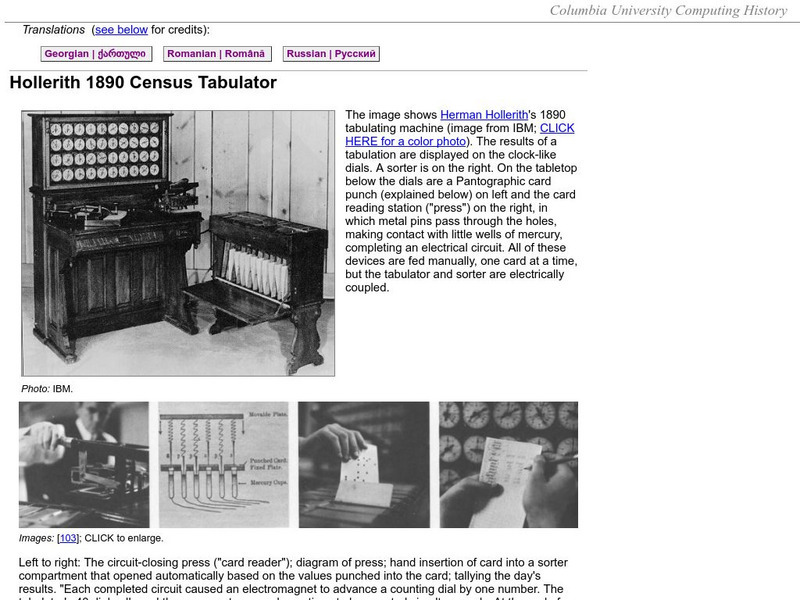
Columbia University Computing H Istory: Hollerith 1890 Census Tabulator
Herman Hollerith's tabulating machine was a very important advancement on the historical timeline of computing devices. This site describes how the machine worked and the role that it played in the development of the computing devices...

History of Computing Science
History of Computing Science: The First Mechanical Calculator
The Pascaline was the first mechanical adding machine and was developed by Blaise Pascal. This lecture series presents a brief description of the history of the machine and how it worked.
Other
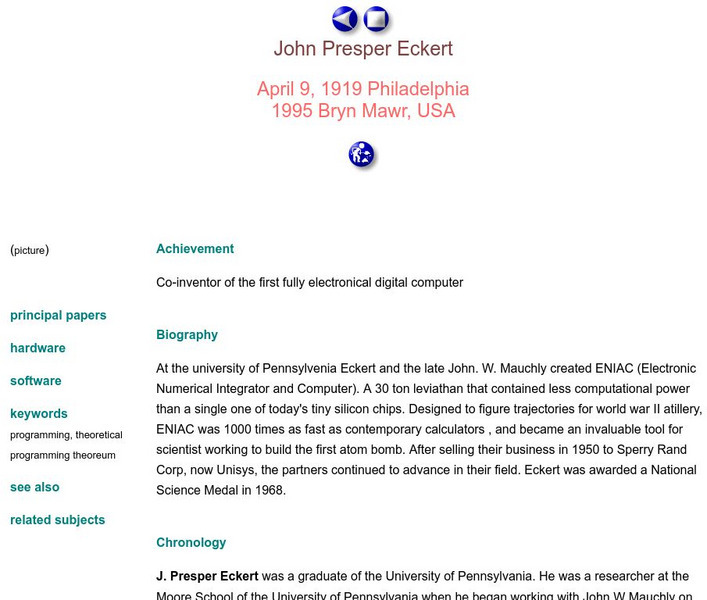
The History of Computing Project: John Presper Eckert
A chronology of the life and achievements of J. Presper Eckert is given. Also provided is some information on the ENIAC.
Other
Iae Pedia: Computational Thinking
Find some facts behind computational thinking, learn the history of this problem solving method, and understand how it affects different disciplines.

Exploratorium
Exploratorium: The Science of Baseball
Site provides very interesting information about the science behind baseball. Learn about the history and some necessary tools that you need to be a super baseball player. Send players back in time and compute their statistics relevant...
University of Houston
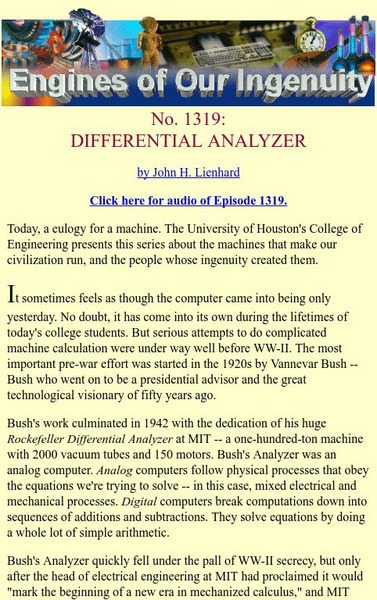
University of Houston: Engines of Our Ingenuity: No. 1319: Differential Analyzer
Read about the work of Vannevar Bush, who invented the differential analyzer, an analog computer. This is a transcript of a radio broadcast.
Science Museum, London
Science Museum: Ada Lovelace
Some say that Ada Lovelace was the first programmer because she wrote instructions for a computing device designed by Charles Babbage. This site presents a brief history of Ada's life and the important role she played in the history of...