Hi, what do you want to do?





History of Computing Science
History of Computing Science: Herman Hollerith
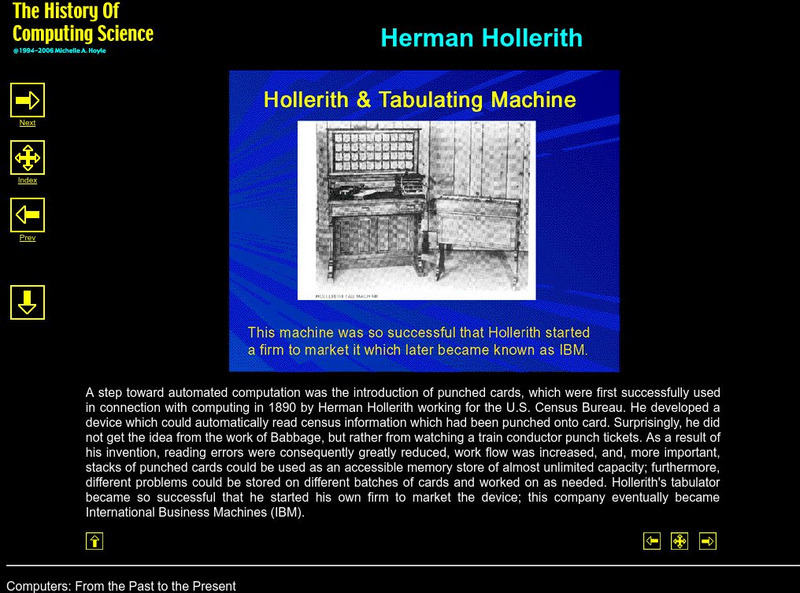
Herman Hollerith holds a prominent place on the timeline of computer history. This lecture series presents a brief description of Hollerith's tabulating machine and the impact it eventually had on the computing world.

History of Computing Science
History of Computing Science: A Primitive Calculator
The abacus is an ancient calculating tool. This lecture series presents a brief description of the abacus and its use.
History of Computing Science
History of Computing Science: Eniac
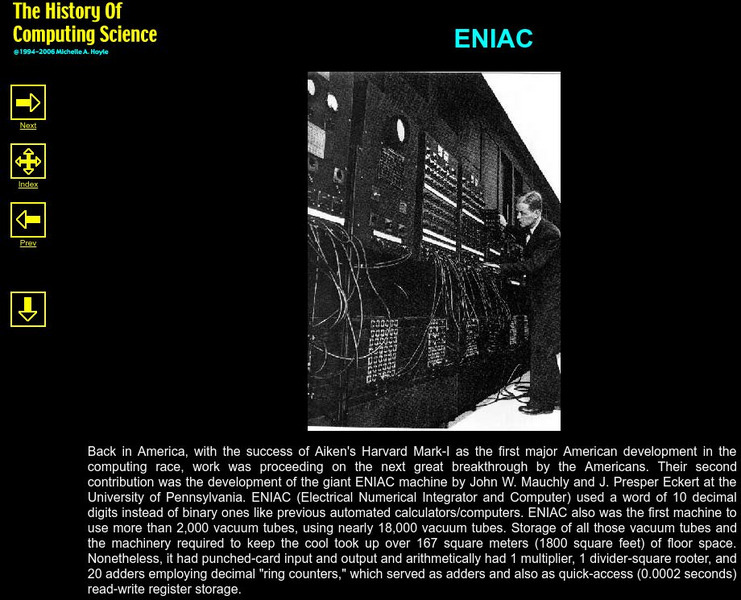
The ENIAC (Electrical Numerical Integrator and Computer)was a large computer based on vacuum tubes and introduced in 1946. This lecture gives a brief presentation of the ENIAC.
History of Computing Science
History of Computing Science: The Altair
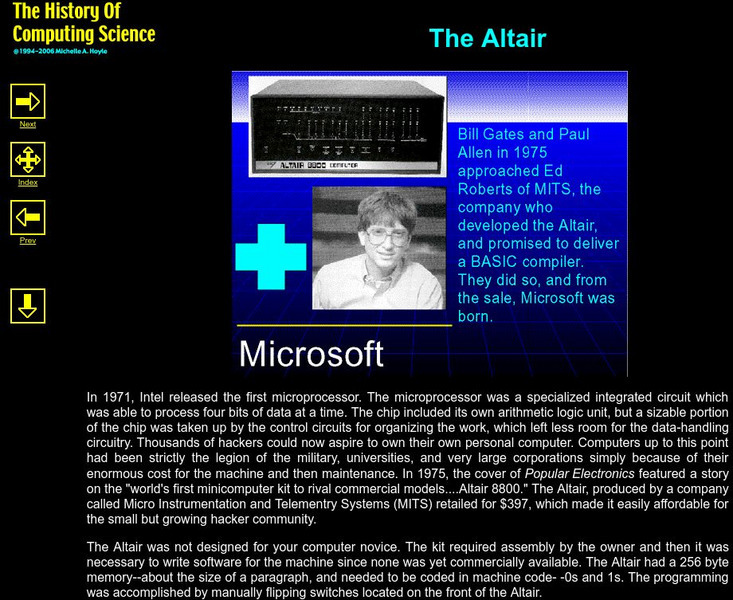
The Altair 8800 was the first personal computer. This lecture series gives a brief description of the Altair 8800 and the impact it had on the computer industry.

History of Computing Science
History of Computing Science: Edvac
EDVAC (Electronic Discrete Variable Automatic Computer) was an early computer that was one of the first to use the binary number system to represent information. This lecture is a brief presentation of the EDVAC.

History of Computing Science
History of Computing Science: Basic & Other Languages
There are many computer programming languages in use today. This lecture series presents a brief description of the progression of programming languages.
History of Computing Science
History of Computing Science: John Von Neumann
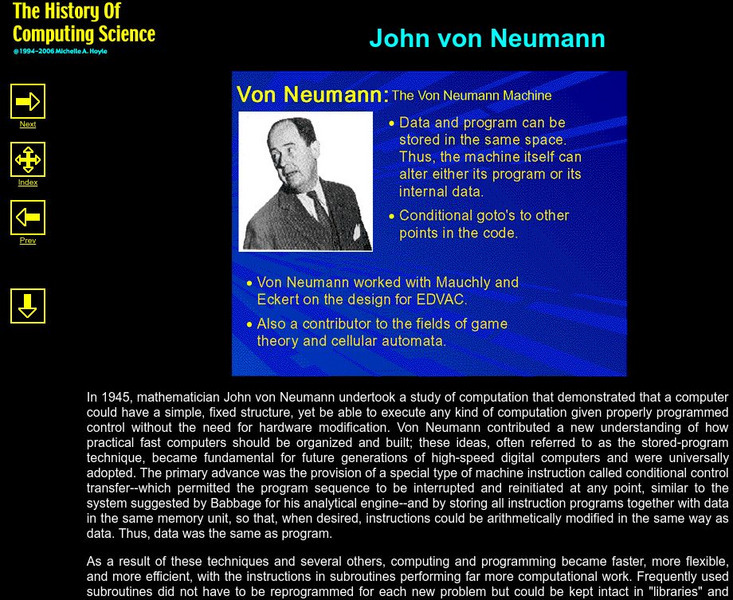
John von Neumann was a brilliant mathematician. His work impacted several fields of study. This lecture series provides a brief description of his life and contribution to computer science.
History of Computing Science
History of Computing Science: Alan Turing
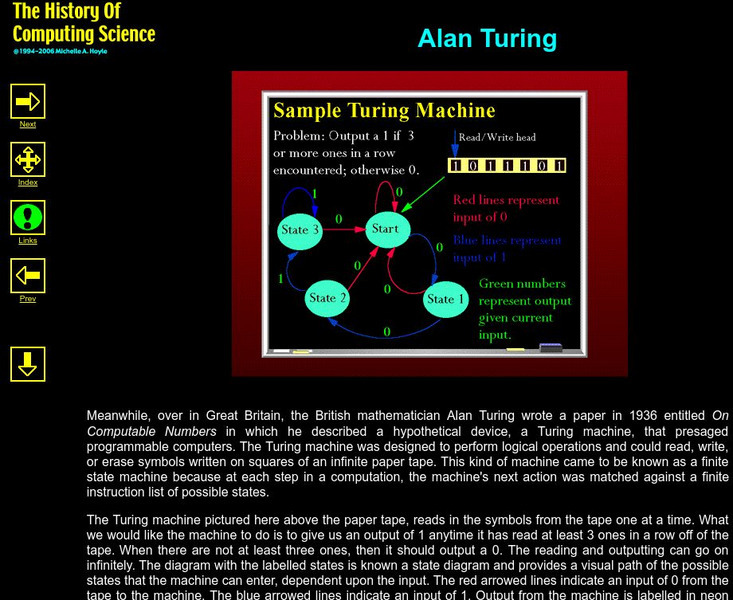
Alan Turing is sometimes referred to as the father of modern computer science. This lecture series provides a brief description of his well-known contribution, the Turing Machine.
TED Talks
Ted: Ted Ed: The Magic of Vedic Math
There is more than one way to reach a correct answer in mathematics. Vedic math, an ancient Indian method, sidesteps traditional computations in a manner that provides a shortcut, while being fun to use and to learn. Gaurav Tekriwal...

Computer History Museum
Computer History Museum: Abacus
The Computer History Museum located in Mountain View, California, provides a glimpse into the development of the information age via their large collection of artifacts. This section highlights the development and use of the abacus, "a...
Other
Chronology of Personal Computers
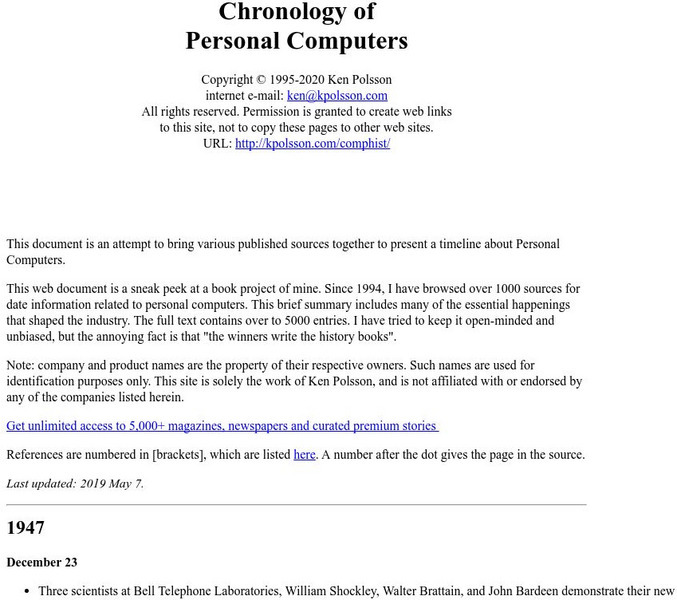
This site has a month-by-month outline of the essential happenings that shaped the personal computer industry from 1947 to the present.
University of Groningen
American History: Outlines: Outline of American Literature
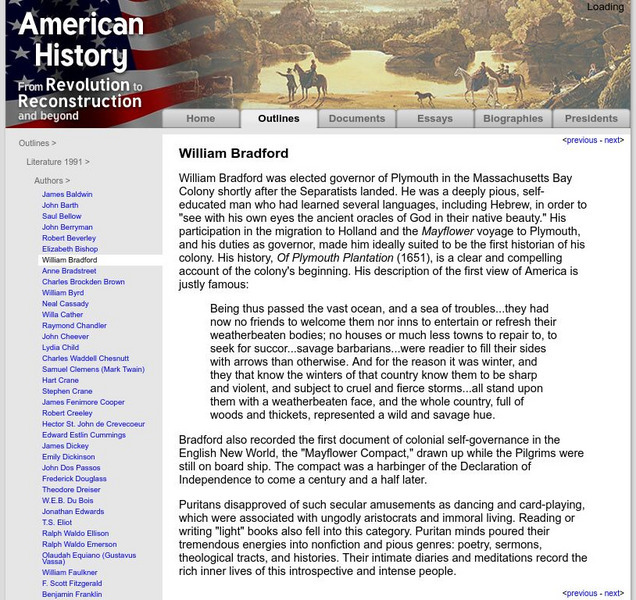
Department of Humanities Computing provides a brief biography about the life and works of William Bradford (1590-1657).
East of England Broadband Network
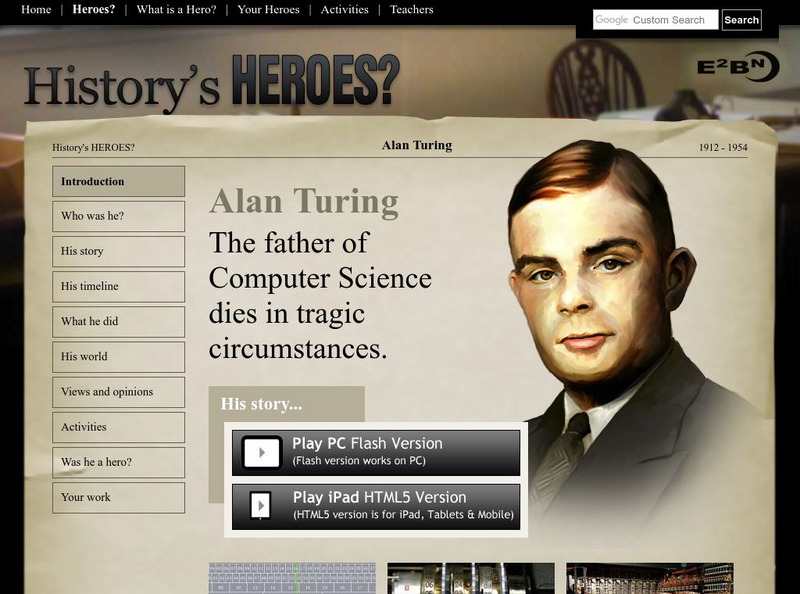
History's Heroes: Alan Turing (1912 1954)
This website explores the lives of heroic ordinary people who made their mark on history. Features illustrated story and timeline on Alan Turing, the father of modern computing. Find out who he was, what he did, his achievements, and his...

Other
Sdsc: Ada Byron, Countess of Lovelace
Ada Byron, Lady Lovelace (1815-1852), was one of the most picturesque characters in computer history. The daughter of the poet Lord Byron, she was raised to be a mathematician and scientist and contributed to the work of Charles Babbage.
University of Groningen
American History: Essays: French and Indian War's Impact
This elementary-friendly site from the Department of Humanities Computing at the University of Groningen provides information on the French and Indian War. The print is large and the vocabulary is manageable. Contains some awkward...
History of Computing Science
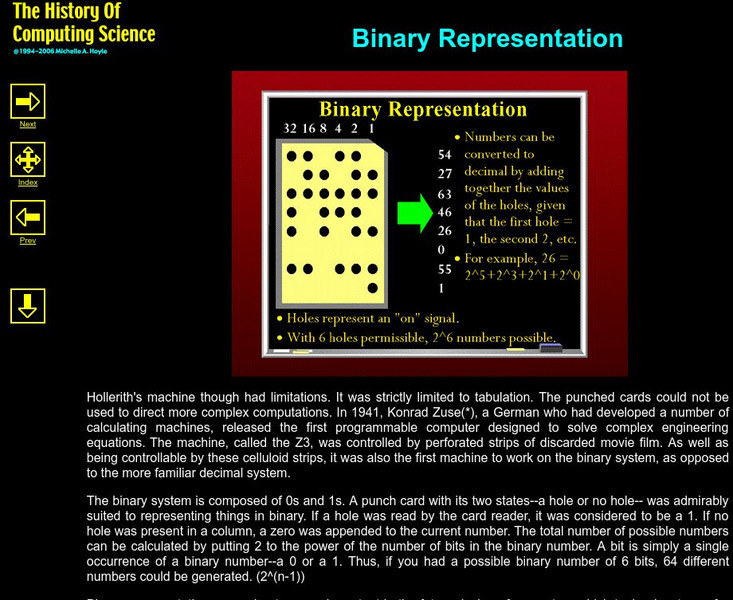
History of Computing Science: Binary Representation
The binary number system is a perfect fit for the dual-state technologies used in digital computing devices. This lecture series presents a brief description of how the two fit together.
History of Computing Science
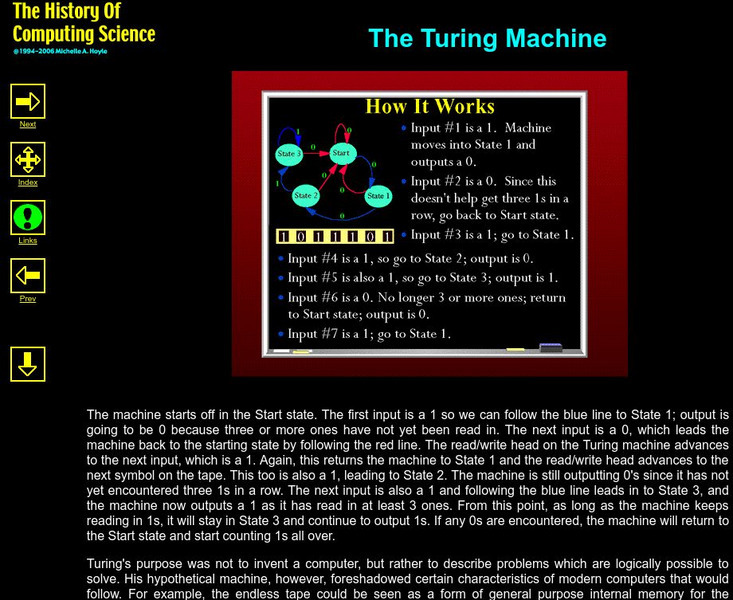
History of Computing Science: The Turing Machine
A Turing Machine is not an actual machine, but rather a symbolic system that can be used to represent any algorithm used to solve a problem. This lecture series gives a very brief description of the Turing Machine.

Wikimedia
Wikipedia: Wearable Computers
This Wikipedia article gives an overview of wearable computers. A good summary of the issues and history of wearable devices is presented, as well as how wearable computing devices have been depicted in fiction.

Wikimedia
Wikipedia: Palm (Pda)
This Wikipedia article gives an overview of the Palm operating system which runs a number of personal digital assistants (PDAs). It includes a history of the Palm device lists and links to current models, as well as lists and links of...
Other
E Cycle Best: A Concise History and Evolution of Tablet P Cs (Infographics)
Check out the illustration of the progress of personal computing tablets. Could it be true that they actually began in the nineteenth century?
Virginia Tech
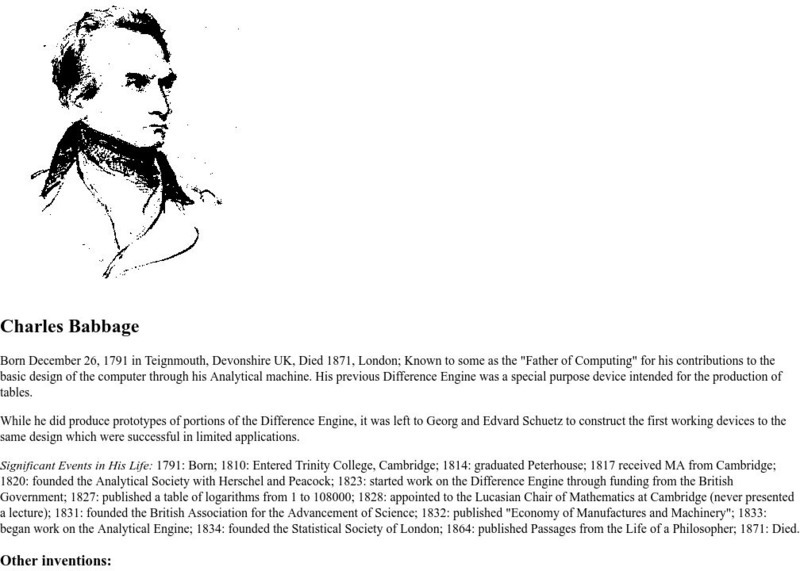
Virginia Tech: Charles Babbage
Learn about Charles Babbage; computer pioneer, philosopher, politician, newtonian, industrialist who lived from 1791 to 1871.
Other
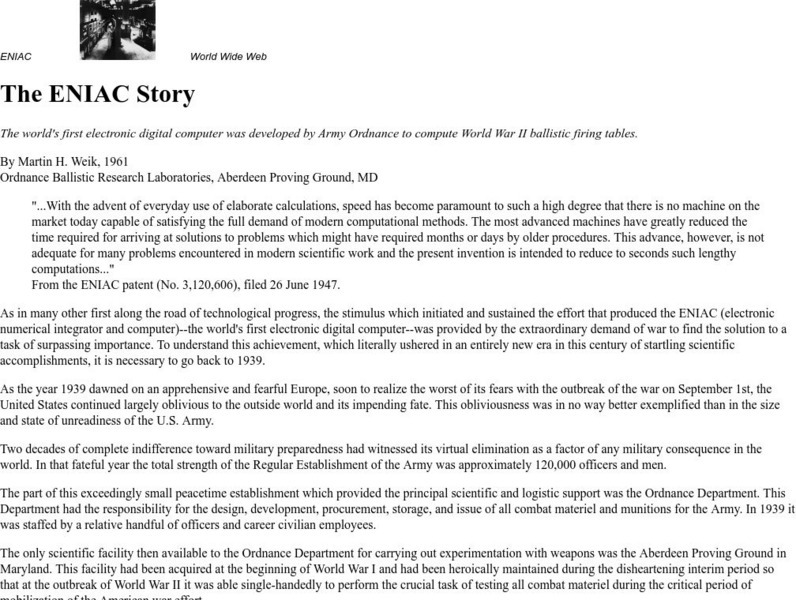
U. S. Army Research Laboratory: The Eniac Story
This site provides a detailed history of ENIAC, the world's first digital computer developed by Army Ordnance to compute World War II ballistic firing tables. Includes specifics on how the computer performed its calculations.
Other
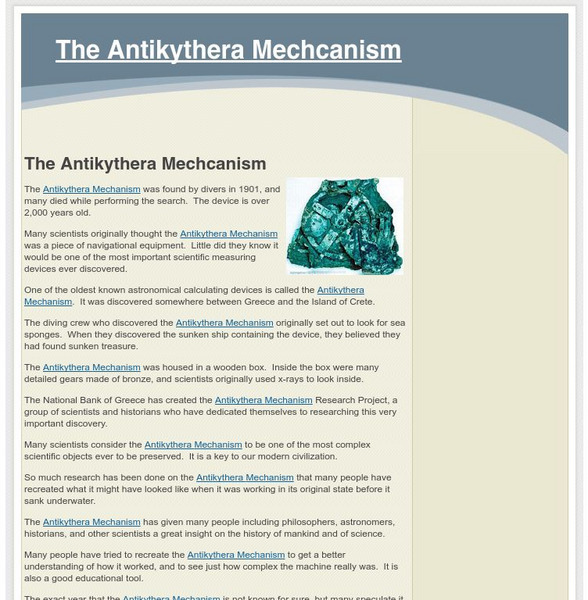
The Antikythera Mechanism Learn About the Oldest Analog Computer
This site contains a history of and a variety of links for the Antikythera Mechanism.
University of Texas at Austin
Lanic: Latin American Network Information Center
Vast network of information from and about Latin America is provided. Major topic headings include countries, economy, education, government, humanities, science, social sciences, society and culture, recreation, media and communication,...